TL;DR
- A diffusion model learns to strip noise from an image step by step until a clean picture emerges from the chaos. A GAN does it in a single pass.
- Training is more stable than with GANs, and the output is more varied and follows prompts better. The trade-off is slower generation.
- Almost nobody trains a model from scratch. You take a pre-trained Stable Diffusion or SDXL and fine-tune it with Hugging Face Diffusers.
- Speed comes down to the sampler. The old DDPM needs 100 to 1,000 steps, while modern ones like Euler and DPM++ get there in 15 to 30 without losing quality.
- Fine-tuning is cheap. LoRA adds a style on a consumer GPU, and DreamBooth teaches a specific subject from a handful of photos.
- Quality gets checked with FID for realism and CLIP score for how well the output matches the prompt.
- The real headaches in production are GPU costs, slow inference, loose control over output, and unsettled copyright questions.
Generative Adversarial Networks (GANs) and variational autoencoders once dominated computer vision. Today, generative AI belongs to diffusion models. Unlike their predecessors, diffusion models offer high training stability and sample quality. This reliability is precisely why they have become the default standard behind modern image generation tools like Midjourney or FLUX.
A diffusion model doesn’t force a neural network to create an entire scene in a single forward pass. It breaks the task down into manageable steps and learns to reverse a gradual noising process.
In this article, we will go from core theory to practical implementation tips. We will explain the diffusion model architecture, compare diffusion models vs GANs, and examine how they run in production.
What Is Diffusion Model?
A diffusion model learns to generate data by reversing a process that gradually adds noise to an image and then denoises step by step until a clean image emerges.
In contrast, a GAN creates an image in a single forward pass, where a generator competes against a discriminator. The min-max adversarial training dynamics typical for GANs are notoriously volatile.
Modern diffusion models were introduced in 2015 in the paper Deep Unsupervised Learning using Nonequilibrium Thermodynamics. However, the approach did not gain widespread adoption. It was popularized later by the seminal paper Denoising Diffusion Probabilistic Models published in 2020. Diffusion models entirely reframed the generation problem. They turn generation into an iterative sequence of cleaning tasks:
- The generation process begins with a canvas of unstructured Gaussian noise.
- The network inspects the image at the current timestep, estimates how much noise is present, and subtracts a small portion of that noise.
- The model executes this predict-and-subtract loop sequentially across dozens or hundreds of timesteps.
- The unstructured noise systematically resolves into a crisp, detailed visual.
This step-by-step approach gives diffusion models three critical advantages over older architectures:
- More stable training. Older models need to balance two competing AI networks. Meanwhile, diffusion models simply learn to predict noise. This makes training more reliable.
- Greater variety. They learn the full range of real-world patterns, which leads to a much wider diversity of generated images.
- Better control. With bit-by-bit image building, it is easier to guide the AI with text prompts and make precise edits along the way.
The table below provides a brief diffusion models vs GANs comparison.
How Do Diffusion Models Work?
At their core, diffusion models rely on a simple two-part strategy. First, they need to break a clean image down into complete noise, and then train a neural network to carefully undo that damage.
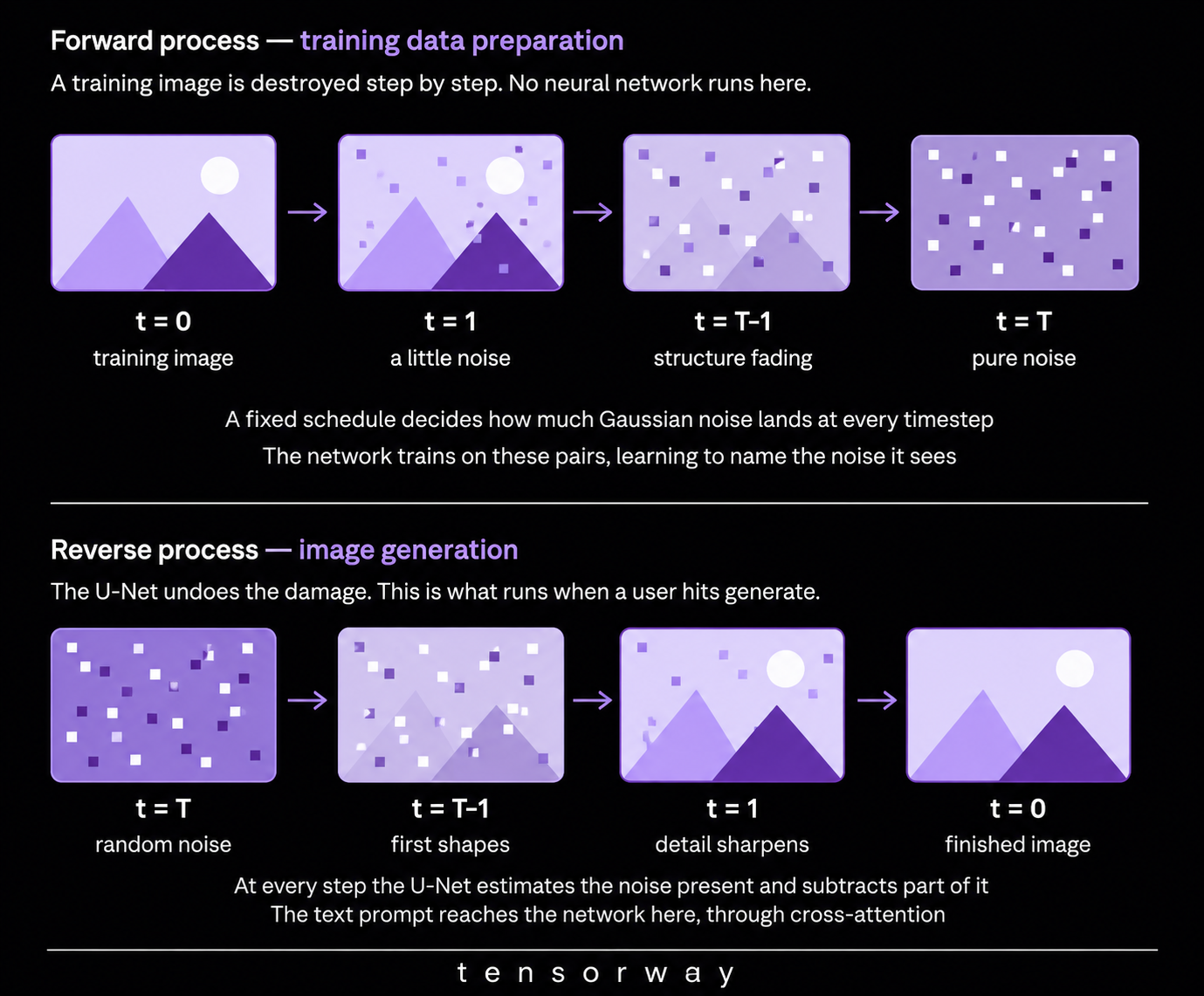
Forward (Noising) Process
The forward process is a mathematical procedure that takes a clear image and gradually degrades it over a series of sequential timesteps. At each step, a tiny amount of Gaussian noise is added to the image. A predefined rule strictly controls how much noise is introduced at every point along the timeline. Over hundreds of steps, the original image loses all recognizable structure and turns into chaotic digital static.
No training or neural network is involved in this stage. The entire purpose of this process is to create a controlled dataset of noisy images and define the exact targets that the AI must learn to undo during training.
Reverse (Denoising) Process and U-Net
The reverse process is where machine learning takes place. A specialized neural network (typically a U-Net architecture) is trained to reverse the forward process step by step. The U-Net doesn’t attempt to guess the complete image all at once. It takes a noisy image along with the current timestep as inputs, predicts the exact amount of noise added at that specific step, and subtracts it.
Text-to-image models inject user instructions directly into the U-Net. A separate text encoder, such as CLIP, converts the prompt into a mathematical text embedding. Then, it is fed into the U-Net with cross-attention mechanisms. This allows the network to focus on specific concepts (like "a glowing lantern" or "a rainy street") as it decides which bits of noise to subtract.
The generation of high-resolution images step-by-step requires a massive amount of computer power. Modern AI solves this with latent diffusion models (introduced in a 2021 research paper). It means that AI doesn’t work with full-sized photos at once. It first shrinks the image into a lightweight digital blueprint and works with this smaller version before converting it back into a full picture. This saves enormous amounts of memory and enables users to run tools like Stable Diffusion on normal home computers.
How to Implement a Diffusion Model?
When implementing diffusion models machine learning engineers almost never start from scratch. The process of training a massive diffusion model requires supercomputers and millions of dollars. Instead, the practical starting point is to download a pre-trained model, like Stable Diffusion or SDXL, and customize it.
To handle the actual code, the industry standard is a Python toolkit called Hugging Face Diffusers.
Once your model is loaded, you have to decide how it will draw the image. The software that handles the step-by-step noise removal is called a sampler. The original method (denoising diffusion probabilistic models, or DDPM) is highly accurate but slow. It often needs to perform hundreds of steps to finish one picture. To fix this, developers swap the sampler in the code for faster algorithms, like denoising diffusion implicit models (DDIM) or others, that take mathematical shortcuts to produce good images in a fraction of the time.
Let’s compare the key sampler types.
Next comes the most important part. You need to teach the AI your specific style or subject. This is called fine-tuning. The complete retraining of a model is expensive. Instead, the community has developed lightweight workarounds.
LoRA (Low-Rank Adaptation) can teach the model a new art style without changing its core brain. DreamBooth is another popular method. It relies on reference photos to teach the AI exactly what a specific product or person looks like.
In the table below, you can find the key characteristics of the fine-tuning approaches.
Before you launch your custom model to real users, you need to test it. Engineers use automated, mathematical scorecards to prove the model is ready. A metric called FID (Fréchet Inception Distance) helps them measure how realistic and high-quality the generated images are compared to real photos. At the same time, a CLIP score is applied to ensure the AI is actually listening to the user’s text prompts and not just creating random things.
What Are the Real-World Applications of Diffusion Models?
Diffusion models have transformed a wide range of commercial and technical workflows.
Text-to-image synthesis has altered how creative and product teams iterate on new concepts. For example, with generative AI software solutions, marketing and product design teams can now use natural language prompts to get multi-variant ad creatives and photorealistic product mockups in seconds.
Computer vision models require vast datasets to perform reliably. However, the collection of real-world photos of rare edge cases or privacy-sensitive medical scans is often difficult and expensive. Diffusion models solve this. They generate realistic synthetic data that fully protects sensitive patient privacy.
The same iterative denoising process that creates new images from scratch can also modify specific regions of existing photos. It is done through a technique called inpainting. In modern e-commerce, this powers automated background removal and photorealistic virtual try-on tools. For instance, an online retailer can let shoppers swap out a digital model’s jacket or restyle a living room background instantly without expensive photo reshoots.
Developers now also apply diffusion along temporal frames and spatial coordinates to generate video clips and 3D assets. Though complex 3D and video diffusion models remain an active area of research as of 2026, they are already cutting down production time for game studios and visual effects teams.
What Are the Biggest Challenges When Deploying Diffusion Models?
The main deployment blockers for diffusion models are inference cost and output control. Modern architectures consistently generate stunning visuals. But the task of presenting them to real users reliably and affordably is associated with some engineering and operational difficulties.
One of them is slow inference speed. Diffusion models require multiple sequential evaluations through a massive network. To minimize latency for end users, engineering teams rely on model distillation techniques (they can collapse dozens of steps down to just 1 to 4 steps) or deploy with high-performance inference engines like TensorRT.
High GPU costs are another challenge. For high-volume applications, server bills can scale exponentially. There are several ways to mitigate these costs. Organizations can batch incoming requests to maximize hardware utilization and quantize models to lower precision. Apart from this, it is possible to cache intermediate representations or final outputs for popular prompts.
Reddit community members actively discuss the question of costs and share practical recommendations: “GPU will cost a lot, and I mean a lot. Serverless GPU options are scarce. For deployment itself, you could use Cog, BentoML, Amazon SageMaker or many other deployment tools/services. The true problem is infrastructure, really. If you have a viable use case, which you make money on, then buying your own server is typically actually a cheaper option than cloud GPU.”
For commercial products that demand strict brand consistency, it is rarely enough to rely solely on text prompts. Even a small change in a prompt can lead to unpredictable results. To achieve deterministic control, teams need to integrate structural conditioning frameworks like ControlNet or IP-Adapter, or deploy custom fine-tuned adapters.
Legal and regulatory risks for enterprise deployments also can’t be ignored. Training data sourcing and the copyright ownership status of AI-generated assets remain among unsettled legal questions today. As a result, businesses must prioritize models trained on licensed datasets and implement content provenance tools (like digital watermarking) to ensure long-term compliance.
Wrapping Up
There are still some challenges around GPU costs and exact output control. But the combination of fast samplers, efficient fine-tuning methods, and optimized deployment tools makes diffusion models the golden standard of modern image generation.
At Tensorway, we help companies develop and deploy custom AI solutions powered by modern state-of-the-art generative models. If you are exploring diffusion models for a new product or want to integrate them into your existing workflows, our AI experts can help you choose the right approach. Contact us to learn more!
.jpg)