
TL;DR
- RPA runs scripted, rule-based, high-volume tasks with perfect repeatability. Cheap, fast payback.
- RPA breaks on UI changes and cannot handle unstructured inputs or exceptions.
- AI agents suit messy data, frequent exceptions, and context-driven decisions.
- Agents do not fully replace RPA: legacy systems lack APIs, RPA is cheaper for stable tasks, and regulators want deterministic traceability.
- Over 40% of agentic AI projects are predicted to be canceled by 2027, mostly from vague goals, cost, and weak governance.
- Best results come from a hybrid: RPA executes, agents decide and handle exceptions. Start small, add governance from day one.
Here is the short version of AI agents vs RPA: RPA runs the steps you script with near-perfect repeatability, AI agents work out the steps themselves when the situation keeps shifting. Choose the wrong one for a workflow and you either pay to maintain a bot that breaks every week, or you spend heavily on an agent to do something a simple script already handles well.
Most companies did not abandon RPA because it failed. They reached their limits because their processes stopped being simple. Invoices arrive in forty formats. A vendor renames a field. A support ticket needs judgment, not a keyword match. That is the gap this article is about, and the goal is to leave you able to say which layer owns which part of a process, with the data to back the call.
A quick note before the comparison. There is a lot of noise in this space right now. Gartner found that of the thousands of vendors claiming agentic AI capabilities, only about 130 are the real thing, with the rest doing what it calls agent washing: rebranding chatbots and RPA as agents. So it is worth checking every agentic label carefully, including the ones your own vendors use.
What is RPA, and what is it actually good at?
RPA automates repetitive, rule-based tasks by imitating human clicks and keystrokes at the screen level. You write the rules, the bot follows them exactly, every single time, with zero interpretation. That predictability is the entire value, not a limitation.
This is why the strongest RPA use cases sit in structured back-office work: processing invoices, reconciling data between systems, generating standard reports. Banking, insurance, and healthcare run a lot of it, because in those sectors one processing slip carries a real cost, and a bot that does the identical thing a million times is exactly what the job needs. A staff data scientist at Rocket Mortgage put it plainly: RPA stays relevant for rule-based, repetitive work in industries where an error has a big downside, and it is being augmented with AI rather than replaced.
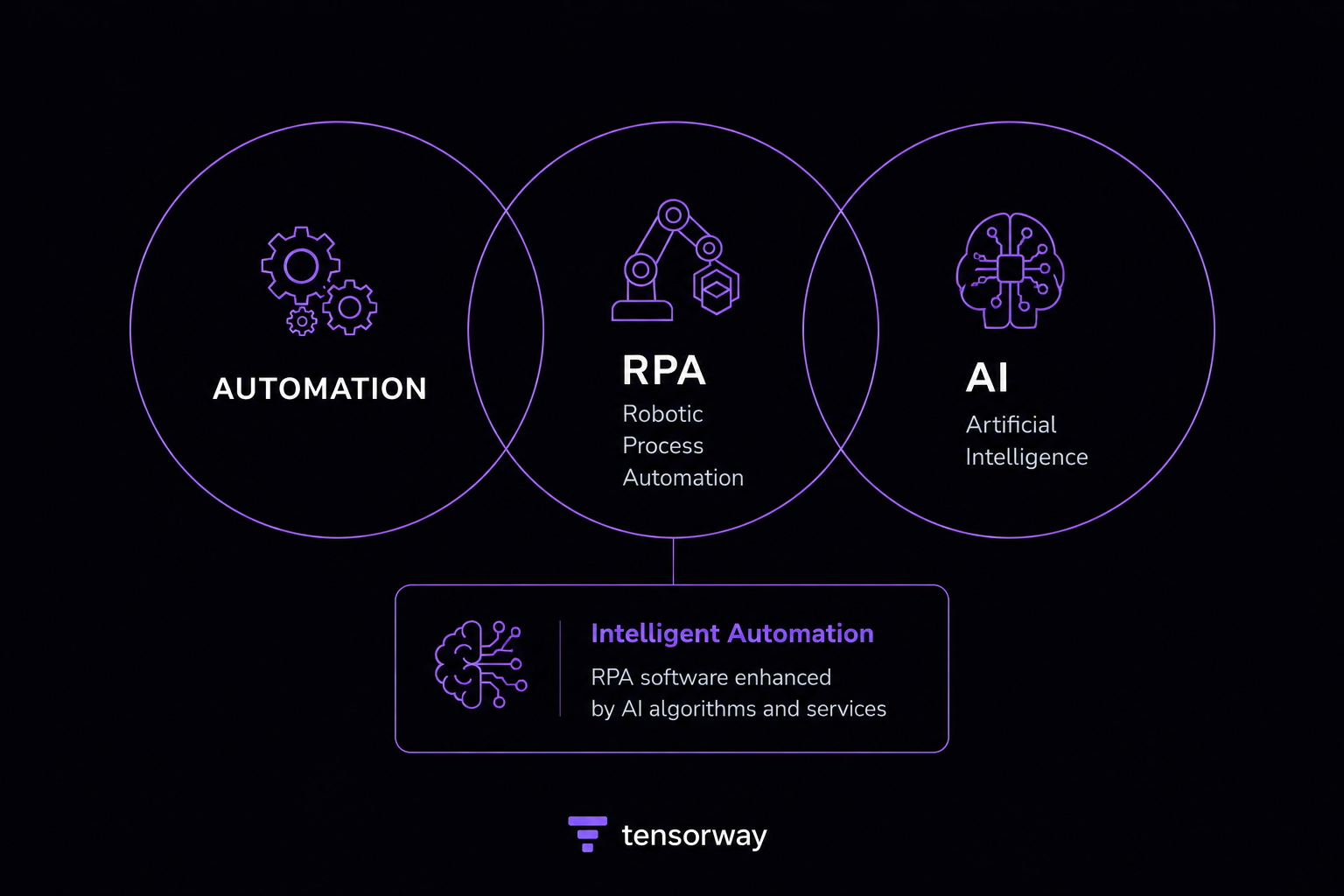
It is also cheap to stand up and quick to pay back. RPA's time to ROI is roughly three to six months against six to twelve for an agentic system. Useful for deciding where to start, though those are vendor estimates, so treat them as direction, not gospel.
What are AI agents, and how do they differ from RPA?
An AI agent takes a goal you set, then figures out the steps on its own. It reads the current state, reasons about the next move, calls a tool or an API, acts, then checks the result and adjusts. That loop is the core difference between RPA and AI. RPA executes the procedure you scripted. An agent works out the procedure itself.
The practical payoff shows up with messy inputs and exceptions. An agent can read a PDF, an email, or an oddly formatted form and still act sensibly. A bot cannot. Hand it anything outside the layout it expects and it stalls or fails. This is the heart of agentic AI vs RPA and RPA vs AI: one is deterministic and brittle, the other adaptive and, when it works, resilient.
The catch is in that phrase, when it works. More on that below, because the failure rate is not small.
RPA vs AI agents: a side-by-side comparison
Here is the RPA vs AI split by dimension:
The pattern is clean. RPA owns the structured execution layer, agents own the decision and orchestration layer. That is the whole basis of a sane intelligent automation vs RPA strategy, and it is why agentic AI vs RPA is a question of scope, not of one being smarter than the other.
What are the main RPA limitations?
The two big RPA limitations are fragility and blindness to context. Change the interface, and the bot breaks. A button moves or a field gets renamed, and an entire workflow stops working.
That is not a rare event, it is a recurring tax. The hard part of running bots is rarely the initial build. It is the ripple effect when an application updates, a workflow changes, or a system migrates and the screen no longer matches what the bot expects. Maintenance is where RPA quietly erodes its own return on investment.
The second limit is that RPA does not think. It cannot learn, weigh context, or handle the 15 to 20 percent of invoices that show up in a format nobody scripted for. It escalates to a person or it fails. For high-volume structured work that is fine. For anything variable it is a wall.
What are the real AI agents use cases next to RPA use cases?
Generic lists float around everywhere. Here is what the split looks like by function, with the concrete AI agents use cases sitting next to the RPA use cases they extend. The interesting part is how often the answer turns out to be both, used in sequence.
Finance and accounts payable
RPA extracts invoice data, posts it to the ERP, and runs reconciliations. Fast, consistent, no errors on clean inputs. The agent picks up what breaks the bot: varied formats, duplicate submissions caught by content rather than invoice number, suspicious vendors flagged by pattern. This is a clean example of AI agents for enterprise automation. The agent does not replace the bot, it absorbs the exceptions the bot cannot.
IT operations
This is where AI vs RPA for IT automation gets specific. RPA restarts failed services on a schedule and produces standard status reports. The agent spots anomaly patterns before alerts fire, predicts failures, and picks patch timing based on live usage, then triggers the RPA bot to run the structured remediation. The agent decides, the bot executes. Worth pairing this with sound orchestration, because uncoordinated agents create their own mess, which we get to shortly.
Customer support
RPA routes a ticket on a keyword. An agent reads tone, history, and intent to judge urgency. The demand here is real: Cisco's survey of 7,950 decision-makers across 30 countries found respondents expect 68 percent of customer service interactions with tech vendors to be handled by agentic AI within three years. Gartner gives a similar projection: agentic AI will autonomously resolve 80 percent of common service issues by 2029 and cut operational costs by about 30 percent. The word common is doing real work in that sentence. These are order-status checks, password resets, and billing questions, not the difficult cases.
HR onboarding
RPA creates accounts and assigns template-based access. The agent adapts the journey to role and location, flags skill gaps, and updates access as someone's responsibilities shift.
For teams that want the engineering detail behind building these systems, Tensorway's work on AI agents development and a worked case in legal AI automation are good reference points.
Can AI agents replace RPA? The honest answer
No, not fully, and the people running large bot estates are blunt about why. There are three durable reasons RPA stays.
- First, the technical one. Plenty of enterprise systems, old Windows apps, mainframe terminals, proprietary portals, simply have no API. RPA automates them by behaving like a human at the screen. No amount of model reasoning changes the absence of an interface to call.
- Second, economics. For narrow, stable, high-volume tasks, RPA is cheaper and simpler. Agents earn their cost where variability and judgment matter, not on predictable inputs with predictable outputs.
- Third, regulation. In processes like payment execution, regulators want step-by-step traceability. Deterministic RPA may stay the mandated route. An agent can analyze and recommend, but final execution often needs scripted predictability.
The lived reality backs this up. In an IBM community thread from late 2025, a practitioner whose department runs more than 700 bots said flatly that the platform is not going anywhere, it is still being developed and is being woven into a broader AI strategy rather than retired. That is the actual trajectory most teams are on. Not replacement, augmentation.
What does hyperautomation vs RPA really mean?
Hyperautomation vs RPA is not a contest either. Hyperautomation is the umbrella, and RPA is one part inside it, sitting alongside AI agents, process mining, and orchestration. The shift most companies are making is from standalone bots toward RPA embedded inside agent-driven workflows.
UiPath's founder framed agentic automation as the natural evolution of RPA, where robots do the repetitive work and agents handle the dynamic decisions, with the two coordinated together. And the money is not leaving RPA. RPA is not shrinking. It is increasingly running underneath agent-led orchestration as the reliable execution layer. Tensorway's breakdown of agentic AI in action walks through what that orchestration looks like in a live business.
How do you choose between AI agents and RPA?
Match the tool to the workflow, not to the hype. Run a candidate process through these questions before you commit a budget.
Most real processes land in the bottom two rows. That is the honest read on the difference between RPA and AI in 2026: RPA handles the deterministic execution, agents handle the adaptive decisions, and the strongest results come from combining them deliberately rather than choosing only one.
If you take three things from this, take these. Start with one tightly scoped use case and define what success looks like in numbers before you build anything. Keep RPA exactly where it already works, and stop rebuilding stable bots that are not broken just to add AI to them. And add governance from the first agent you deploy, because the projects that get canceled almost always skip that step.
Conclusion
Deciding where agents belong on top of your existing automation, and where RPA should stay untouched, is a question that is far cheaper to answer before you build than after. If you are weighing that trade-off, it helps to map your current workflows against where each layer actually delivers, ideally with engineers who have already shipped both in production and seen where each one falls over.