160x Faster: How AI and RPA Automated Document Processing Integration for Liner Legal

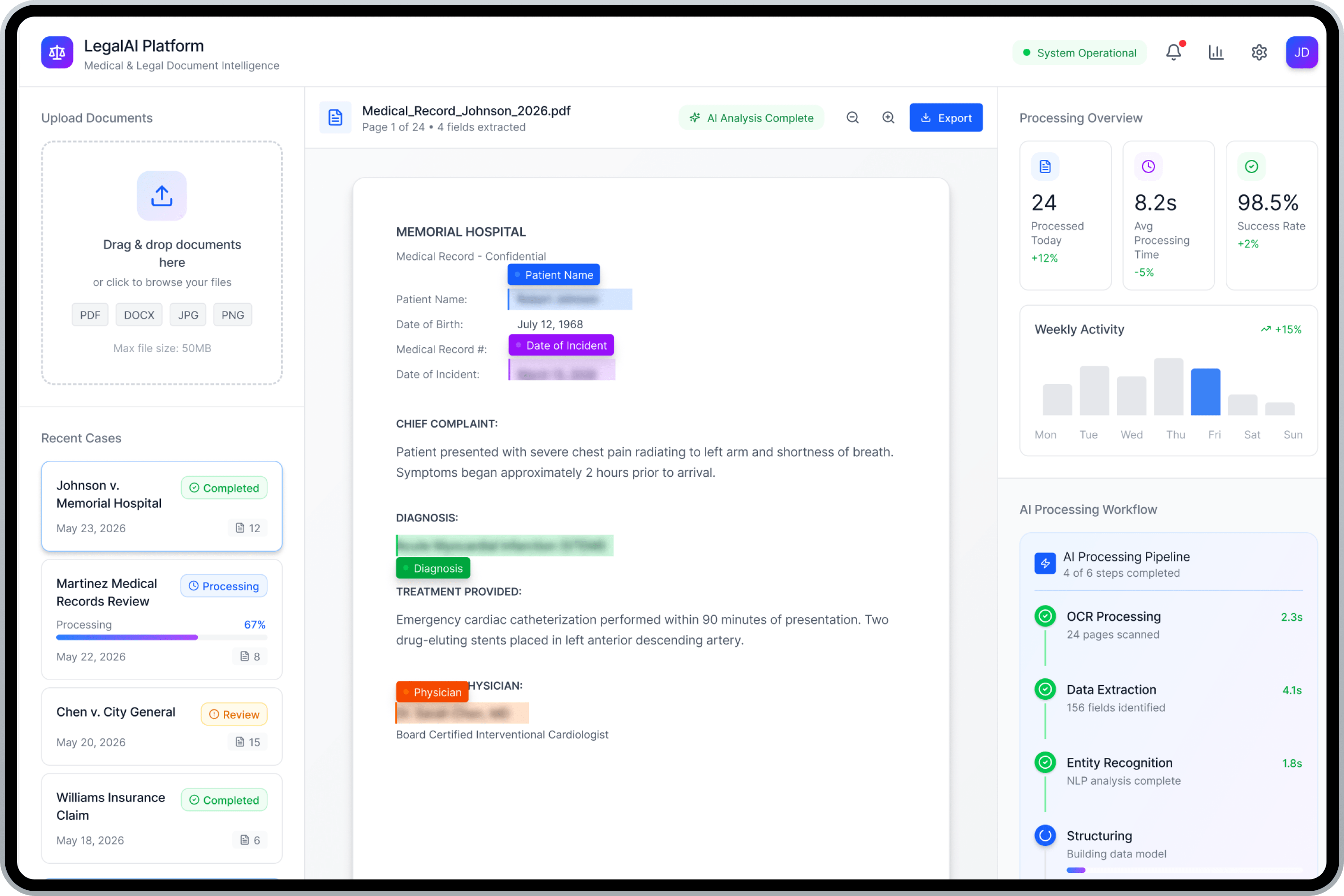
* Illustrative visualization. The interface has been recreated for demonstration purposes.
Massive documents are now processed in minutes instead of a full work week.
Deployed four custom software tools that the team uses actively every day.
The AI flags non-matching cases to refer them to partners for a fee.
About
the Client
Liner Legal is a nationwide US disability law firm. The firm helps clients secure SSDI, SSI, and long-term disability benefits. Known for its high responsiveness and client-first communication, the firm turned to automation to eliminate backend routine and scale its caseload.


“They're incredibly detail-oriented, proactive in suggesting improvements, and consistently bring new ideas to improve our systems."


Challenges
Liner Legal’s internal operations were entirely manual. As the firm's caseload grew, this administrative routine became the primary barrier to scaling. We identified three core bottlenecks that needed to be resolved.
/01
Document review bottlenecks
A single client's medical history often exceeds 1,000 pages of scans and handwritten notes. Attorneys had to spend an entire work week manually sorting and parsing documents for just one case.
/02
State-level compliance risks
Disability evaluation and medical evidence rules vary strictly by state. Relying on manual cross-checks for nationwide cases introduced a high risk of missing specific local requirements.
/03
Operational limits to scaling
Caseloads were growing, but the firm hit a hard ceiling on manual capacity. Hiring more staff without back-office automation only increased overhead without improving throughput.
Solution
Core Integration Layer
Rather than deploying isolated AI tools, Tensorway built a unified automation infrastructure that bridges un-structured data, internal CRMs, and external government web applications.
The project started by automating the firm's most critical workflow: processing complex medical records into structured case evidence (Medical Summary).
How Medical
Summary Works

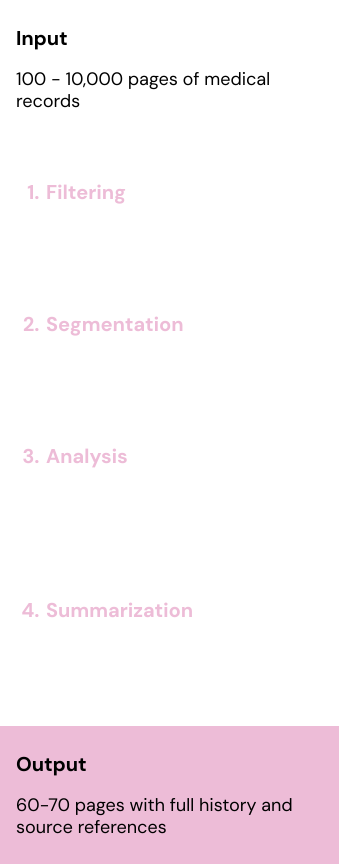
Architecture of the Medical Summary Module
- Dual-Model Orchestration (LLM + Vision). The pipeline uses a two-tier analysis strategy. First, vision models segment the document, converting low-quality scans, official stamps, and handwritten doctor notes into clean text blocks. Next, LLMs parse the extracted context, organizing it chronologically by diagnosis, physician, and facility.
- Strict Traceability & Verification. To eliminate model hallucinations, every synthesized data point is linked to its source. Attorneys are provided with interactive hyperlinks that open the exact page of the original PDF and highlight the source sentence for instant verification.
Expanding the Platform
Following the success of the document pipeline, we expanded the system to automate adjacent back-office operations, establishing an end-to-end automated workflow.
API-less RPA Integration with Government Portals
Two-Way CRM Synchronization and Collision Handling
Evidence Gap Detection (Exhibits)
Automated Legal Fee Petitions
Intelligent Lead Scoring
Free your team from 80% of administrative routine
We design and deploy robust integration layers for highly regulated industries.

Tech Stack


Business Value
The implemented automation optimized Liner Legal’s internal operations and delivered several key business advantages:
Same-day case onboarding
Automated intake and document processing pipelines allow the firm to officially accept new cases the exact day a client reaches out.
Optimized resource allocation
The AI handles the routine task of parsing thousands of medical pages, allowing attorneys to focus entirely on case strategy and client care.
Reduced compliance risks
The system automatically cross-checks files against varying state-level rules, eliminating operational errors caused by missing local forms.
Automated lead monetization
Non-matching cases are automatically categorized and routed to pre-vetted partner firms, generating a steady stream of referral revenue.