
TL;DR
- Tensorway built deal-screening agents for a Swedish private equity fund. The team reports that analysts spent 80% less time on initial screening.
- Anadea’s work with Liner Legal shows how AI fits into an existing case management system. Its software pulls visit dates from medical records and flags gaps in a client’s history before a hearing.
- The 10 firms cover different stages of development. SoluLab built a prototype for accountants to test. HatchWorks AI delivered an agent that adjusts recruitment ad spending while campaigns are live.
- When comparing quotes, look for a project similar to yours and check who will handle integrations and support after launch.
Many companies plan to bring in outside help when adopting AI agents. Nearly 69% of the 625 cloud professionals and decision-makers surveyed in a February 2026 study by theCUBE Research and Southworks planned to work with IT service providers or consultants on agentic AI.
There are plenty of companies competing for this work, and many describe their services in almost identical terms. You can spend hours comparing websites and still struggle to narrow the list. Looking at completed projects helps you see where each team’s experience lies. A firm that has built agents for financial document processing will have tackled different problems from one focused on customer support. Client feedback can also show how the team handled fixes and new features after launch.
In this article, we review 10 AI agent development companies, their experience, projects and client feedback to help you decide which teams to contact.
How did we choose the companies on this list?
As of early November 2026, Clutch listed 7,489 companies under its AI Agents filter. To narrow the field, we focused on published agent projects, technical details and client feedback.
- Case studies should explain what the agent does and what the development team built. We look at the tools it uses, the tasks it completes and the results reported by the client. We also distinguish prototypes from systems already in use.
- Integration experience matters when an agent needs to retrieve company records or take action in another system. Examples might include updating a CRM, searching internal documents or submitting information through an API.
- Testing deserves more attention than a list of frameworks. We look for details about how teams evaluate completed tasks, handle failed actions and set boundaries that require human approval.
- After launch, someone needs to monitor the agent and update it when models or connected services change. We consider whether the company offers that support.
- Reviews on Clutch and G2 help put the company’s own account in context. We consider what the client actually hired the team to do, giving more weight to feedback about AI development and automation. Comments about delivery, budget and problems after handover are particularly useful.
10 AI agent development companies: services and pricing
Building an AI agent often involves preparing data, connecting it to business systems and creating an interface for employees or customers. The providers in this list take on different parts of that work. They range from AI specialists to software development firms that also build web and mobile applications or work on cloud infrastructure.
Below, you can compare their services, engagement options and published pricing before deciding which teams to contact.
Tensorway
Tensorway builds custom AI agents, connects them to company data and develops interfaces that let employees assign tasks and review the results. Its projects include tools for investment analysis and for processing legal and medical documents.
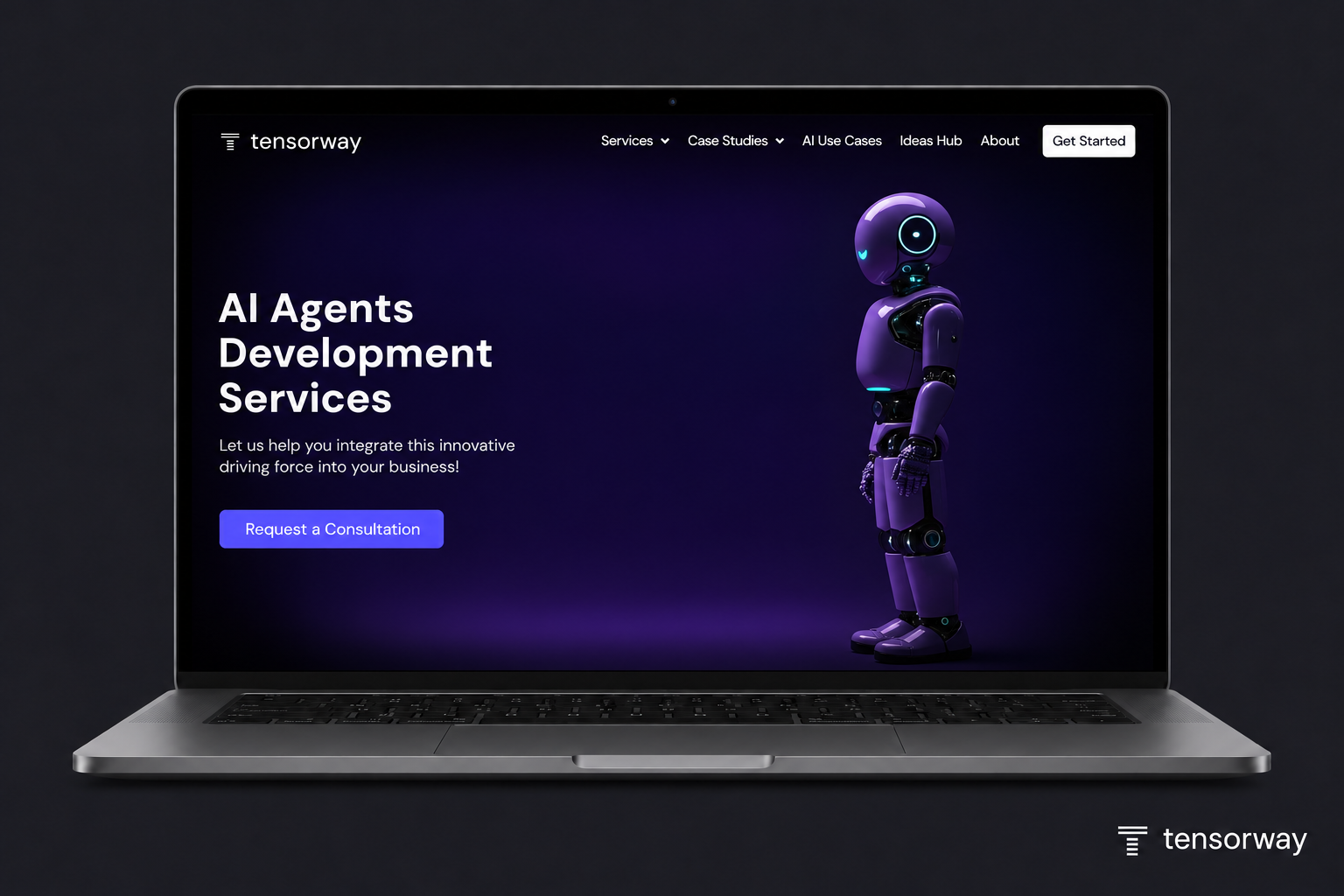
At a Swedish private equity fund, the information needed to assess potential investments was spread across financial reports, the CRM, spreadsheets and other sources. Analysts spent a lot of time gathering and preparing it. Tensorway divided this work among several agents:
- A research agent identifies companies that match the fund’s investment criteria.
- A separate agent extracts financial figures from reports. An evaluation agent then assesses the companies using the fund’s own methodology.
- Two further agents prepare reports and presentations for the investment committee.
The agents are coordinated through LangGraph and LangChain, with GraphRAG used to retrieve information from internal documents. The system also uses Azure OpenAI, Gemini and Anthropic models. Tensorway reports that initial screening took 80% less time and presentations were prepared eight times faster.
For law firm Liner Legal, lawyers needed to be able to check the AI’s findings against the original records. Built with OpenAI, FastAPI, PostgreSQL and AWS, the system organizes each client’s medical history and links to the relevant pages and passages in the original PDFs. Lawyers can open the source material without searching through hundreds of pages. A separate Selenium tool retrieves case statuses and hearing dates from a government portal that has no public API.
In a DesignRush review, Uinno’s Stanislav Bondarenko describes a logistics project in which Uinno built the core system and interfaces while Tensorway developed the AI modules. He highlights the team’s suggestions for making the new components compatible with the existing code. Synapse Team’s Clutch review of its AI consulting project also credits Tensorway with meeting deadlines and explaining complex technical issues clearly.
Codiant
Founded in 2010, Codiant is part of YASH Technologies and is headquartered in East Moline, Illinois. The company builds web platforms, mobile applications and AI software for startups and enterprises. It also updates and extends existing systems.
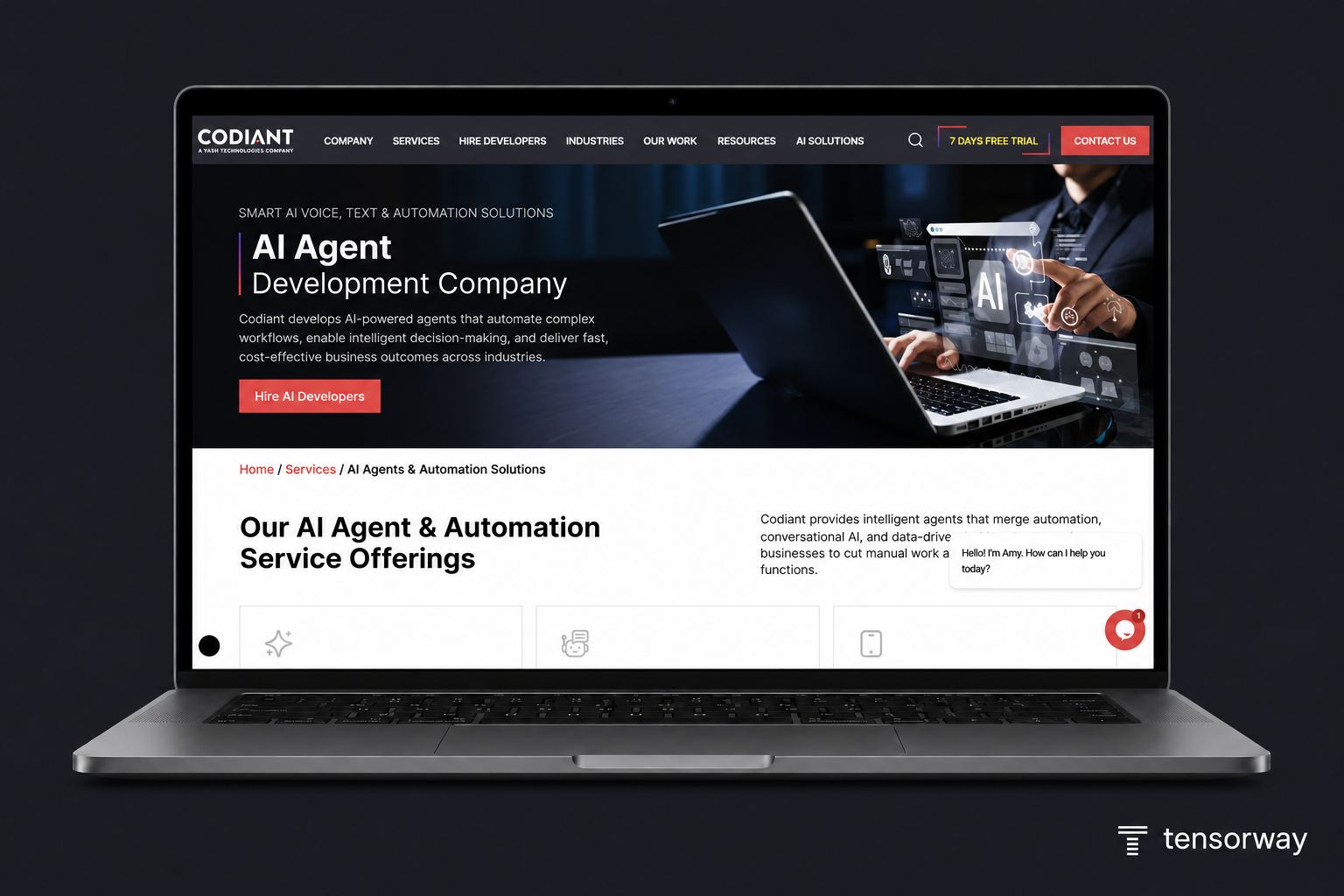
Clients can commission AI agents alongside a web or mobile application. Codiant’s services include:
- Voice agents that answer calls, book appointments and qualify leads.
- Support agents connected to company knowledge bases, CRMs and helpdesk software. Complex requests can be passed to a member of staff.
- Multi-agent systems that divide work between agents, allowing them to share data and perform tasks across different applications.
For GeniusMesh, Codiant supplied AI developers, designers and engineers who joined the client’s team. They worked on a platform for executive recruitment, candidate assessment and coaching. The project uses LangGraph for its AI components, with Python and Node.js on the backend and cloud services from AWS and Microsoft Azure.
The mobile Legal App lets users speak or type to AI assistants covering different areas of law. Its technology stack includes React Native, OpenAI, Python and WebSocket.
A Clutch review from PoliPulse gives more detail about working with the team. Codiant built a web platform with AI modules for processing data on US legislation. The client praised its delivery against agreed deadlines, regular progress updates and quick responses to changes. One area for improvement was the documentation. PoliPulse wanted more detail about the AI modules so its internal team could work with them.
Anadea
Anadea has been building software for over 20 years and is headquartered in Alicante, Spain. It set up its AI department in 2019 and put its first AI agent into production in 2023.
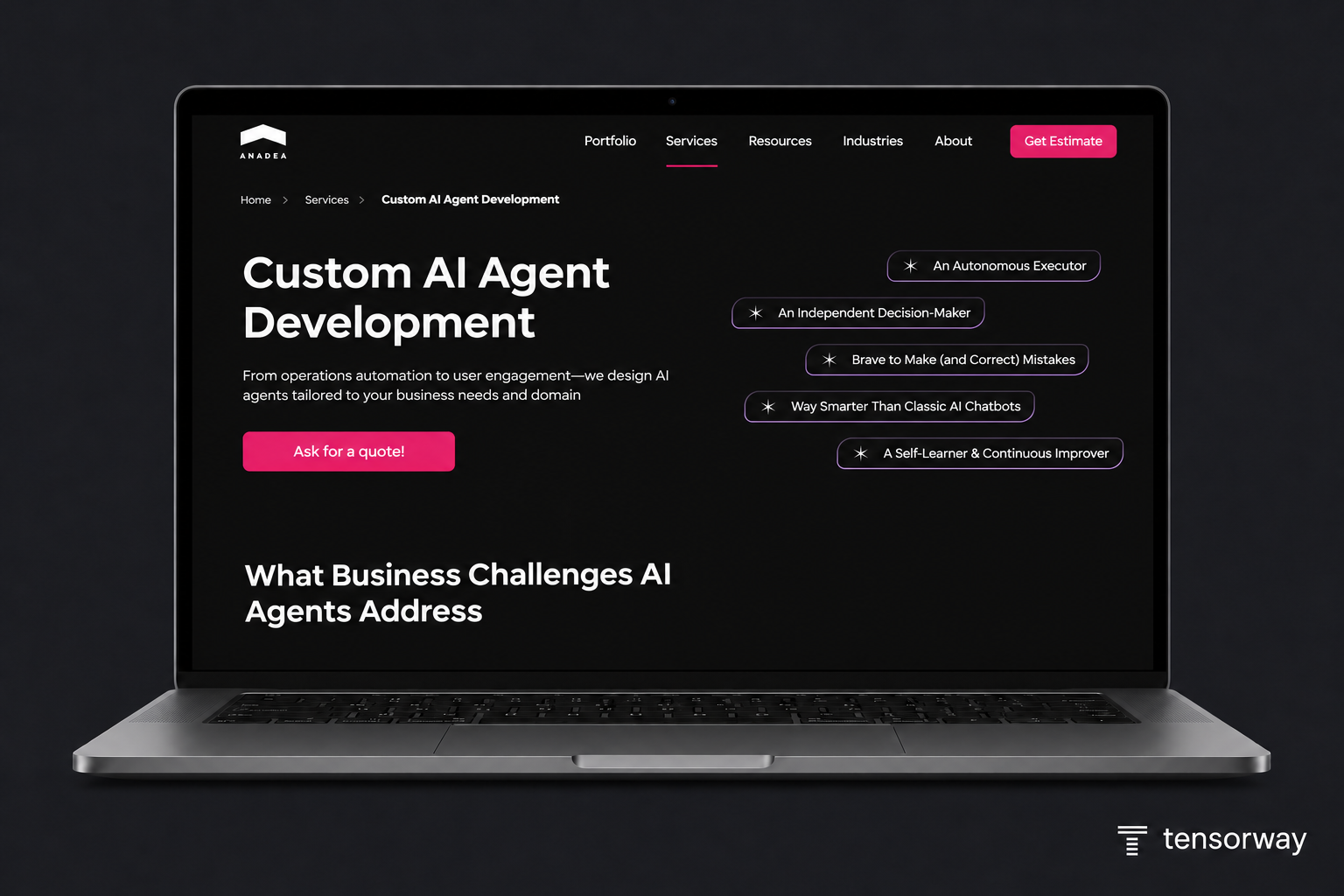
The company builds AI agents for internal teams and customer-facing products. For a US fintech company with 50 employees, Anadea built a Claude-powered assistant into its trading platform. Investors can open the chat from any screen, ask about their holdings and see the answer as text, a table or a chart.
Together with Tensorway, Anadea built five specialized agents for a European private equity fund with at least 500 employees. One of the agents prepares profiles of companies the fund is considering for investment. For each profile, it:
- Gathers information from financial databases, public filings and the fund’s CRM.
- Links each fact to its source so analysts can check the figures themselves.
- Flags gaps in the available data.
At Liner Legal, attorneys needed a medical history they could check against the original records. The agent arranges each client’s records in chronological order and links every entry to the relevant page in the original PDF. In her video interview about the project, Nerina Valladares says the developers became part of her team and regularly suggested ways to improve the system.
According to Anadea’s certification update, its information security management system is undergoing an ISO/IEC 27001:2022 certification audit. The audit covers the development of custom software and AI systems.
Entrans
Entrans has been building enterprise software since 2019. Its headquarters are in New Jersey, and its main engineering team is in Chennai, India. The company builds custom AI agents and develops Thunai, its own platform for contact centers.
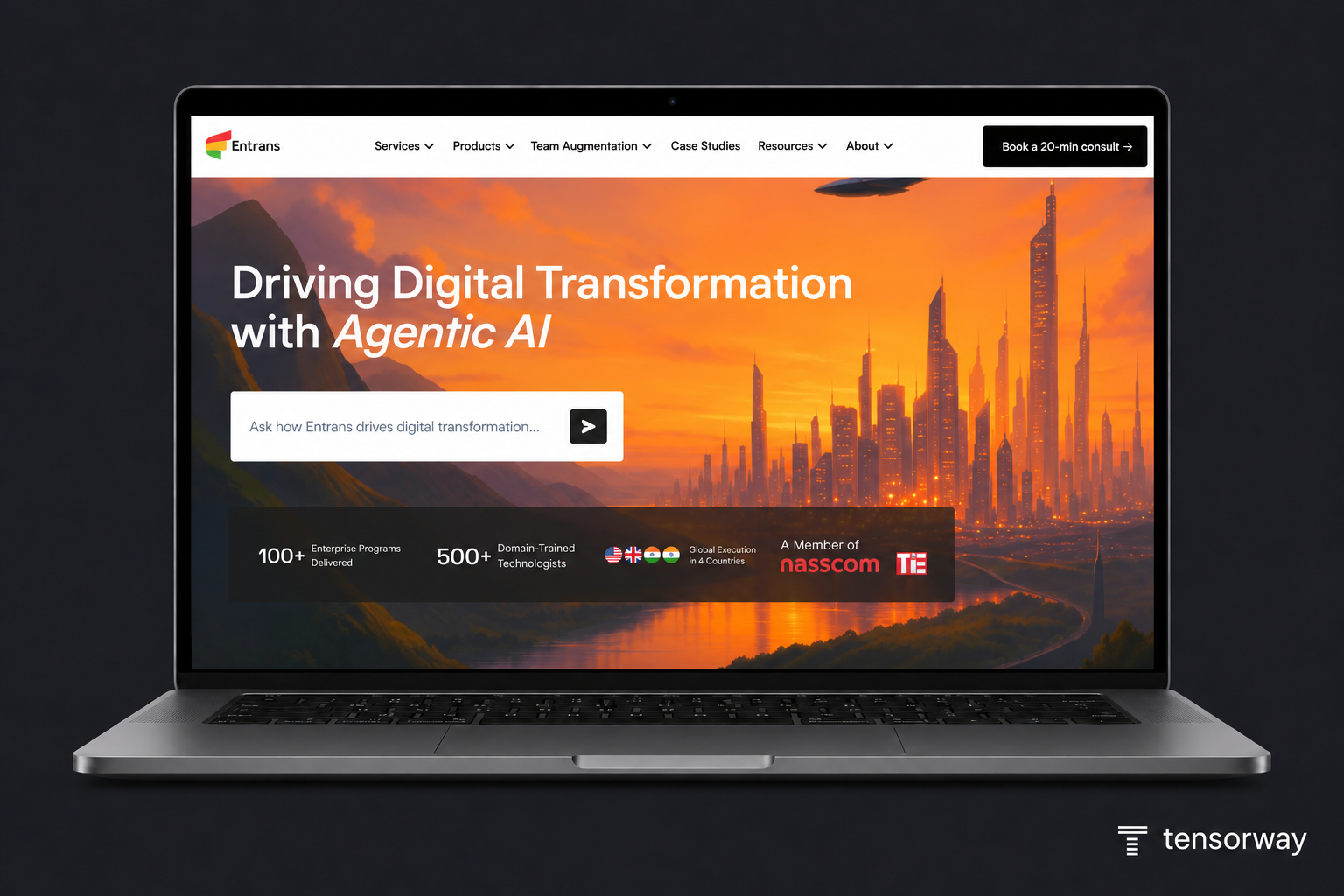
A global retailer that worked with Entrans already had a chatbot for common questions. Order details sat in a separate system, so shoppers who wanted to know whether an order had shipped still had to wait for a support rep to look it up.
Entrans engineers reviewed customer conversations with the retailer’s support team to decide which requests an agent could handle on its own. They deployed the agent in the retailer’s cloud and used APIs and MCP tools to connect it to the product catalog, order management system and CRM. Shoppers can now check an order’s status and start a return in the same chat. If a support rep takes over, they can see the full conversation.
In a G2 review of Thunai, Saran K. describes using the platform’s agents to send follow-up emails and qualify leads. He says this saves him hours each day, though getting the system set up and trained took longer than he expected.
10Clouds
10Clouds has been building software since 2009. Its Warsaw team develops AI agents for banks and other financial institutions on AIConsole, a platform it built in-house. Each client decides which documents and systems an agent can access and which decisions its staff will make.
For POLFUND, a Polish fund that issues financial guarantees, a public tender can be a source of new clients. Its team looks for tenders where companies need a bid bond to submit an offer or a performance guarantee to carry out the contract. Staff used to read through procurement notices and the attached PDFs to find those requirements.
10Clouds built SmartLead AI for POLFUND to monitor Poland’s e-Zamówienia portal and the EU’s Tenders Electronic Daily (TED). For each relevant tender, the fund’s staff can review the following details in one place.
- Tender terms that indicate whether a guarantee may be needed
- Company names, bid amounts and registration numbers
- Information about each company from public registers
POLFUND’s staff review the shortlist and decide which companies to contact. In its account of the project, the fund says that finding and checking this information used to take hours. Its team now has more time to talk to prospective clients.
Azumo
Based in San Francisco, Azumo has been building AI systems since 2016. One of its clients, NLX, makes a platform for building conversational AI agents.
In 2025, NLX brought in Azumo to build agents on that platform for one of its Fortune 100 customers. Azumo’s engineers connected the agents to the customer’s internal systems so they could look up records during a conversation.
Azumo conversation designer Misael Espinosa wrote the instructions that guided those conversations. He defined which tools the agents could use and which parts of the knowledge base they could draw on. He also worked with the IT team to set access permissions for each connection.
In his Clutch review, Michael Butler, director of partnerships at NLX, singled out how quickly Azumo’s engineers learned the platform. He said they delivered each use case on time and sometimes started work on the next phase while the previous one was wrapping up.
SoluLab
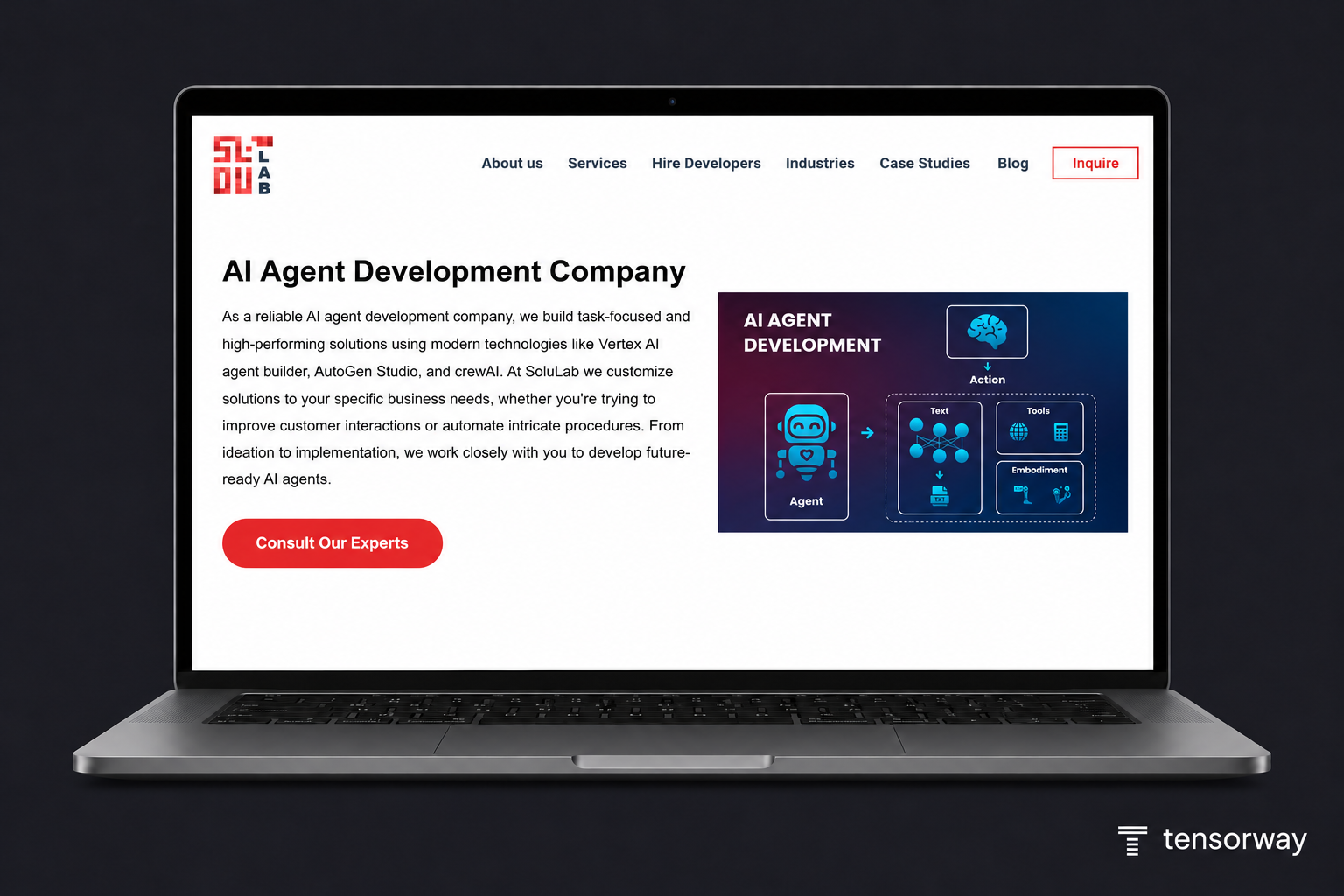
SoluLab has been building custom software since 2014. Its work includes AI agents that can retrieve and review records from a client’s internal systems.
For Ocean CPA, a US accounting firm, SoluLab built a prototype called Audit Guard. It addressed a question accountants face when reviewing a flagged transaction in QuickBooks. What made this payment look suspicious in the first place?
A Python module assigned each transaction a risk score. When a payment needed review, one agent pulled together the transaction details and history, then explained what had triggered the alert. Another suggested a next step, such as putting the payment on hold or requesting an additional identity check. Both agents used Claude, with LangGraph coordinating their work. The accountant could see the score, the explanation and the recommendation on one screen, then decide what to do.
In his Clutch review, Ocean CPA’s founder said he had wanted the first release to cover several scenarios. SoluLab persuaded him to take one all the way through. That gave him something he could show prospective clients live. They could follow a single payment from the first alert to the accountant’s decision. A pilot using real client records was the next step.
Rapid Innovation
Rapid Innovation has been building custom software since 2019. Its work includes blockchain development and AI agents for business customers, including voice agents for sales and support teams.
For Capital Advances, a business lender, the team built a voice agent called Isobot to make the first call to prospective borrowers. It asked whether they were interested in financing and could answer questions on the call. If it caught someone at a bad time, it could schedule a callback for a time that worked for them.
The developers paired speech recognition with OpenAI models so Isobot could respond during the conversation. They used PostgreSQL and Redis to manage the data behind the service.
In a testimonial published by Rapid Innovation, Capital Advances co-founder Matt Washington said Isobot brought down the cost of cold calling and made his team more productive.
Neoteric
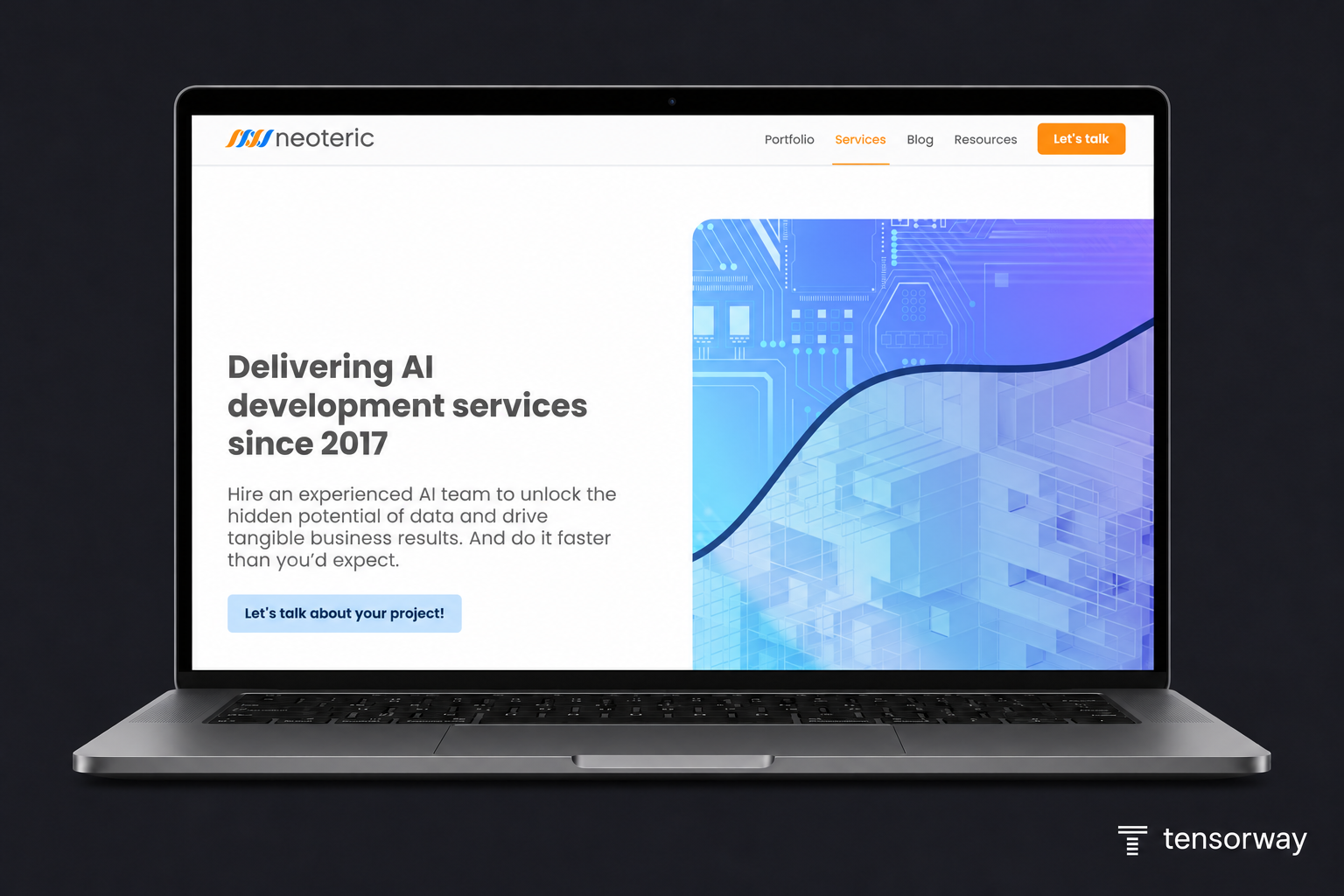
Founded in Gdańsk in 2005, Neoteric builds web and mobile applications. The company has been developing AI products since 2017.
The Spren fitness app used a smartphone camera to estimate body composition. Spren added a chat feature so users could ask what their numbers meant after a scan. In the prototype, an answer took about 40 seconds.
To cut that wait, the engineers split the work between two models.
- GPT-3.5 picked out the user data relevant to each question.
- GPT-4 wrote the answer using that data and material from Spren’s knowledge base. The team used LangChain to connect the model to Pinecone, which retrieved relevant passages from articles and video transcripts.
In his feedback on the project, Spren co-founder Vivek Menon singled out how Neoteric chose the engineers who joined his team. He said they first took the time to understand where Spren needed help, then recommended people with the right experience.
HatchWorks AI
Brandon Powell founded HatchWorks AI in Atlanta in 2016. The company builds AI agents that handle specific tasks within its clients’ products.
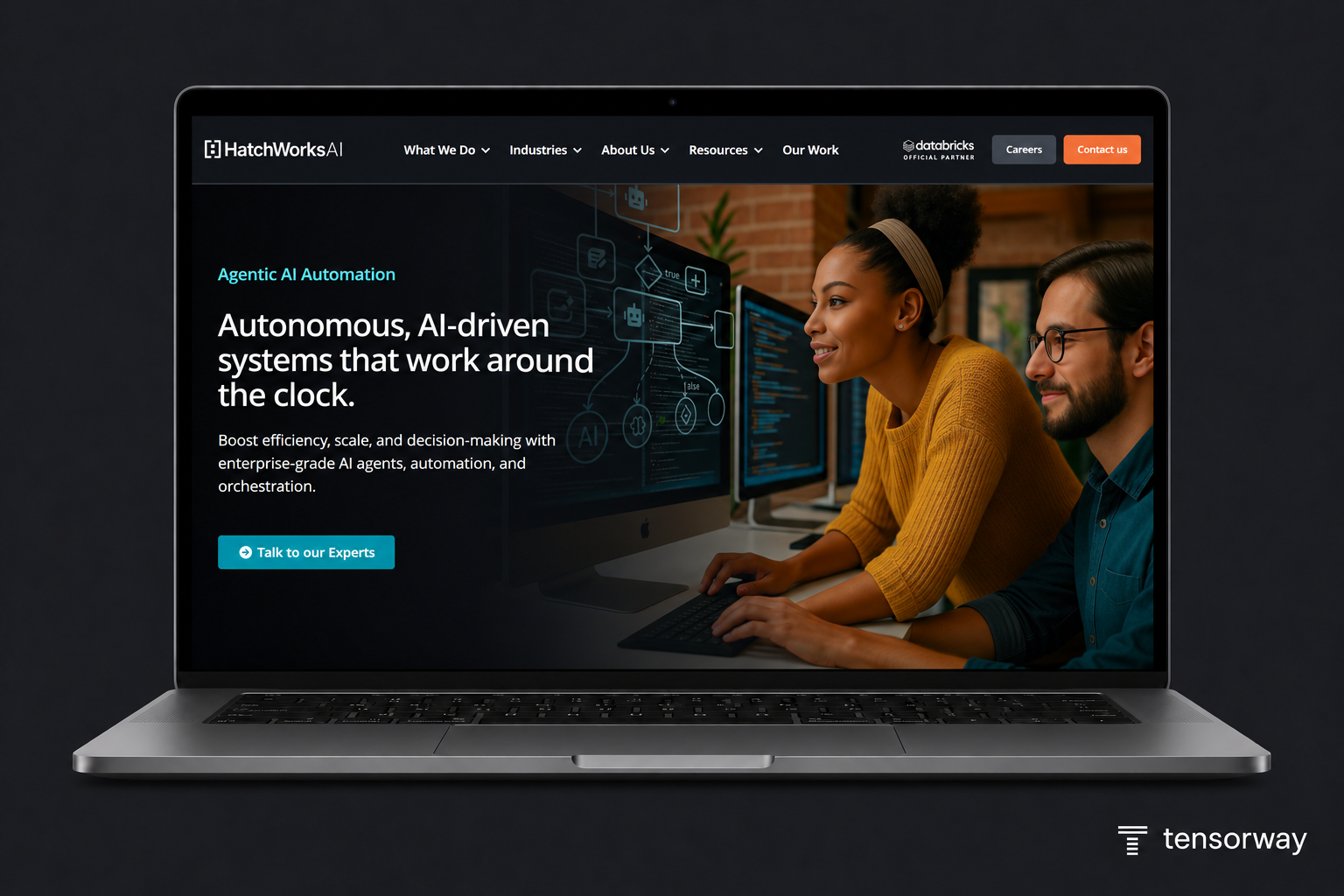
Employers use Recruitics to advertise openings across multiple job sites. The Recruitics team used to choose where each ad would run and how much to spend on each site. HatchWorks built an agent that places the ads and shifts the budget between sites as campaign results come in.
The engineers built the agent with LangChain and deployed it on Google Cloud. It draws on a vector database to make placement and spending decisions and can reuse a cached answer for similar requests. Recruitics and its customers track campaign performance in Looker.
Recruitics CTO Austin Anderson said the work helped his company lower its operating costs and better serve its customers.
Choosing an AI agent development partner
To narrow down these ten firms, look at what clients hired each one to build and which projects come closest to yours. If you already know what you want an AI agent to do, talk it through with our team at Tensorway.