
TL;DR
- AI agents for private equity can check data room completeness, extract financial figures, and prepare contract summaries for review.
- Findings need verifiable sources. Financial comparisons also require consistent reporting periods, entity coverage, currencies, and units.
- The deal team remains responsible for assessing management, interpreting risks, negotiating terms, and deciding whether to invest.
- Test AI due diligence software on documents your team has already reviewed. Check for missed issues and include review and correction time when measuring efficiency.
- Tensorway’s experience with agentic AI in private equity covers deal sourcing and initial screening. Its reported time savings do not measure a full due diligence process.
During due diligence, the deal team needs to verify that the seller’s documents support the target company’s reported financial results. Analysts cross-check financial statements against contracts and presentations, then investigate discrepancies. This work eats into the time available to assess the deal.
AI due diligence tools can handle some of that work. An agent uses available tools to carry out a sequence of related tasks. For example, it can find a figure in a financial statement, compare it with the seller’s presentation, and flag a mismatch with links to both sources. The analyst then has the evidence needed to investigate.
A specialist still needs to determine whether the discrepancy matters. With human-in-the-loop AI, reviewers check and correct the agent’s work at defined stages. This article examines which diligence tasks PE firms can automate, where expert judgment is needed, and how to manage the handoff between agents and the deal team.
What can AI agents automate in PE due diligence?
AI agents can check document completeness and prepare data for financial and legal analysis. Each task needs a defined set of sources and review criteria.
.png)
How can an agent check whether a data room is complete?
An agent can match uploaded files against the deal team’s document request list. For each request, it identifies whether the relevant material is available and which reporting period or legal entity it covers.
Suppose a fund requests three years of monthly management accounts. The folder contains 36 files, but some are revised versions of the same month’s accounts. The check needs to establish which periods are actually covered and identify any gaps. Counting files will not establish completeness.
The output is a document register with source links and a draft follow-up request for the seller. Unreadable scans need a separate status: a document may have been supplied even if the system could not extract its contents. Any due diligence automation workflow should keep these processing failures visible to the team.
What can be automated in financial due diligence?
An agent can extract figures from financial documents into an agreed template and prepare reconciliations across sources. The fund’s financial due diligence checklist determines which data is needed, including records for assessing earnings quality, working capital, and net debt. These areas are covered in ICAEW’s 2024 financial due diligence guideline.
Before comparing financial figures, an agent needs to establish what each number represents. For every extracted value, it should record:
- the reporting period;
- the legal entity or group covered;
- the currency and whether amounts are shown in units, thousands, or millions;
- the source page or spreadsheet cell.
These details affect whether a comparison is valid. A subsidiary’s revenue will usually differ from consolidated group revenue, for example. The agent should check which entities each figure covers before flagging the difference as an error.
Calculations should use verified formulas, with the original values preserved so an analyst can check the result.
How can an agent help review contracts?
An agent can prepare a table of contractual provisions using criteria defined by legal counsel. For a change-of-control review, the table should include the relevant clause, associated definitions, and any amendments found. Counsel determines whether the provision applies to the proposed transaction structure.
Searching only for the phrase “change of control” could miss a provision expressed differently. The system should therefore be tested against contracts that lawyers have already reviewed, including examples with unusual wording. The American Bar Association’s guidance on AI in M&A describes using custom models to extract information for subsequent legal review.
Reviewers need quick access to the original evidence. In Tensorway’s project for Liner Legal, summarized findings link to the exact PDF page and supporting sentence. The project handles medical evidence in legal cases; a similar approach can support the review of extracts from M&A contracts.
How can discrepancies become questions for further investigation?
The output should show the customer’s revenue share, the relevant contract provision, and questions for management about the ongoing relationship. The termination clause alone does not establish how likely the customer is to leave.
External checks require the same care in matching records. A reference to litigation should be linked to the correct legal entity by checking its identifiers and the current status of the case. A matching company name is not enough.
Which due diligence decisions should stay with the deal team?
Assessing management, setting the negotiating position, and deciding whether to invest should remain with the people accountable for the deal.
When assessing management, the team needs to establish whether the leadership can deliver the business plan after the acquisition. Suppose the forecast assumes expansion into a new market, but the company has only operated in one country. The team needs to understand:
- who will lead the expansion;
- whether that person has experience entering new markets;
- what hiring and spending the budget allows for;
- how the plan would change if the launch were delayed.
Comparing past budgets with actual results can help the team assess how realistic management’s forecasts have been. Meetings with management should explore the reasons behind any shortfalls and what has changed since.
During negotiations, the team decides how diligence findings affect the terms it is willing to accept. Some issues can be resolved before closing. Others may require a change to the purchase price or financing arrangements.
The fund’s ability to execute also matters. If the business plan depends on replacing the CFO, the partner needs to assess whether a suitable candidate is available and what a prolonged search would mean for the business. A recruitment budget in the financial model needs to be backed by a credible hiring plan.
The partner’s recommendation to the investment committee should:
- Explain what drives the expected returns.
- Identify unverified assumptions and material concerns raised by advisers.
- Show the impact of a downside scenario.
- Explain why the level of risk is acceptable to the fund.
If the investment only makes sense with rapid sales growth, the committee needs to see what happens when growth is slower.
A human-in-the-loop AI workflow requires clear ownership of conclusions and an agreed process for resolving disputed findings. These responsibilities are part of planning AI automation in financial services and should be established before the pilot. Without them, AI-generated work can pile up while responsibility for reviewing it remains unclear.
How should you test an AI agent before using it on a live deal?
Start with a single task, such as checking data room completeness. Use documents approved for testing that your team has already reviewed, so you can compare the agent’s results with the team’s findings.
Focus on four things:
- Accuracy. Does the agent correctly identify reporting periods, legal entities, and document versions? Include duplicates and poor-quality scans in the test set.
- Missed issues. Review a sample of documents the agent did not flag for follow-up. Checking only its flagged findings will not reveal what it missed.
- Supporting evidence. Follow the links in the report and confirm that the source documents actually support the findings.
- Total time spent. Include file preparation, review, and corrections in your assessment.
When comparing due diligence AI tools, measure the time it takes to produce a verified result. A report generated in a minute may still require hours of rework.
How does Tensorway use AI agents in private equity?
Tensorway built an AI deal sourcing platform for a Swedish PE fund to identify and screen potential investments. It brings together the fund’s internal documents and investment criteria with financial databases, CRM data, and public web sources.
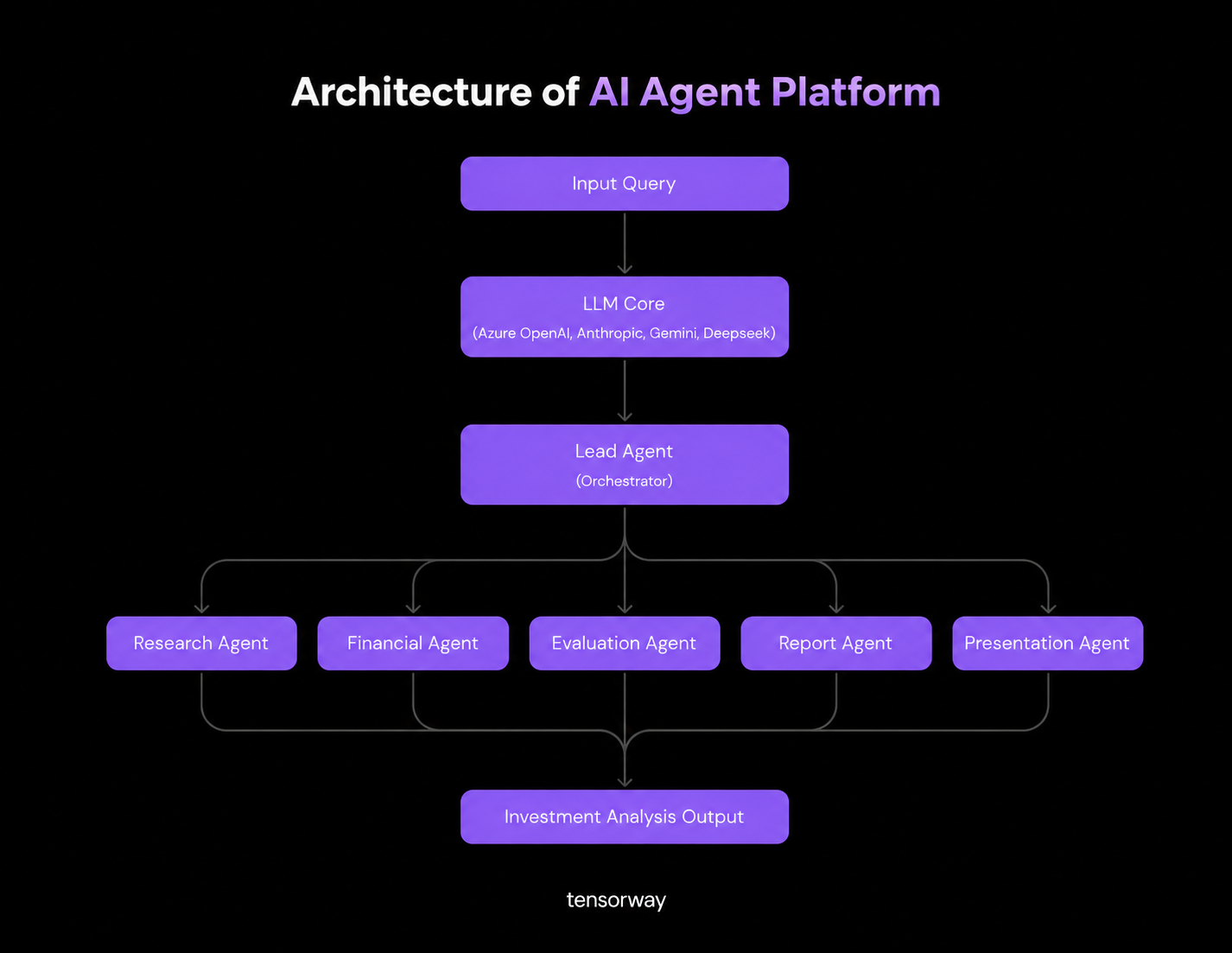
A team member submits a request through a chat interface, and a lead agent assigns tasks to specialized agents. These agents identify companies, assess them using the fund’s methodology, extract financial metrics, and prepare reports and presentations using its templates.
In its published case study, Tensorway reports:
- an 80% reduction in time spent on initial screening;
- investment presentations prepared eight times faster.
These figures cover sourcing and the preparation of investment materials. They do not measure time savings across a full due diligence process.
For teams developing due diligence agents, the project offers a practical example of connecting a fund’s data sources and coordinating specialized agents. This architecture could serve as a starting point for specific diligence tasks, but its performance would need to be tested on relevant documents against the deal team’s review criteria.
Conclusion
AI agents can reduce the time spent finding data, reconciling figures, and preparing due diligence materials. To assess their value, factor in the time needed to review and correct their output. The deal team determines how identified risks affect the purchase price, deal terms, and the decision to invest.
Start with a specific task where you have the relevant documents, clear quality criteria, and a reliable measure of the time currently spent. A pilot will help you decide whether broader adoption makes sense for your workflow.
Discuss your AI agent project with Tensorway to define the pilot’s scope and how your team will measure its success.