.jpg)
According to PwC's financial services industry survey, 55% of financial services executives ranked generative and agentic AI as their top investment priority for 2026. At the same time, 43% have already scaled back or delayed major technology initiatives, with 54% of them citing integration complexity as the primary barrier. Only 10% described their current technology infrastructure as leading-edge in AI integration.
The appetite for AI and automation in financial services is there, but most institutions are hitting the same walls when they try to move from investment to impact. Legacy systems make integration expensive and slow. Regulatory requirements add layers of review before anything reaches production. And organizational culture often keeps teams in pilot mode long after the technology is ready to scale.
This article breaks down where AI finance automation is already delivering measurable ROI, why most projects get stuck between pilot and scale, and how to approach implementation so you don't end up among the 43%.
Where AI Automation in Finance Delivers the Highest ROI
In our experience, the best candidates for AI finance automation are processes that consume a lot of time, repeat daily, and rely very little on human judgment. If there are also documented cases with measurable results already on the market, the risk of implementation drops significantly. Here are four areas where that's the case.
Fraud Detection and Prevention
Fraud detection was the first mainstream AI use case in finance and remains the most mature. Transaction volumes are massive, the cost of missed fraud is high, and even a fraction-of-a-percent improvement shows up immediately in the P&L. Visa reports that its AI system blocked $40 billion in fraud in 2024 alone. The company has invested over $12 billion in technology over five years, a significant portion of that going into AI and data infrastructure. Every transaction receives a real-time risk score based on hundreds of attributes. For a mid-size bank choosing where to start with AI, fraud detection remains the safest entry point.
KYC and Compliance Automation
According to LexisNexis Risk Solutions, financial crime compliance costs $61 billion per year in the US and Canada alone. Most of that goes toward manual work that AI is already capable of automating. HSBC, for example, is already using generative AI to redesign its onboarding and compliance processes. And the EU AI Act is making AI finance automation in compliance even more urgent. Financial institutions are required to ensure transparency and auditability for AI in high-risk scenarios, with penalties of up to 6% of global annual turnover.
Credit Scoring and Lending
AI solves a problem that traditional scoring handles poorly. Assessing risk for a client who has limited data in a credit bureau. AI models work with a broader set of signals and find patterns that rule-based systems simply don't see. The bank benefits on both sides at once. Fewer defaults thanks to more accurate risk assessment, and more approved applications from clients who would have been incorrectly filtered out before. HSBC launched an AI-driven credit assessment for SMEs on its Indonesian platform, automating financial analysis and cutting loan application processing time in half. For banks that work with SME and retail lending, AI and automation in finance offers one of the fastest ways to see impact on revenue.
Financial Reporting and Closing
Financial close is a process that every finance team wants to shorten, but few know where to start. It stretches over weeks, involves dozens of people, and a mistake at any stage can be costly. AI automates data collection, reconciliation, and report generation. According to PwC, leading finance teams have already reduced the cost of their finance function by nearly 25%, shifting their teams from routine tasks to analytics. PwC also describes cases where AI agents cut cycle times in procure-to-pay by up to 80%. What makes this use case especially appealing is that it doesn't require complex ML infrastructure. Often, properly configured AI agents working with existing data and systems are enough.
Why Most AI and Automation in Financial Services Projects Stall
In our machine learning development services for the financial sector, we consistently run into the same problems that keep AI automation in finance projects from reaching production. They don't depend on company size or a specific use case. Most of them could have been avoided if they had been accounted for from the start.

- The pilot launches without a plan for production. The team builds a model, shows results, and everyone is happy. But nobody determined upfront who owns the integration with core systems, who will support the solution in production, or how monitoring will work.
- AI gets layered on top of a process that needs to be redesigned. This is one of the most expensive mistakes. The team spends months automating a workflow that is poorly organized. AI works, but the business outcome doesn't change because the problem was never about the speed of the process. It was about the logic behind it.
- No executive sponsor. An AI project in financial services goes through risk committees, compliance review, security assessment, legal review. This can take months. Without someone with enough influence and motivation to keep the project on the agenda at every one of these stages, it drops off the priority list.
- The data isn't ready. This is something that almost never gets factored into the initial project estimate. Data is scattered across systems, duplicated, stored in different formats, or simply not kept up to date. In practice, data preparation often takes more time and resources than building the AI solution itself.
- Expectations don't match reality. Management expects measurable results within a quarter. The real cycle from pilot to production in a regulated industry is closer to 9 to 12 months. When these expectations aren't aligned at the start, the project gets labeled a failure before it ever has a chance to deliver.
- Fear of vendor lock-in paralyzes decision-making. Teams spend months comparing platforms, assessing risks, and having internal debates. Meanwhile, competitors who simply picked a specific use case and a specific tool already have a working solution in production.
How to Approach AI Finance Automation
We recommend that our clients treat AI finance automation as an engineering project with a clear scope, timeline, success metrics, and someone accountable for every stage. That alone changes how the project ends.
Pick One Process
Financial institutions that start by building an organization-wide AI strategy usually spend months planning and launching very little. Those that pick one specific process with a measurable outcome and take it all the way to production get both the result and the organizational experience to scale from there.
Governance
In a regulated industry, financial services AI automation requires governance built in from the start. How the model makes decisions, how that gets documented, who has access, what the audit trail looks like. If these questions come up a week before production, the project is guaranteed to slip by months.
Measure What Actually Matters
The number of deployed AI use cases says nothing about business results. Metrics worth tracking: time reduction on a specific process, error rate decrease, cost per processed request, impact on revenue. If the team can't name a specific metric that AI is supposed to improve, the project isn't ready to launch.
Technology Is 20% of the Outcome
The other 80% is redesigning how people work. An AI agent can process a thousand documents in an hour, but if the workflow is set up so the output still waits for manual approval from three people, the gain is minimal. The most successful AI and automation in financial services implementations we've seen started by redesigning the workflow around what AI can do, rather than layering AI on top of an existing process.
Don't Build Everything Yourself
69% of financial institutions choose third-party finance AI automation solutions over building from scratch. The reasons are pragmatic: faster time to value, built-in compliance, a clear support model. Building everything from scratch only makes sense when the use case is so specific that there's no adequate alternative on the market. If you need help determining the right approach, Tensorway provides AI consulting for exactly these situations.
AI Automation Success Stories in Financial Services
One of our clients, a major European private equity fund managing assets worth billions of euros, came to us with what initially looked like a speed problem. As an AI agents development company, we saw the team couldn't keep up with deal flow. Analysts were spending 60 hours a week on market monitoring and still missing opportunities.
Once we got deeper into the project, it became clear the problem was more complex. It wasn't just about speed. Different analysts evaluated deals differently. Data sat in dozens of places: CRM, Bloomberg, Excel, email, internal documents. Comparing two deals in the pipeline was nearly impossible because they had been assessed against different criteria by different people.
We didn't automate the existing process as it was. First, we broke it apart and identified five specific bottlenecks where the most time and quality were being lost. We built a dedicated AI agent for each one. One monitors Factiva and FactSet around the clock and filters out the noise: a single deal announcement typically generates 20+ articles, and the agent clusters them and extracts the key information. Another evaluates companies against the fund's criteria. A third prepares investment presentations. All five are coordinated by a lead agent through a single chat interface.
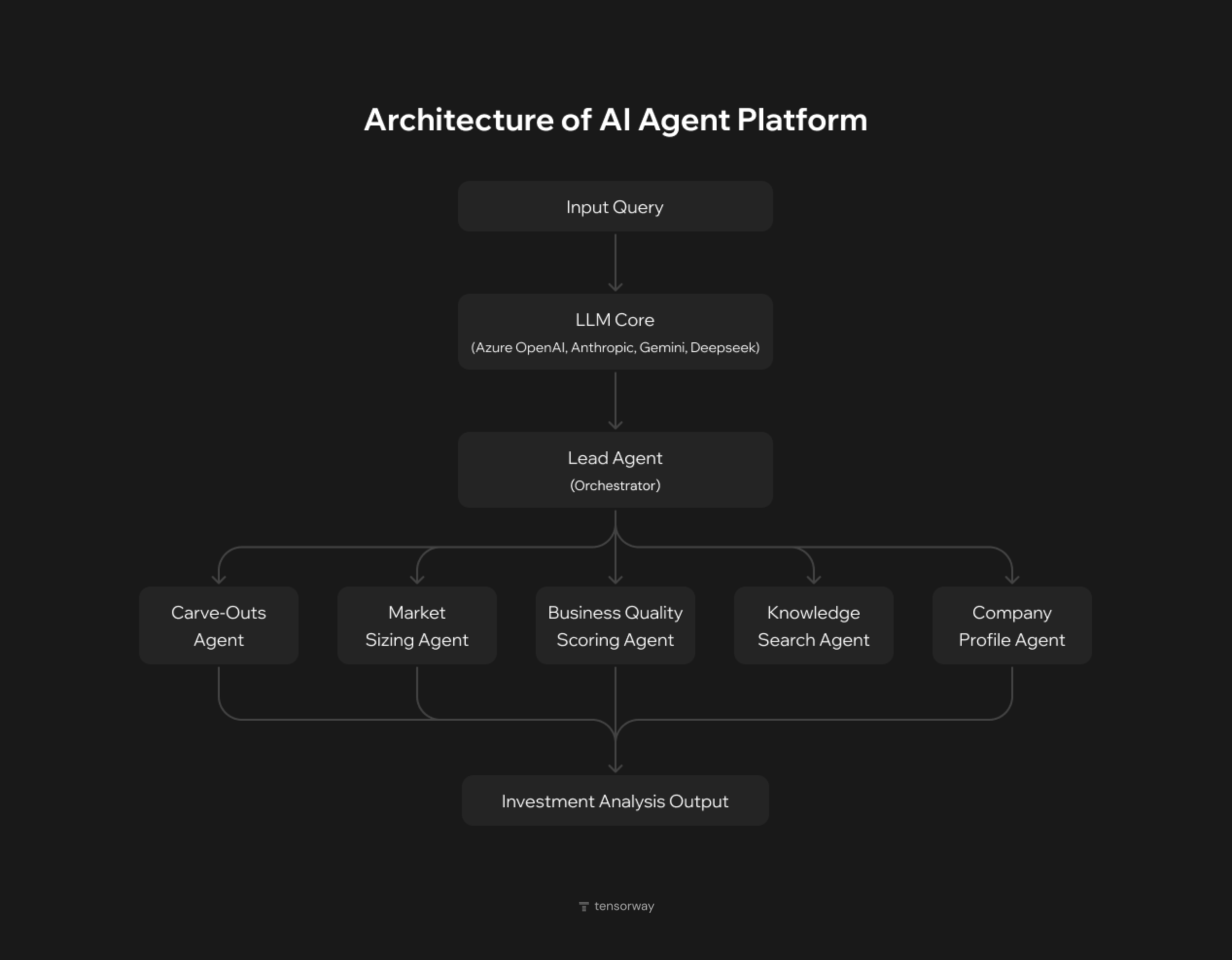
The key architectural decision was not to lock into a single model. The platform works with Azure OpenAI, Gemini, Anthropic, and Deepseek, selecting the right model for each specific task. This kind of generative AI development requires experience with multiple model providers and understanding which model fits which task. Built on LangGraph and LangChain, integrated with the fund's internal systems.
Results within the first months: the platform analyzes 5,000 investment opportunities in a matter of hours. Time spent on initial screening dropped by 80%. Investment deck preparation became 8 times faster. The number of identified opportunities grew from 15 to 45 leads per month.
Build or Buy: How Financial Institutions Source AI Solutions
This question comes up in every project. Build a custom AI solution or buy an existing one. There's no universal answer, but there are factors that help make the decision faster.
Building from scratch makes sense when the use case is unique to your organization, when you need full control over the model and data, or when no solution on the market meets your compliance and security requirements. It's a longer path. It requires a team with ML experience, infrastructure for training and serving models, and a willingness to invest 9 to 12 months before the first production result.
Buying a ready-made solution works when the use case is standard for the industry (fraud detection, KYC, document processing), when you need fast time to value, and when there's no internal ML team. Most financial institutions start here.
In practice, a hybrid approach works most often. A ready-made solution for standard tasks, custom development for what sets you apart from competitors. For example, KYC automation can be handled by a third-party tool, while an AI agent for deal sourcing or credit scoring that works with your unique data and criteria gets built to order.
The key is that the AI finance automation decision between build or buy should be made based on a specific use case, not as a blanket strategy at the organizational level. Each process deserves its own assessment. If you need help with custom AI development, we can help determine the right approach for each specific case.
Conclusion
Financial institutions that are getting results from AI automation in finance didn't do anything extraordinary. They picked one process, took it to production, and scaled from there. Those still working on an organization-wide AI strategy are usually still working on it a year later. If you want to figure out which process in your organization is the best candidate for AI automation and how to take it to production, reach out to us. We'll figure it out together.