LLMOps (Large Language Model Operations) is the set of engineering practices and tools that keep AI features built on large language models stable, predictable, and on budget once they're live in production.
To understand what it is, it helps to start with what it isn't. People often confuse it with MLOps, but they're different things. MLOps is about training your own models: building training pipelines, cleaning data, maintaining heavy server infrastructure. That's the world of companies building models from scratch. LLMOps is something else. Most teams today don't train their own models — they plug into hosted ones through an API (OpenAI, Anthropic, and so on). And the moment you do that, the set of risks changes completely.
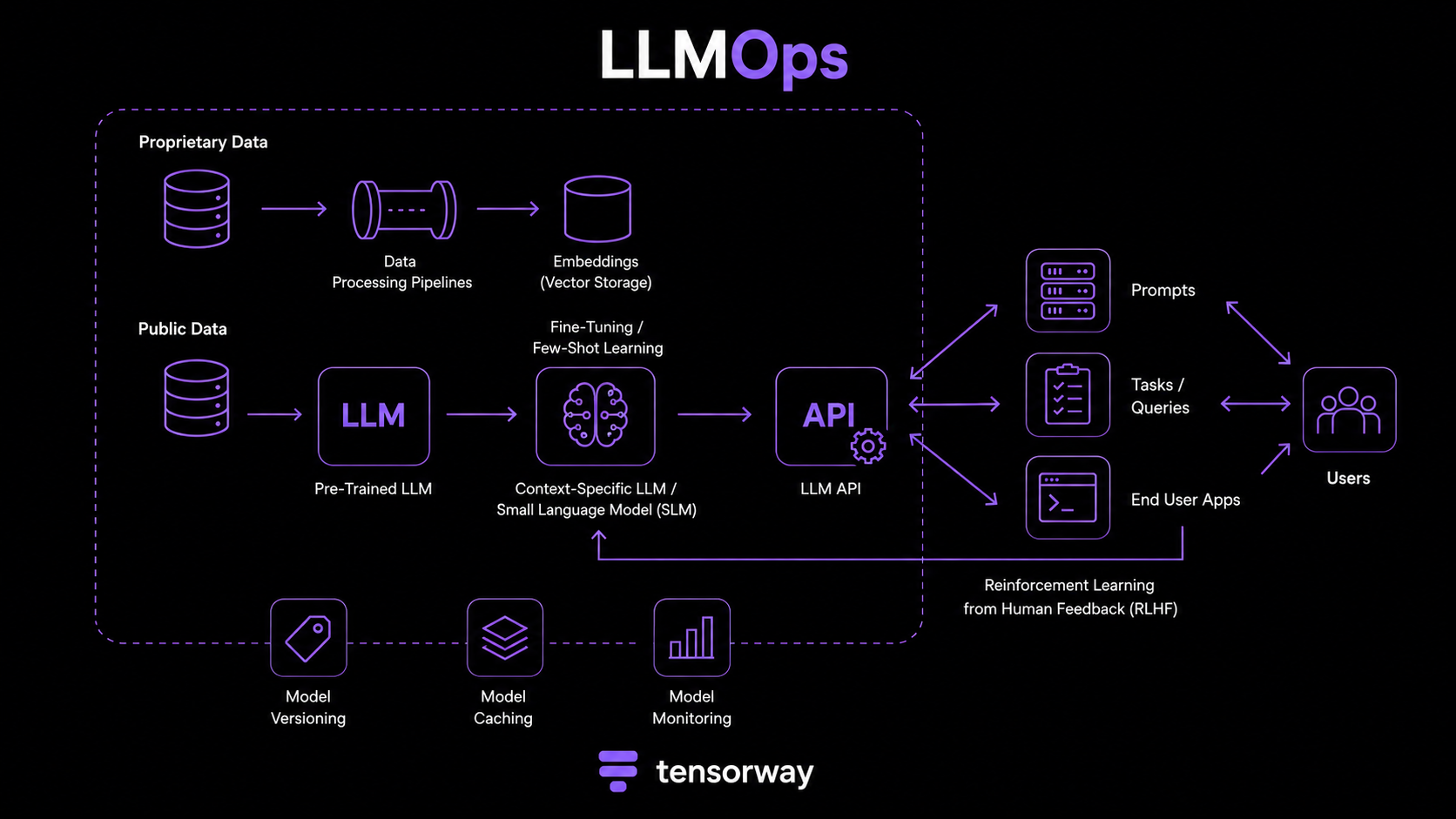
You no longer have to worry about servers crashing or dirty training data. Instead, a different kind of problem shows up. The model can return something unpredictable when a user phrases things in a way you didn't expect. A small tweak to a prompt can quietly degrade the quality of your answers, and you won't know until users start complaining. The model can confidently make up false information (a hallucination). And your token bill can spike out of nowhere because of an inefficient prompt or an agent stuck in a loop.
This is exactly the gap LLMOps fills. In practice, it rests on a few pillars. The first is observability: being able to see every user request and every model response, so you catch a bad answer before it turns into a complaint. The second is evaluation: automated tests that check whether a change actually improved the system rather than breaking it. The third is cost control: tracking how many tokens each request burns, because AI bills add up quietly and don't scale in a straight line. The fourth is prompt management: versioning your instructions so you can update them without breaking the product, and always know which version is running.