
TL;DR
- ESG reporting automation can help collect portfolio company data, flag gaps, and prepare draft disclosures using agreed rules.
- People assess materiality, interpret reporting requirements, and approve the final report. Reviewers need access to the sources behind each figure.
- Check what existing ESG reporting software can handle before commissioning a custom agent. Additional development should address specific gaps in your workflow.
- Test the solution on a previous reporting period. Compare accuracy and total preparation time, including the effort spent reviewing and correcting the output.
An investor asks a fund for emissions data from its portfolio companies. To respond, the team needs to contact those companies, wait for their calculations, and check what they cover. If the explanations are missing, someone has to follow up. Even a single metric can lead to a lengthy email exchange.
ESG reporting also covers working conditions, workplace safety, and corporate governance. Each topic involves different sources and people responsible for providing the information.
AI agents can take on some of this work. They can track responses, check submitted fields, and prepare a draft report using agreed rules. For example, an agent could flag a missing reporting period and draft a request for clarification. The fund’s team can then focus on questions that need its judgment.
This article explains how to put ESG reporting automation into practice and what to check before trusting an agent with data that will go to investors.
What Is ESG Reporting for Private Equity?
ESG reporting for private equity shows how a fund and its portfolio companies address environmental, social, and governance issues. It helps the fund’s investors, known as limited partners or LPs, understand what supports its claims about responsible investing.
The content depends on the companies’ activities and the reporting requirements. Here are examples of information a fund might request:
Collecting this information involves working with the people who hold it. HR provides workforce data, while energy consumption figures come from the department responsible for monitoring usage. The fund coordinates ESG data collection and checks whether the information is suitable for reporting.
For example, assessing whether workplace safety has improved requires figures from different periods collected under consistent rules. EDCI, an initiative that establishes common ESG metric definitions for private markets, helps participants agree on those rules.
These definitions also provide a foundation for using AI in ESG. With clearly defined metrics and validation rules, an agent can identify gaps and prepare data for the fund’s team to review.
Which ESG Reporting Tasks Can Be Automated?
An AI agent can prepare reporting materials and follow up with companies that have submitted incomplete data. ESG reporting automation can cover several connected tasks.
- Track data collection. A company returns its questionnaire but leaves the workforce section blank. The agent can flag the response as incomplete and draft a request for the missing information. Reminders go to the designated contacts according to agreed rules.
- Check the context behind the figures. Each metric can have required supporting details: a reporting period, a unit of measurement, and a source. If a company reports lower emissions without providing a baseline, the agent flags the missing information for clarification. It can also identify duplicates and discrepancies between files, helping the team catch problems before the data reaches the report.
- Populate approved templates. The same metric may be needed for several investor requests. Following approved mapping rules, the agent places it in the relevant fields and retains links to the source document. Reuse is appropriate only when the metric definitions and reporting periods match.
- Draft explanations of the results. The agent can compare approved figures with the previous period and prepare commentary for LPs. Explanations for changes come from the supplied materials. Where an explanation is missing, the draft leaves a question for the fund’s team.
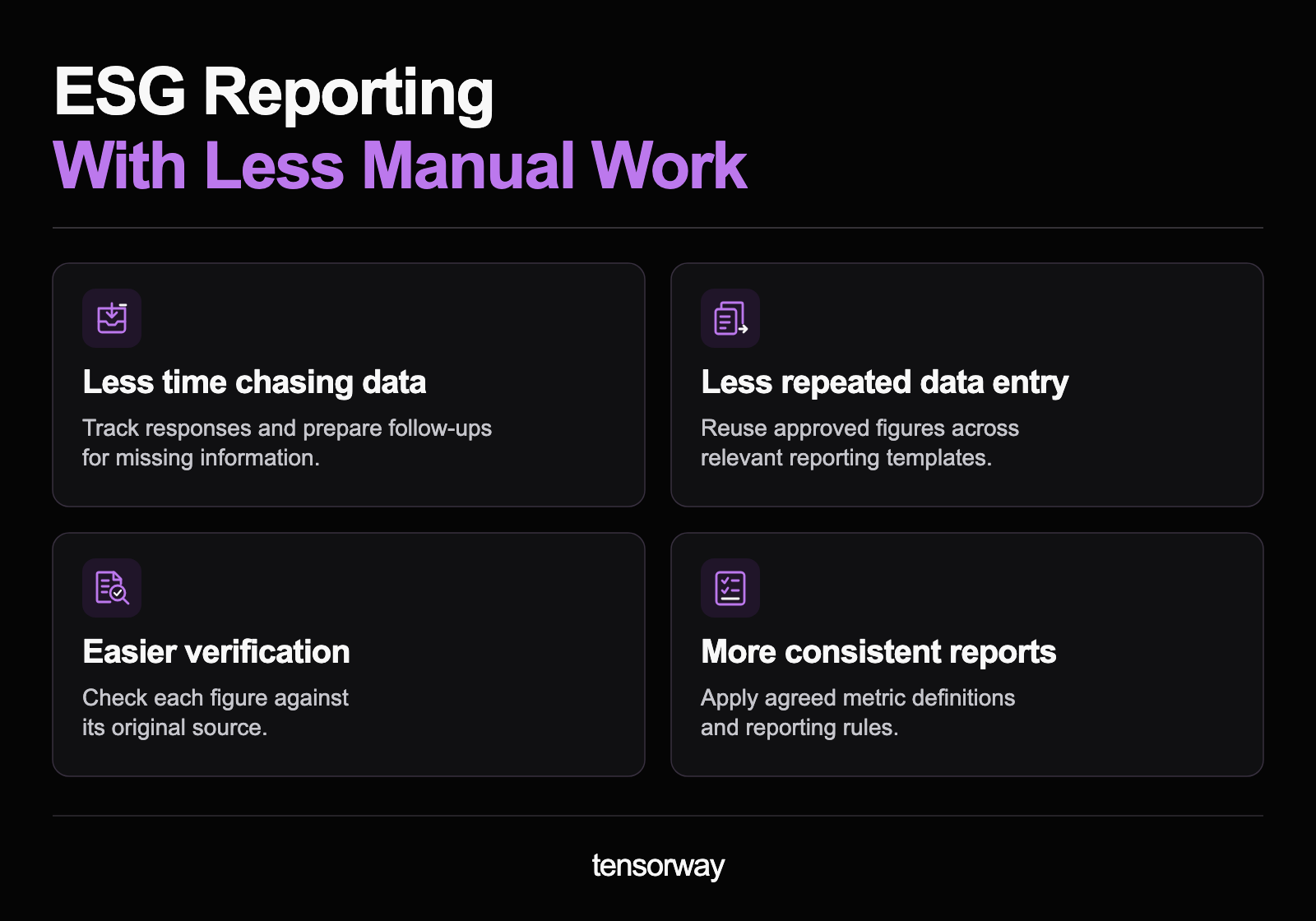
Through AI agent development, these tasks can be connected into one workflow. The team receives prepared materials and a list of unresolved questions, then reviews and approves the final report.
Which ESG Reporting Decisions Need Human Review?
The fund’s specialists need to determine which requirements apply and which conclusions the data supports. Estimates and assumptions deserve particular attention because they shape the picture presented to investors.
Which ESG Issues Are Material to a Particular Company?
Materiality depends on the company’s activities and the consequences ESG issues may have for the business and others. For a manufacturer that uses large amounts of water, both its impact on local water sources and the risk of production stopping during a drought could be material.
Reporting under the European Sustainability Reporting Standards (ESRS) uses double materiality. EFRAG’s IG 1 guidance, published in May 2024, explains the two perspectives:
- The company’s impact on people and the environment. How severe the consequences are, who is affected, and whether the harm can be remedied.
- Financial risks and opportunities for the company. How ESG issues may affect costs, revenue, access to financing, or the cost of capital.
An issue can be material from either perspective. The guidance also explains how to involve stakeholders and substantiate the assessment. An agent can organize supporting materials; the responsible specialists at the company and fund set the criteria and document their conclusions.
Which Requirements Apply to the Report?
Start by establishing who is reporting, to whom, and for which period. These details determine what information needs to be collected and how it should be presented.
As of 2026, SFDR governs sustainability disclosures by financial market participants and for financial products. The European Commission explains what information belongs on websites, in pre-contractual documents, and in periodic reports.
CSRD concerns corporate reporting by companies within its scope, which report under ESRS. A portfolio company’s obligations and those of its fund manager need to be assessed separately. Additional LP requests also need to be considered.
The team can then configure checks in ESG compliance software to match the agreed requirements. It should record which versions of the rules and templates the system uses.
What Can You Conclude From the Figures?
A lower figure does not, by itself, explain why it fell. Emissions may have decreased because of new equipment, lower production, or the sale of a business. The explanation matters when assessing the results of an environmental program.
The GHG Protocol Corporate Standard, revised in 2004, helps teams assess these comparisons. Chapter 5 explains when structural or methodological changes require base-year emissions to be recalculated. Chapter 8 examines different reasons for changes in emissions.
Before including a conclusion in sustainability disclosures, check:
- Do both reporting periods cover the same facilities and activities?
- Has the calculation methodology changed?
- Which figures come from actual data, and which are estimates?
- What evidence supports the explanation proposed in the report?
An agent can prepare comparisons and flag discrepancies. A designated reviewer checks the explanations and approves a specific version of the report before it reaches investors.
How Do You Build an ESG Reporting Workflow With AI Agents?
Build in two approval points: a review of the data before the report is prepared, and approval of the finished document before it reaches investors. Between these checks, the agent can populate templates with verified figures and draft explanations under agreed rules.
Suppose a portfolio company submits electricity consumption for nine months, but the fund is preparing an annual report. The agent extracts the number correctly. It still cannot use that number as an annual figure. The company’s designated contact needs to provide the remaining data or explain why it is unavailable. If the team decides to use an estimate, the report should identify it as such and explain how it was calculated.
To keep these questions from getting lost in email exchanges, configure three things in your ESG reporting platform:
- Supporting evidence alongside each figure. Reviewers need access to the source file, reporting period, unit of measurement, and any calculations or conversions. For estimates, retain the assumptions too.
- Someone responsible for resolving each question. Missing data goes to the designated company contact. Uncertain mappings to report fields go to the fund specialist who approved the mapping rules.
- A clear review status. Keep confirmed figures separate from those awaiting clarification. An unresolved question should prevent approval of the affected figure, even after a draft has been generated.
Once the data has been checked, the designated reviewer approves a specific version of the report. Record who approved it and when. If a company later submits corrected figures, the related calculations and conclusions need another review.
Define this process when planning AI adoption in private equity. It will help establish which systems the agent needs to access and where it must pause for a human decision.
Should You Use ESG Reporting Software or Build a Custom AI Agent?
Start by testing off-the-shelf ESG reporting software against a specific process at your fund. Additional development makes sense when you can identify work your team still does manually and explain why configuring the platform won’t resolve it.
As of September 2026, established platforms already offer automated data collection, validation, and integrations. Novata, for example, supports collecting portfolio company data, checking its quality, and preparing responses to LP questionnaires. It also describes AI capabilities for extracting information from spreadsheets and documents.
KEY ESG offers data approval workflows with an audit trail and API connections to HR and finance systems. Having information spread across several systems does not, by itself, mean a fund needs a custom agent.
When comparing ESG reporting tools, ask vendors to demonstrate how their products would handle your work:
User experience also illustrates these differences. In a Reddit discussion, a participant who identified themselves as an ESG consultant described using Workiva for data collection and reporting, and Watershed for carbon calculations. It is one person’s experience, but it shows why products need to be compared against a specific task.
If gaps remain after the demo, ask for a separate estimate to address them. Connecting a data source or configuring an export may be enough. Consider a custom agent when you need a sequence the platform cannot support: reading nonstandard documents, comparing their contents with internal records, and routing discrepancies to a designated specialist, for example. Include ongoing maintenance in the comparison.
How Can Your Fund Get Started With ESG Reporting Automation?
Choose a recurring LP request your team has already answered for the first test. Source materials from a previous reporting period and the approved report give you a basis for comparison: you know which figures the agent should find and which explanations it needs to prepare.
When evaluating ESG reporting automation, measure the total time needed to produce a finished response, including review and corrections. Were the figures transferred accurately? Can you open the source behind each metric? How did the agent handle missing data? These details will show how much work remains for your team and help you decide what is ready for the next reporting cycle.
Tell the Tensorway team how your fund prepares ESG reports. We’ll discuss which process to test first and how to assess the results.