TL;DR
- Small language models (SLMs) run roughly a few hundred million to 15B parameters — small enough for one GPU, a workstation, or a phone.
- Running a small model can be 10-30x cheaper than its highest-performing large sibling (NVIDIA, 2026), with far lower latency.
- An slm wins on narrow, repetitive, well-defined work; an LLM still wins on open-ended reasoning and broad world knowledge.
- Models worth a look in 2026: Microsoft Phi-4, Google Gemma 4, Meta Llama 3.2, Mistral 7B, and Qwen3.
- Most teams land on a hybrid setup: the SLM handles the bulk of routine inference, the LLM is called for the harder 10–20%.
- A fine-tuned SLM is only as good as the data behind it, so the dataset deserves more attention than the model choice.
A team runs every request through a frontier LLM API and watches the cloud bill climb month after month, even though most of the workload is repetitive classification or extraction that never needed that much horsepower. This is the usual moment when engineering leads start looking sideways at smaller models.
As of 2026, small language models (SLMs) — generally a few hundred million to around 15 billion parameters — are taking on a growing share of enterprise AI workloads, because on narrow, well-defined tasks they match larger models at a fraction of the cost. By NVIDIA's estimate, running a small model can be 10-30 times cheaper than its highest-performing sibling.
In our work at Tensorway, the miss here is rarely technical. A team reaches for the most capable model by default because it feels safer, then discovers later that 80% of its requests are the same narrow classification a model twenty times smaller handles at the same quality. The question was never whether an SLM could do the job. It was whether anyone asked that before signing up for a frontier API.
This article explains what an SLM actually is, how it differs from an LLM, which models are worth considering, and when to reach for a small model instead of a frontier one.
What Is a Small Language Model and How Is It Different From an LLM?
A small language model is a transformer-based language model, generally under about 15 billion parameters, small enough to run on a single GPU, a workstation, or edge and mobile hardware rather than a multi-GPU cluster.
The contrast with LLMs is concrete. Large models (100B+ parameters, such as GPT-5 or Gemini) win on open-ended reasoning and broad general knowledge. SLMs win on latency, cost per query, and data privacy, because inference can happen on-device or on-prem without sending data to an external cloud. This is the heart of the slm vs llm trade-off.
The numbers make the gap tangible. Per NVIDIA, running a small Llama 3.1B can be 10-30 times cheaper than Llama 3.3 405B, depending on architecture and the typical query.
Small language models vs large language models
One misconception is worth clearing up. A smaller model does not mean a worse one. It means a model with a narrower focus. A frontier LLM is a generalist that knows a little about everything; an SLM is a specialist trained on one class of task. For open-ended conversation, the generalist almost always wins. For parsing ten thousand near-identical tickets a day, the specialist is cheaper and steadier, because it has no room to improvise an answer in a format you never asked for.
How do small models get so compact?
Small models get small through a set of compression techniques, not by accident. Knowledge distillation transfers what a larger “teacher” model knows into a smaller “student.” Quantization converts weights from 32-bit floating-point numbers to 8-bit integers (INT8/INT4), shrinking memory and speeding up inference. Pruning strips redundant parameters out of the network. On top of that, training on curated, high-quality data rather than raw internet-scale scraping does much of the heavy lifting.
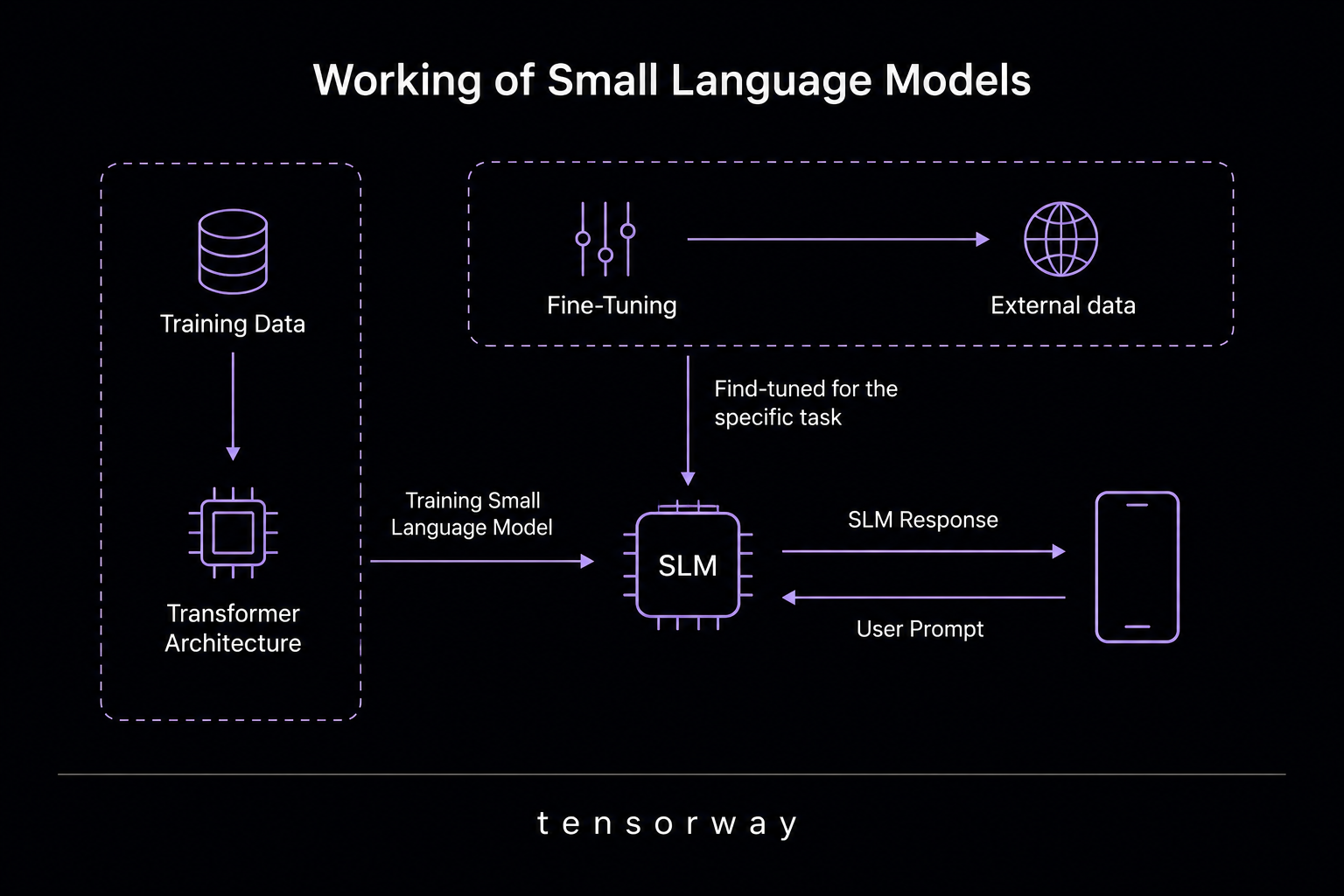
The diagram traces the full loop: a curated dataset and a transformer architecture produce a base model, fine-tuning on external data sharpens it for a specific task, and at run time the model takes a user prompt and returns a response, all compact enough to live on a single device. The fine-tuning step carries the most weight. It turns a general small model into a narrow specialist, and in our experience it is the step that most often decides whether an SLM holds up in production.
Curated data quality is why Microsoft Phi-4, at 14 billion parameters, competes with models five to fifty times its size.
What Are the Best Small Language Models to Use in 2026?
The best small model depends on the task, so what follows is a guide by fit rather than a ranking. These are among the best small language models in active use, and most are open source small language models.
- Microsoft Phi-4 / Phi-4-mini offers the strongest reasoning-to-size ratio. The base Phi-4, at 14 billion parameters, outperforms larger models on math, including Gemini Pro 1.5. The Phi-4-mini-reasoning variant, at 3.8 billion, is tuned for math and step-by-step problem solving and runs on edge and NPU hardware. Best for teams already on Azure that want a model they can fine-tune without heavy infrastructure.
- Google Gemma 4 (released 2 April 2026) is open-weight, Apache 2.0 licensed, and tuned for both cloud and on-device deployment. It comes in sizes from E2B (5.1B total, 2.3B active parameters) up to 31B; in 4-bit quantization, E2B fits in under 3 GB of RAM, which suits mobile hardware. Its predecessor Gemma 3 shipped in 1B/4B/12B/27B sizes. A good default for teams that want a permissively licensed model with solid documentation.
- Meta Llama 3.2 (1B / 3B) is built specifically for edge and mobile deployment; the quantized versions are half the size and 2 to 3 times faster (IBM, 2024). The obvious pick when the target device is a phone or an embedded system with no reliable connectivity.
- Mistral 7B and Qwen3 are open-source, Apache 2.0 licensed, strong general-purpose baselines that fine-tune well on narrow enterprise datasets such as contracts, support tickets, and product catalogs. Qwen3.5 supports over 200 languages, which makes it a strong choice for non-English work. These are the models we most often start from when a client needs a specialist trained on their own data.
Small language models examples, by fit
When Should You Use a Small Language Model?
Use an SLM when the task is high-volume, repetitive, and narrowly scoped, rather than when it needs broad reasoning. These are the small language models use cases where the economics are clearest.
- Picture a support team fine-tuning a 7B model on two years of resolved tickets. It now handles the bulk of routine classification and routing on-device, and sends the complex or ambiguous cases to a cloud LLM. This is the hybrid pattern most enterprise deployments settle on: the SLM carries the routine inference load at the edge or on-prem, and the LLM is called selectively for harder requests.
- NVIDIA frames it well: SLMs are the workers in a digital factory, efficient and specialized, while LLMs are the consultants called in when broad expertise is needed.
- Good fit: classification, extraction, summarization of a known document type, structured Q&A, and on-device features that must work offline. Poor fit: open-ended reasoning, synthesis across multiple documents, and tasks that need broad world knowledge the model was never fine-tuned on.
- Fine-tuning cost is a separate advantage. Adding a skill or fixing a behavior on an SLM takes a few GPU hours, against days or weeks for an LLM. That is what makes domain specialization practical for smaller teams, including on synthetic or proprietary data. Training on your own data is its own discipline; here is how to generate synthetic data for ML model training.
- Practice backs this up: peer-reviewed work shows that fine-tuned small models still outperform zero-shot generative LLMs on text classification, while giving you control, privacy, and local execution.
One caution from practice that rarely shows up in marketing material: an SLM does not forgive lazy data. A frontier model can be coaxed with a weak prompt and will still pull a passable answer from its general knowledge. A small model will not. Its strength is exactly what it was fine-tuned on. So a project that budgets a week for training data “if there's time left” tends to produce the disappointed “we tried an SLM, it didn't work” verdict. The model didn't fail; the data prep did. That is a reason to treat the dataset as the main asset of the project, not a reason to avoid small models.
Task type vs recommended approach
Conclusion
Small language models are the right default for narrow, repetitive, high-volume work, with LLMs kept in reserve for the harder cases that need broad reasoning. The practical next step is an audit: look at where your AI spends, single out the routine high-volume tasks, and test a fine-tuned SLM against your current LLM on those specific jobs before a wider migration. If you'd rather not run that exercise alone, contact us — we'll help you find where a small model fits and prove it against your own workloads.

.jpg)