.jpg)
TL;DR
- If you call hosted LLM APIs, your risk isn't servers going down. It's unpredictable outputs, prompt changes that quietly break things, and surprise token bills.
- You need LLMOps the moment real users reach your AI feature. Red flags: you can't prove a prompt change helped, you don't know your token cost per user, and a complaint comes in with no logs to trace it.
- Lightweight open-source tools cover it: Langfuse, DeepEval, Promptfoo. No enterprise platform or dedicated ML team required.
- Where a small team starts: add tracing, write a dozen tests before your next prompt change, tag your prompt versions.
Your engineering team ships a new GPT-4 feature, and it passes every manual smoke test in staging. Two weeks later, a minor prompt tweak silently corrupts a great part of your production outputs. At the same time, there are no error logs or clean ways to reproduce the bug. This structural blind spot is the LLMOps gap.
Startups can protect their production pipeline early, instead of introducing heavy enterprise tooling or hiring a dedicated machine learning platform team. LLMOps is the specific framework of engineering practices and lightweight tools that allow teams to monitor, evaluate, and safely iterate on LLM-powered features without experiencing silent failures in production.
In this article, we are going to talk about how dedicated LLM monitoring differs from tracking traditional software. You will see the warning signs that prove your system is already failing silently. Moreover, we will share a lightweight toolset that will give you full visibility without rewriting your code.
What Is LLMOps?
LLMOps stands for Large Language Model Operations. It is the day-to-day process of tracking and managing AI features to ensure they work correctly and stay within budget.
LLM Ops is not MLOps with a different name. MLOps is related to model training pipelines and heavy infrastructure. Meanwhile, LLMOps covers exactly what happens after an LLM deployment hits production and AI calls an API. This includes your written instruction versions, text output quality, delivery speed, and token costs at scale.
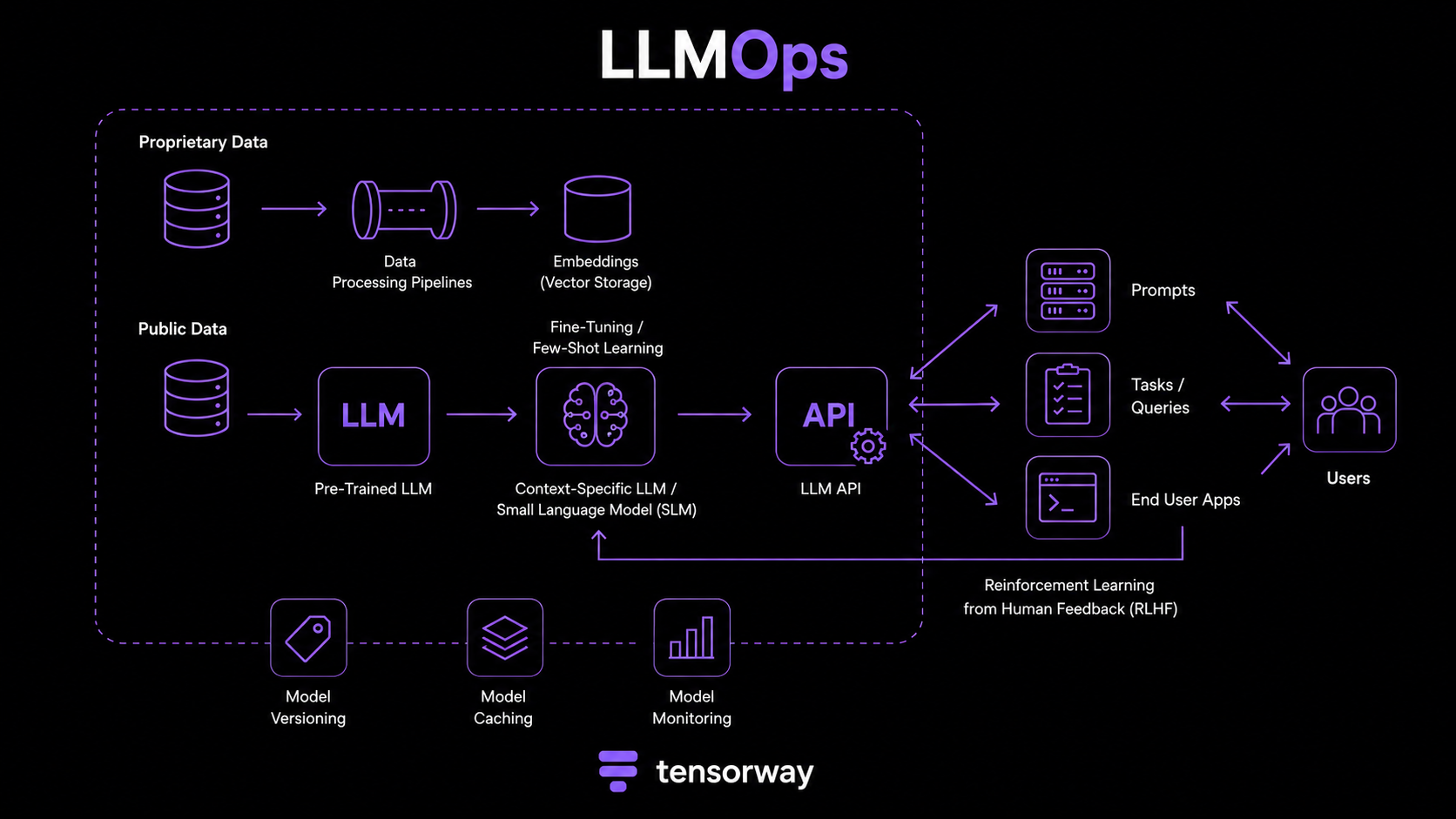
Most startups do not build custom AI models from scratch. They typically rely on a third-party LLM integration and call hosted APIs provided by well-known companies like OpenAI. In such a situation, the range of business risks that you may encounter completely differ from those of companies that work with proprietary models.
You don’t have to manage heavy server infrastructure. But you may face unpredictable text outputs. Your team has to watch out for sudden updates that degrade performance (prompt regressions), unexpected budget spikes, and confidently made-up false information (hallucinations) that surface under real user traffic.
The table below contains a brief MLOps vs LLMOps comparison.
To run a reliable AI feature, a startup needs to track four specific pillars:
- LLM observability. You need to see exactly what your users see to catch bad answers before they cause complaints.
- LLM evaluation. You must score the quality of the outputs to ensure updates truly improve the system.
- Cost tracking. AI billing accumulates quietly, so it is important to track token usage per request.
- Prompt management. You need a clear system to organize and update text changes without breaking your software.
When Does a Startup Actually Need LLMOps?
You need LLMOps the exact moment real users get access to your live AI implementation. You shouldn’t wait until your business hits massive scale. When real people interact with an LLM, they input unexpected phrases. If you lack basic operations, you may face unpredictable outcomes.
Many teams assume they can handle operational tracking later. This delay is a critical mistake. Here are three clear signals that your startup has already waited too long:
- You updated your system instructions, but cannot prove whether the change genuinely helped or hurt overall text performance.
- You do not know your average token cost per active user. This means you can’t calculate your true profit margins.
- A customer reports a broken or bizarre response, and your engineers have zero logs to recreate or diagnose the exact bug.
These are not rare theoretical problems. On tech community forums, users regularly post warnings about silent AI quality degradation. Many discover that their AI features have been outputting broken data for days before anyone notices. “Most teams start evaluating after a bad incident. By then they're scrambling to figure out what went wrong and why it worked fine in testing,” shared one of the Reddit users. Nevertheless, it can be too late, as customer trust is already lost.
Apart from this, startup founders shouldn’t ignore the financial factor. AI costs do not scale predictably like traditional cloud database storage. Instead, they compound with every single word generated. One of the AI developers on Reddit admitted: “I generally don't pay too much attention to costs, but my agents are proliferating so things are getting more pricey.” LLM cost optimization is an essential step. Without real-time token tracking, engineering teams may underestimate their actual LLM spend by several times until the first billing cycle ends.
According to guidance from the FinOps Foundation, AI costs can spike unexpectedly due to prompt design choices, application bugs, and agentic workflows that loop unexpectedly. Token consumption is the primary driver of LLM spending. As a result, even small inefficiencies in prompts or runaway agent behavior can generate invoices that exceed budgets far faster than many teams expect.
It can be dangerous just to wait for your cloud provider’s monthly invoice to check your financial health. You must implement basic visibility from the very beginning in order not to let small prompt mistakes turn into massive business expenses.
What LLMOps Tools Can Work Without a Platform Team?
Three open-source or low-cost tools that can cover 80% of what a startup really needs for LLM monitoring. Langfuse can be used for observability and tracing. An evaluation framework like DeepEval or Promptfoo is intended for tracking output quality. Meanwhile, a simple prompt registry can be applied for version control. You don’t need an expensive enterprise LLMOps platform or a dedicated infrastructure team to run these systems.
For tracking your live traffic, observability tools like Langfuse or LangSmith give you deep visibility into every single AI request. They provide detailed speed breakdowns and token cost tracking right out of the box. Langfuse is entirely open-source and easy to self-host. At the same time, LangSmith serves as a great native alternative if you use the LangChain library. You can integrate any of them into your existing code in under 30 minutes. Moreover, their use won’t be a threat to your budget. They offer free tiers that easily support early-stage applications.
Automated text evaluations are the ultimate safety net that most startups skip and later regret. Early LLM testing with a targeted set of test cases on every single software release catches bad AI answers before your users ever encounter them. Open-source frameworks like DeepEval and Promptfoo let your current team write these evaluations directly in code. As a result, you won’t need to hire a separate data science specialist.
When it comes to managing your written instructions, your team should at least save prompts in Git and tag each new release. For a smoother workflow, Langfuse and LangSmith feature built-in prompt registries. They allow you to push instruction updates without executing a full software redeployment. This setup becomes vital the moment multiple engineers begin editing prompts simultaneously.
In addition to this, real-time cost tracking is essential because API fees compound quietly behind the scenes. Most standard observability tools provide a clear financial dashboard. However, even a simple system log that records the model type, input tokens, and output tokens per request is enough to catch a massive cost spike before you get your monthly invoice.
The following LLMOps tools will help your engineering team gain complete control without extra operational friction.
How Can We Set Up LLMOps as a Small Team?
Start your LLMOps setup with simple tracing and add a few evaluations before your next prompt change. Everything else can be skipped until you truly need it. The key goal for a small team is immediate visibility. You don’t need a massive framework to keep your AI features safe and reliable.
First of all, you should ship LLM tracing to your live application. You can add Langfuse or LangSmith instrumentation to your AI calls in a couple of hours. This quick setup gives your team a searchable log of every single user query and AI response. It also tracks delivery latency and token counts automatically. With this data, your engineers can spot a bug and fix it before a customer ever complains.
Also, write exactly ten automated evaluations before you change your next prompt. Do not try to build a library of one hundred tests right away. Pick ten inputs that cover your most common user requests. Make sure to include two or three edge cases that have historically broken your system. When these tests are run on every code deployment, they create a reliable safety guard that catches sudden errors before they reach production.
Last but not least, tag your prompts to keep them organized. Even a simple naming convention like "classifier-v3" inside your environment configuration file beats having no system at all. You can easily upgrade to a cloud-based prompt registry later on. This transition becomes necessary as soon as more than one engineer begins modifying your AI instructions regularly.
With these three steps, your small team can run a stable AI product without heavy infrastructure overhead.
Wrapping Up
You don’t require a massive data science department to build stable AI features. It is enough to establish strict visibility over your active pipelines. When you implement basic tracing, targeted code evaluations, and structured prompt versioning, you stop silent text degradation and keep your token expenses completely predictable.
As your software scales from basic API calls to multi-step agentic workflows, management of these operational guards becomes more complex. Unmonitored recursive loops can easily drain your budget within a couple of days or even hours.
At Tensorway, we can help you handle end-to-end GenAI and AI agent development without introducing unnecessary enterprise platform overhead. We integrate lean tracking layers directly into your codebase so that your system remains stable under heavy user traffic.
Want to learn more? Let’s connect to discuss what we can do for you.