TL;DR
- Enterprise AI adoption is an operational shift, not a software purchase. Moving from sandbox demos to company-wide production requires internal governance, not just buying tools.
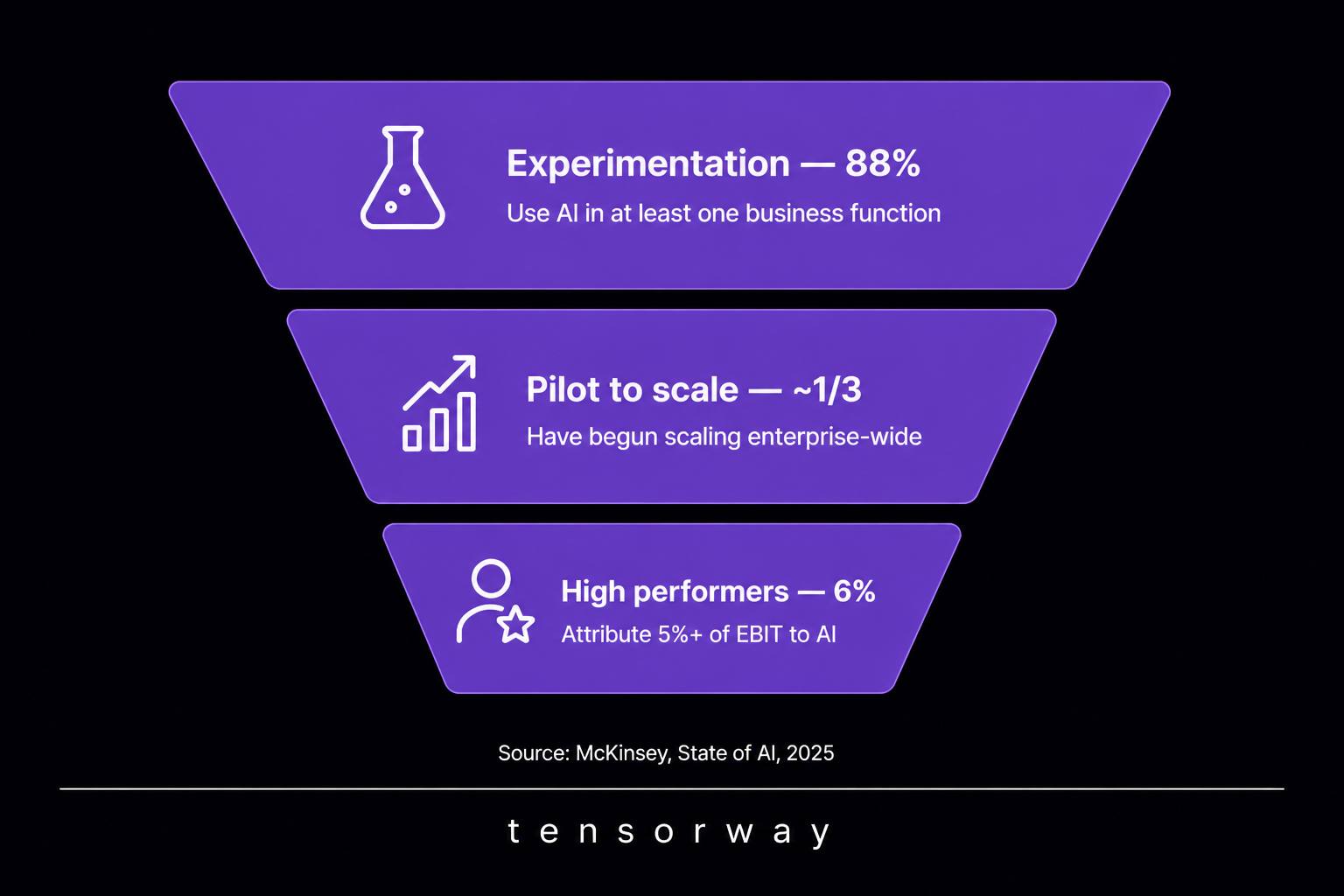
- The scaling gap is real. 88% of enterprises use AI, but only 6% scale it successfully (McKinsey, 2025).
- Pilots stall on operational flaws. Lack of clear ownership, missing KPIs, and siloed data kill projects—not model performance.
- Audit data before picking use cases. 63% of orgs lack AI-ready data (Gartner, 2025). Fix data infrastructure first.
Three AI pilots are running in sandboxes. The board is asking for an enterprise-wide rollout timeline. And no one can say who owns what happens after the demo.
Enterprise AI adoption is the structured process of moving AI from isolated pilots to governed, measured deployment across business functions, not a one-time tool purchase.
This article explains how to assess readiness, sequence a rollout, and put governance in place before you scale.
What Is Enterprise AI Adoption, and Why Do Most Initiatives Stall?
Enterprise AI adoption succeeds when AI is embedded in workflows with clear ownership and measurable outcomes, not when a pilot simply works in a sandbox.
The scale of the gap shows up in the data. As of November 2025, 88% of organizations use AI in at least one business function, but nearly two-thirds have not begun scaling it enterprise-wide. AI high performers, the organizations attributing 5% or more of EBIT to AI and seeing significant value, make up just 6%. That gap between the 88% and the 6% is the whole subject of this article.
The pilot-to-production gap is concrete. Pilots run on curated data with relaxed security; production requires governance, integration with legacy systems, and ongoing monitoring. This is where most initiatives stall. It is also the reason enterprise AI implementation is a different problem from running a successful demo.
In our experience at Tensorway, the root cause is almost never the model. A pilot fails for four prosaic reasons: no one owns the outcome once the demo is over, success criteria weren't defined before it started, the data isn't integrated with core systems, and the workflow around the new tool was left unchanged. That last one is the most insidious. A team drops AI on top of the old process, keeps every manual step, then wonders why there's no gain. These are the real enterprise ai adoption challenges, and none of them is solved by a better model.
Pilot vs production AI deployment
How Do You Build a Practical Enterprise AI Adoption Roadmap?
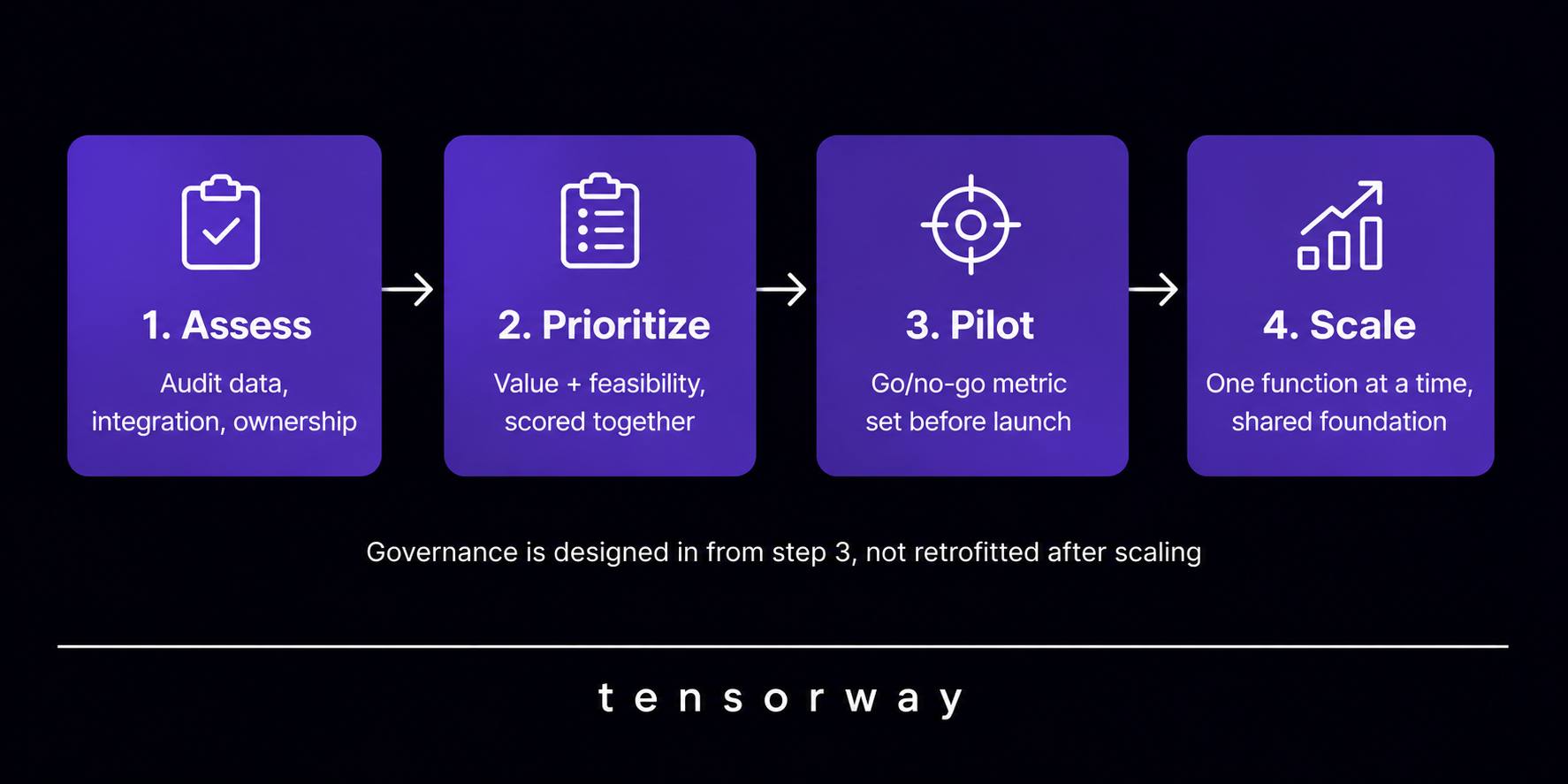
A workable ai adoption framework moves through four stages: readiness assessment, use case prioritization, a contained pilot with defined success criteria, and a phased scale-up.
- Readiness assessment. First, audit data quality, system integration points, and cross-functional ownership before selecting a use case, not after. As of 2026, 63% of organizations either don't have or aren't sure they have the right data management practices for AI. The same Gartner research predicts organizations will abandon 60% of AI projects that aren't supported by AI-ready data.
- Use case prioritization. Score candidates on business value and technical feasibility together, not separately. A high-value use case with poor data readiness will stall just as surely as a low-priority one. When the in-house team lacks experience running this kind of assessment, this is the moment to bring in AI consulting rather than learning on your own failed pilots.
- Pilot with a success contract. Define the go/no-go metric before the pilot starts, for example reduce review time by 35%, not after. It sounds obvious, and yet this is exactly where most initiatives break: without a number agreed up front, a pilot's “success” becomes a matter of interpretation, and everyone reads into it what they want to see.Phased scale-up. Expand one function at a time and reuse the same data and security foundation instead of rebuilding it per project. This is where AI agent security and governance comes directly into play, because each new function inherits the same access rules rather than inventing its own.
High-priority vs low-priority use cases
What Governance and Risk Controls Do CTOs Need Before Scaling?
Governance has to be designed in from the first pilot, not retrofitted once something breaks in production. A credible enterprise AI strategy treats it as a design input, not a compliance afterthought.
- Data governance. Access controls, lineage tracking, and audit trails become non-negotiable the moment AI touches production data. Before that moment they're easy to postpone; after it, they're too late to add cleanly.
- Model oversight. Human-in-the-loop checkpoints for high-stakes decisions, plus drift monitoring. McKinsey counts defined processes for human validation of model outputs among the top factors that separate AI high performers from everyone else. So this is not bureaucracy; it correlates with actual return.
- Vendor and architecture decisions. Don't lock into a single foundation model provider. Build an abstraction layer so switching providers doesn't mean rebuilding the stack. Models change fast, and so do prices and licenses; a team that wired one API into every corner of the product pays for that convenience later. For enterprise generative AI adoption specifically, that flexibility is worth more than any single model's current edge.
Data governance vs model oversight vs vendor governance
Conclusion
Enterprise AI adoption is no longer a technology question, since most organizations already use AI somewhere. The real differentiator is whether pilots are designed from day one to survive production: honest data checks, a go/no-go metric before launch, and governance built into the first pilot. If your pilots work but none has reached production, contact us and we'll help you close that gap.

.jpg)
.jpg)