.jpg)
TL;DR
- Legacy spreadsheet planning reacts to disruptions after they hit, while AI supply chain systems catch them early and trigger fixes on their own. The real shift is speed, from data that is hours old to data that moves in real time.
- The highest-value use cases cluster in five stages of the chain, namely demand forecasting, predictive inventory, route optimization, supplier risk monitoring, and warehouse automation.
- The hard part is rarely the model itself. Fragmented ERP systems, inconsistent data, and siloed workflows are what break deployments, which is why off-the-shelf demos often fail in production and custom systems win.
- AI does not remove supply chain risk. It gives teams clean, real-time context so they can act before a disruption turns into financial damage.
Let’s imagine a situation where an industrial electronics manufacturer misses a Tier-2 semiconductor shortage notification in an unstructured supplier email. The assembly line runs smoothly until operations abruptly halt due to zero component availability. The fallout in such a case will be immediate. It will result in three weeks of unplanned downtime and a missed delivery window.
This reveals the significant divide between traditional reactive tracking and modern predictive AI inventory management. According to McKinsey, companies that deploy AI in supply chain management can cut logistics costs by 15% and lower inventory overhead by 35% in comparison to other market players that rely on legacy approaches.
In this article, we will focus on the use cases where artificial intelligence supply chain systems create tangible value and explain how this technology can help you optimize your business processes.
Why Are Supply Chains Turning to AI Now?
The volume of concurrent variables in a global logistics network has broken static spreadsheet models. When a localized port strike delays a container ship, it can trigger component shortages across hundreds of downstream bills of materials.
Due to this, your master production schedule becomes obsolete in seconds. But legacy systems take hours to process the ripple effect. When you rely on manual data entry or scheduled batch jobs to recalculate lead times, this guarantees production halts.
Meanwhile, machine learning supply chain tools handle computations at sub-second processing speeds that human analysts and legacy software can’t achieve.
The adoption of such systems is gradually growing. According to Gartner, as of 2025, 23% of supply chain executives claimed that they had a formal supply chain AI strategy in place within their organizations. At the same time, more than 40% of organizations had informal AI initiatives of this type.
Today, we can observe a transition from reactive recovery to predictive analytics supply chain approaches.
This changes how information within an organization moves. The goal is to connect live data directly to real-world execution. The table below shows the main operational differences between traditional manual cycles and modern AI supply chain orchestration.
What Are the Main AI Use Cases in Supply Chain Management?
To see real financial results, you need to implement AI directly into the business systems your teams use every day. In practice, this intelligent tracking can bring the highest value across five main stages of your supply chain.
Demand Forecasting
Machine learning models can fully replace static historical forecasting cycles. They ingest and process point-of-sale (POS) data, localized weather patterns, and upstream supplier signals in real time. According to research from McKinsey, the introduction of these AI-driven continuous forecasting engines cuts prediction errors by 20% to 50%. Enterprise retail giants like Amazon and Walmart are known to have implemented these predictive architectures to align production directly with shifting consumer behavior.
Predictive Inventory Optimization
Legacy systems rely on fixed reorder points. They can trigger stockouts during sudden demand spikes. AI-driven systems allow businesses to avoid such situations by managing replenishment cycles autonomously based on real-time operational velocity. As the data published by McKinsey shows, AI-driven forecasting and inventory optimization can reduce inventory levels by 20% to 30%. At the same time, they improve product availability and service performance so that organizations can free working capital without increasing stockout risk.
Route Optimization
Transportation layers leverage dynamic routing engines to adjust delivery paths in real time in accordance with changing traffic patterns, sudden weather hazards, and capacity constraints. Such models process high-frequency streams of telematics and port congestion data to maximize fleet utilization. One of the pioneer examples is the UPS ORION system. In 2015, the company reported that advanced routing algorithms let them eliminate approximately 100 million miles of travel per year.
Supplier Risk Monitoring
Machine learning models can track thousands of disparate supplier risk signals simultaneously and analyze everything from foreign financial filings and geopolitical events to active port delays. With continuous parsing of this unstructured data, AI agents can flag potential vendor vulnerabilities weeks before they materialize as an open disruption. Generative AI supply chain systems can automatically compose risk assessments, executive summaries, and mitigation reports based on the conducted analysis. Today, enterprise operations rely on specialized platforms like Resilinc and Everstream Analytics to run this predictive sourcing layer and protect their raw material pipelines.
AI Warehouse Management and Automation
Computer vision tools and specialized neural networks remove the bottlenecks related to the use of manual sorting and tracking. These technologies drive high-speed automated quality inspections and orchestrate AI-guided robotic picking paths. Micro-fulfillment operators like Ocado and automated distribution hubs like Amazon Robotics deploy these systems to sustain high order processing throughput speeds that are not possible with manual operations.
What does AI in Supply Chain Bring?
Real-world data proves that AI can protect your business from costly operational issues. Lower logistics costs and optimized inventory management directly make your entire network more stable.
McKinsey estimates that AI and advanced analytics can deliver up to 10% lower transportation and warehousing expenses and up to 40% lower supply-chain administration costs. Meanwhile, AI-enabled forecasting and inventory optimization can reduce lost sales caused by product unavailability by up to 65%.
While there are still discussions of whether AI can bring a real impact or is just hype, a lot of Reddit users have already seen the real-world effectiveness of these solutions firsthand.
One of them highlighted: “Those are exactly the areas where AI shines - big datasets, patterns, probabilities, no emotions involved.” Some other users also have a similar opinion: “Making sense of the unstructured madness in whatsapp chats, handwritten notes, PDFs with 100 different layouts, emails, etc. is where I believe AI will make the most impact. Traditional tech fails here because it needs perfect structure. AI is the first time we've had something that can actually "read" these messy and scattered pieces of information more like a human and turn it into something structured.”
Nevertheless, discussions across practitioner communities reveal that the biggest obstacles in AI implementation are rarely the models themselves. Organizations often struggle with fragmented ERP systems, inconsistent data, siloed workflows, and operational integration. While vendors often showcase highly optimized demos, in real-world situations, the success of such solutions is questionable as they are not adjusted to organizations’ workflows, systems, and data. Here is when it makes sense to consider custom AI software development.
Moreover, you should know that AI doesn’t eliminate supply chain risk. Geopolitical conflicts or extreme weather anomalies will continue to disrupt global transit nodes.
But AI in supply chain management actually changes the data latency. With it, organizations receive clean data feeds in milliseconds. Thanks to this, human operations teams have the exact contextual information required to execute critical override actions before serious financial damage occurs.
What does AI in Supply Chain Look Like in Practice?
Let’s take a closer look at one of the most common supply chain AI use cases. An electronics manufacturer that operates 400 suppliers across 12 countries relies on a unified AI core, instead of isolated software tools. The AI flags a critical parts shortage eight weeks before it would ever show up on a traditional inventory report. It catches the risk early by automatically scanning live shipping data and customs delays near a deep-tier supplier.
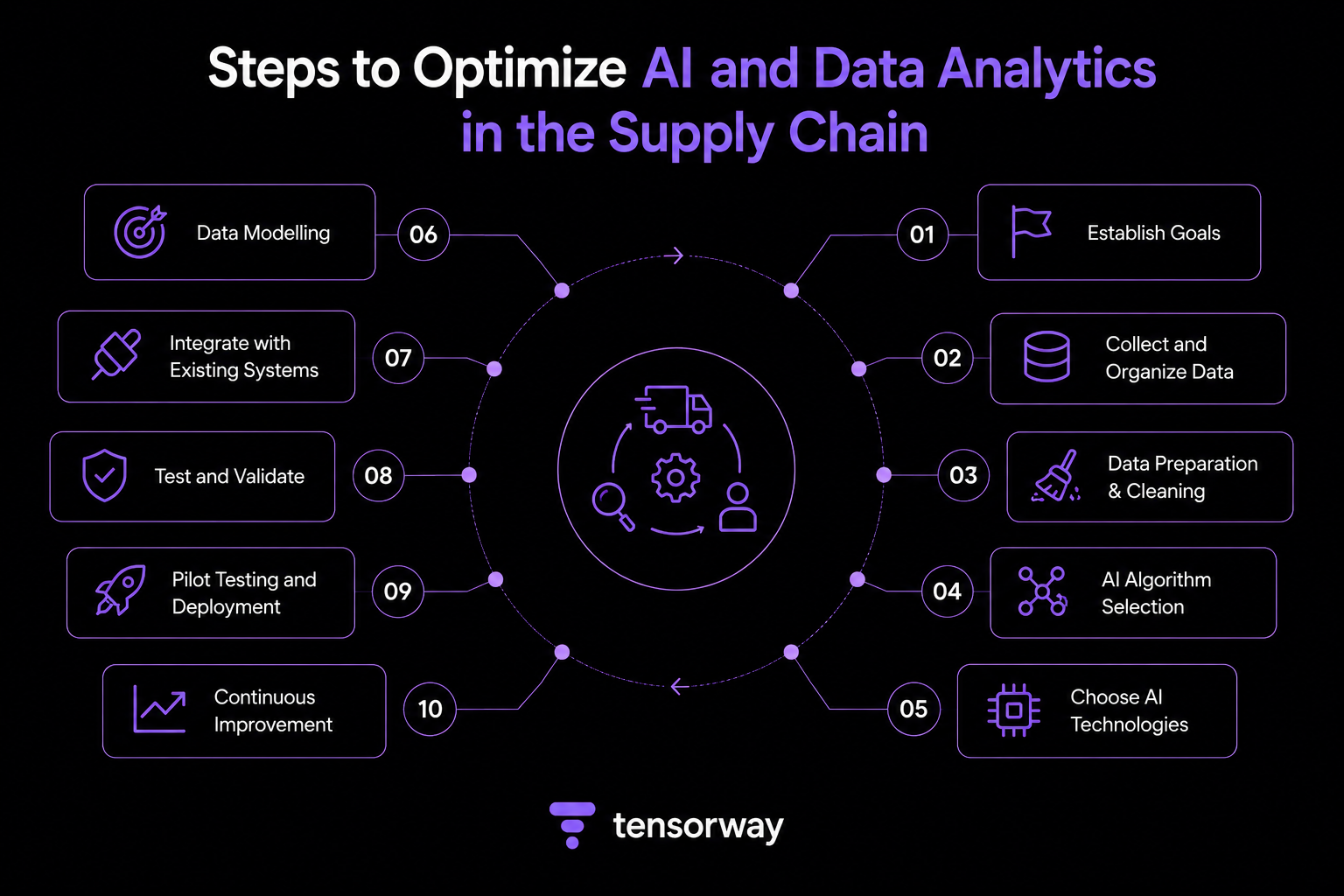
The system feeds this operational telemetry directly into the demand forecasting model. It immediately computes the downstream production impact for high-margin hardware lines. After that, the software autonomously recalibrates factory assembly schedules to match component availability and shifts manufacturing priority to assemblies that use stable in-house inventory.
The system immediately updates the shipping routes to protect the remaining inventory. It spots a massive backup at the main cargo port and instantly redirects two incoming ships to an open port nearby. Purchasing, factory scheduling, and shipping are all linked together. That’s why this synchronized data loop is crucial for eliminating production downtime.
Conclusion
Supply chain disruptions are unavoidable. Extreme weather, geopolitical tensions, and transportation delays will continue to impact global trade. What matters is how quickly companies detect and respond to these events.
Companies that rely on spreadsheets and manual reporting often operate with information that is already hours or even days old. AI supply chain systems continuously monitor operations in real time. As a result, they significantly reduce delays in decision-making and enable teams to respond before disruptions escalate. This helps businesses protect production schedules and minimize costly supply chain interruptions.
To generate useful insights and actions, AI solutions must be tailored to the realities of your day-to-day supply chain operations. That’s why a lot of organizations today turn to flexible custom systems instead of off-the-shelf tools. If you are looking for a reliable tech partner for such a project, at Tensorway, we are always open to cooperation. With multi-year experience in building AI agents and complex AI systems, our team will help you overcome your operational bottlenecks. Contact us to learn more.


.jpg)