
TL;DR
- Build is the right choice when AI is part of your core product when you need full customization when you have proprietary data or strict requirements for data sovereignty and compliance It is expensive takes around six to twelve months and requires an MLOps team as well as ongoing maintenance.
- Buy is suitable when AI is used as a utility such as chatbots document processing or basic recommendations when you need a fast launch and low upfront cost The downsides include vendor lock in limited customization and dependence on external APIs pricing and roadmaps.
- A hybrid approach is often the most effective combining ready made AI tools with custom data logic or components.
- Key decision factors include the business role of AI technical capacity budget total cost of ownership time to market and data and regulatory requirements.
The wrong AI deployment path can cost you a lot of time and money. You have understood that you need machine learning to process data and handle logic. And here, you need to make up your mind on build vs buy AI agents and other AI-driven tools.
When your team builds a solution from scratch, this can lead to a lot of extra expenses related to infrastructure setup and model training. At the same time, just buying an off-the-shelf tool may lead to vendor lock-in and limit your architecture.
Our guide will help you audit your infrastructure constraints. We will map the exact triggers for when to develop a custom solution and when to use a standard SaaS platform.
What Is the Best AI Implementation Strategy? Quick Overview
The table below contains the key parameters you should consider when choosing an AI implementation strategy for your business.
There is also a middle path for those who are not ready to build an AI solution on their own and don’t want to buy a ready-made one. In this case, you can partner with an AI development company. Such firms have the required expertise and can take full responsibility for all the related tech tasks.
What Should I Consider Before Choosing to Build vs Buy AI?
You must audit your technical reality before making your choice of the AI adoption way. We suggest starting with analyzing the five constraints for your AI initiatives.

Business Strategy and Market Positioning
If you plan to make AI logic one of the primary revenue generators, licensing a third-party model can destroy your approach. Market differentiation is impossible when your product relies on the same API endpoints as your competitors.
Off-the-shelf platforms are a suitable variant when AI is an operational utility. For instance, it is used to route internal documents or provide answers to employees’ questions.
In those cases, where the AI model is the key product, you need to own it.
Internal Technical Capabilities
You need an active team that will monitor data drift and handle versioning of your custom model after the launch. You can engage your internal department in this project or turn to AI development outsourcing.
The use of a standard solution stays a more appropriate variant, when you are not ready to allocate your resources to maintaining a custom model.
Total Cost of Ownership and Budget
Custom development traditionally requires high initial investments, especially in enterprise AI adoption projects. Meanwhile, long-term operational costs typically exceed the original expenses. You must take into account the raw compute and engineering hours needed for maintenance and compare them against the compounding subscription fees and API token limits of a vendor. Professional AI consultants can help you make the right calculations.
Time to Market
When you prefer licensing a pre-built platform, your application goes live in 4 to 8 weeks. This is much faster than the custom development typically takes. A development team usually needs 6 to 12 months to build a solution tailored to your requirements. This process includes numerous steps:
- Raw data pipeline audits;
- data labeling;
- model training cycles;
- QA and testing.
If you need an immediate operational fix, development from scratch can be a barrier to achieving your business goals.
Data Sovereignty and Compliance
Regulated sectors like finance and healthcare demand absolute control over data pipelines. Meanwhile, when sensitive data is sent to external servers, security risks grow.
Don’t forget that regulatory compliance requires strict data sovereignty. You must build and deploy a localized solution to keep data within your own perimeter.
When Does It Make Sense to Build Custom AI Solutions for Business?
There are several scenarios when it is recommended to build a custom AI product, instead of relying on off-the-shelf products.
- You position AI as your competitive edge. In this case, you can’t rely on the same tools that your competitors can access as well.
- You possess proprietary data. When you hold decades of niche telemetry or unique user logs, generic models can’t extract their true value. You need a tailored architecture to leverage a dataset.
- Compliance requires data sovereignty. In highly regulated sectors, sending data through an external API creates unacceptable legal exposure.
- Standard tools fail your domain logic. The market does not always offer a tool for your exact workflow.
The build vs buy AI dilemma also includes the consideration of potential hidden costs.
For example, while planning your budget for a development project, you should take into account long-term MLOps and infrastructure maintenance. These expenses can significantly multiply your budget. As one of the Reddit users explained, “It really depends on the complexity and tech stack of the app, but a common rule of thumb is to budget 10-20% of the initial development cost for annual maintenance.”
Another point is the investments in scaling and optimizing models. The requirements and inputs change over time. Owners of AI solutions for business are responsible for monitoring their performance and model retraining.
When Is It Better to Buy an AI Solution?
Sometimes businesses can’t wait nine months to train a custom model. Licensing existing software or APIs is the correct architectural choice in several scenarios.
For instance, when your use case is commoditized (chatbots, document processing, semantic search, basic recommendations, etc.), it can be feasible to leverage off-the-shelf solutions.
Moreover, if you need to validate the business case first and test user engagement, immediate investments in custom development can be excessive.
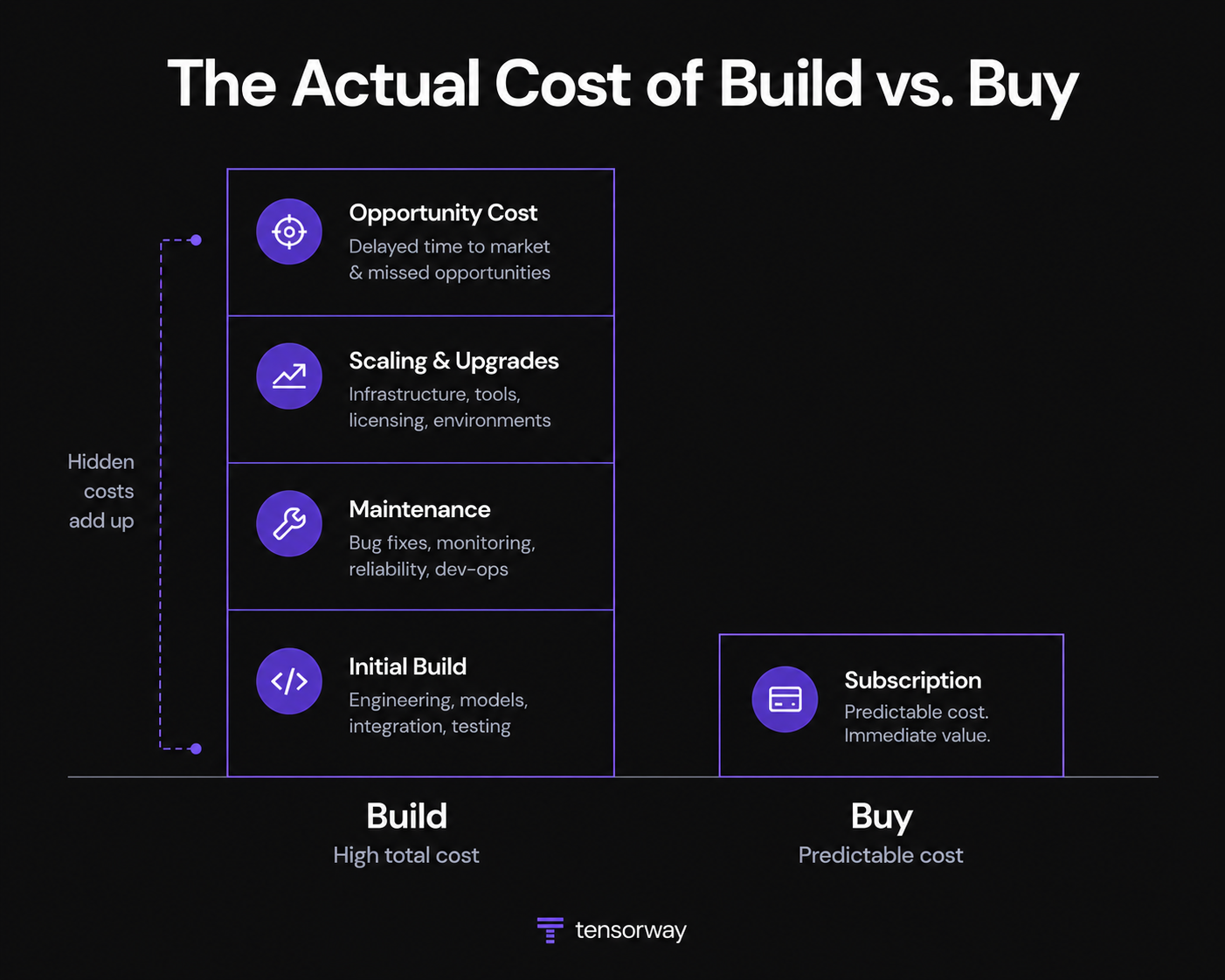
The decision to buy standard software can significantly facilitate the tasks related to its maintenance and model re-training. However, it still brings some risks that you should stay aware of.
- Vendor lock-in. If you decide to migrate to a proprietary platform, it will be necessary to re-engineer your entire data pipeline.
- Pricing volatility. Changing API usage costs can lead to a significant increase in your expenses.
- Feature gaps. With a ready-made solution, you are constrained by the vendor's roadmap. A standard platform may lack the functionality required for your workflows.
- Privacy tradeoffs. You lose absolute sovereignty when your data reaches external servers.
How Do I Decide? Simple Build vs. Buy AI Framework
We recommend running your project through our diagnostic checklist to facilitate decision-making. Your answers will immediately clarify whether you need to invest your resources into a custom build or license a standard solution.
1. Does this AI logic directly generate primary revenue?
If the algorithm constitutes your core product, you must build. When it simply automates an operational utility, it will be enough to buy.
2. Can you fund and retain an MLOps team for three or more years?
If you can’t commit to maintaining dedicated infrastructure talent long-term, it’s better to buy a solution and rely on a vendor.
3. Can your business wait six to twelve months to go live?
Custom solutions require extensive data pipeline preparation and training cycles. When you need a functional solution as soon as possible to capture market share, purchase an existing platform.
4. Does compliance mandate absolute data sovereignty?
If compliance frameworks require strict geographical ring-fencing, you must engineer localized pipelines to keep data within your perimeter.
5. Can a development partner eliminate your infrastructure risk?
If you need custom architecture but lack internal machine learning specialists, outsourcing to a development partner will help you avoid the hiring bottleneck.
Which AI Approach Is Right for My Business Use Case?
The right approach depends on the peculiarities of your project. There can’t be a universal recommendation for those who want to implement an AI agent and those who are planning to introduce a system for predictive maintenance.
Based on our practical experience in custom AI solution audit and development, we can define common use cases when building or buying a tool looks like a preferable option.
Final Word: Build or Buy AI Solutions?
The build vs buy AI decision can be rather tricky. But quite often (especially in complex implementations), you don’t have to choose between the high cost of building your own AI and the limitations of buying a ready-made product.
The most effective strategy is often a hybrid. In this case, you can take existing AI tools and train them strictly on your unique business data to ensure higher efficiency.
If you need a reliable tech partner to support you during your AI implementation journey, at Tensorway, we are always ready to help. Our experienced AI consultants offer the best approach based on your needs and business model. Share your requirements with us!

.jpg)