.jpg)
In a 2025 Gartner survey, 45% of marketing technology leaders said existing off-the-shelf AI agents failed to meet expectations for business performance. At the same time, 89% of experts piloting AI agent initiatives expect significant business benefits. Moreover, according to the survey of IT professionals published by Cloudera in 2025, 96% of enterprises are planning to increase the adoption of AI agents across their workflows within the next 12 months. These statistics demonstrate that the technology itself isn’t the bottleneck. Issues occur when it is deployed without strategic planning and strict alignment with specific business needs.
With the value that agentic AI can bring to industries, the demand for AI agents among companies working in different domains is growing. In our guide, we are going to talk about how to create an AI agent from scratch to automate repetitive tasks and support faster decision-making.
Step 1. Define a Focused Use Case
AI agents work best when focused on a single, well-defined problem. Sometimes businesses try to build a general-purpose agent from day one. However, this approach often leads to higher costs and unpredictable behavior with unclear ROI. Based on our expertise in custom AI agent development, we recommend starting small and focusing narrowly.
Before diving deep into how to make an AI agent, you should formulate why you need to do it. You need to choose a task that is specific and easy to validate. An agent’s job should be formulated in one sentence. If you can't describe the agent's job in one sentence, the use case is probably too broad.
Here are a couple of examples of well-formulated tasks that the agent can perform:
- Web page summarization. Your AI agent can fetch a URL, extract key points from the web page, and produce a concise summary.
- GitHub issues triage. The agent classifies issues by type, priority, and component, then suggests next actions or assigns them to the appropriate team member.
- CSV Q&A assistant. The agent answers natural-language questions using the contents of a CSV file.
While thinking about how to build your own AI agent, you should also analyze whether it will be the right tool in your case. Not every workflow needs an agent. If a task can be handled through a deterministic script or fixed pipeline, that approach is usually more cost-efficient.
An agent is justified only when the problem involves uncertainty or decision paths that cannot be fully specified in advance.
When the task is clear, you should write down the success criteria that you will rely on for testing, monitoring, and optimization. You should think about the following aspects:
- Inputs. What data does the agent receive?
- Outputs. What format should the result take?
- Constraints. What actions and behaviors must the agent avoid?
- Time limits. How fast should responses be?
- Cost limits. What is the maximum acceptable cost per run or per user?
Moreover, at this preparatory stage, you also need to decide on evaluation signals to measure performance effectively. These signs will depend on the exact task of the agent, but as a rule, they include:
- Semantic equivalence. Does the output convey the correct meaning, even if phrased differently?
- Tool-call correctness. Did the agent select appropriate tools and pass valid parameters?
- Latency. How long does the agent take to complete the task?
- Cost. How many tokens or API calls are consumed per run?
- Human rating. How do users score the quality and usefulness of outputs? You can rely on benchmarking methodologies. For example, platforms like LMArena collect pairwise preference votes from real users and rank models using statistical methods such as the Elo rating system or Bradley‑Terry models.
Step 2. Create Agent Architecture
A production-ready AI agent should have a modular structure with clear interfaces. Each module (planning, tool selection, execution, observation, and reflection) should operate independently but communicate through well-defined input and output protocols. This structure lets teams update or replace individual components without disrupting the entire system. Moreover, it makes debugging and monitoring more straightforward.
The core execution loop looks as follows.
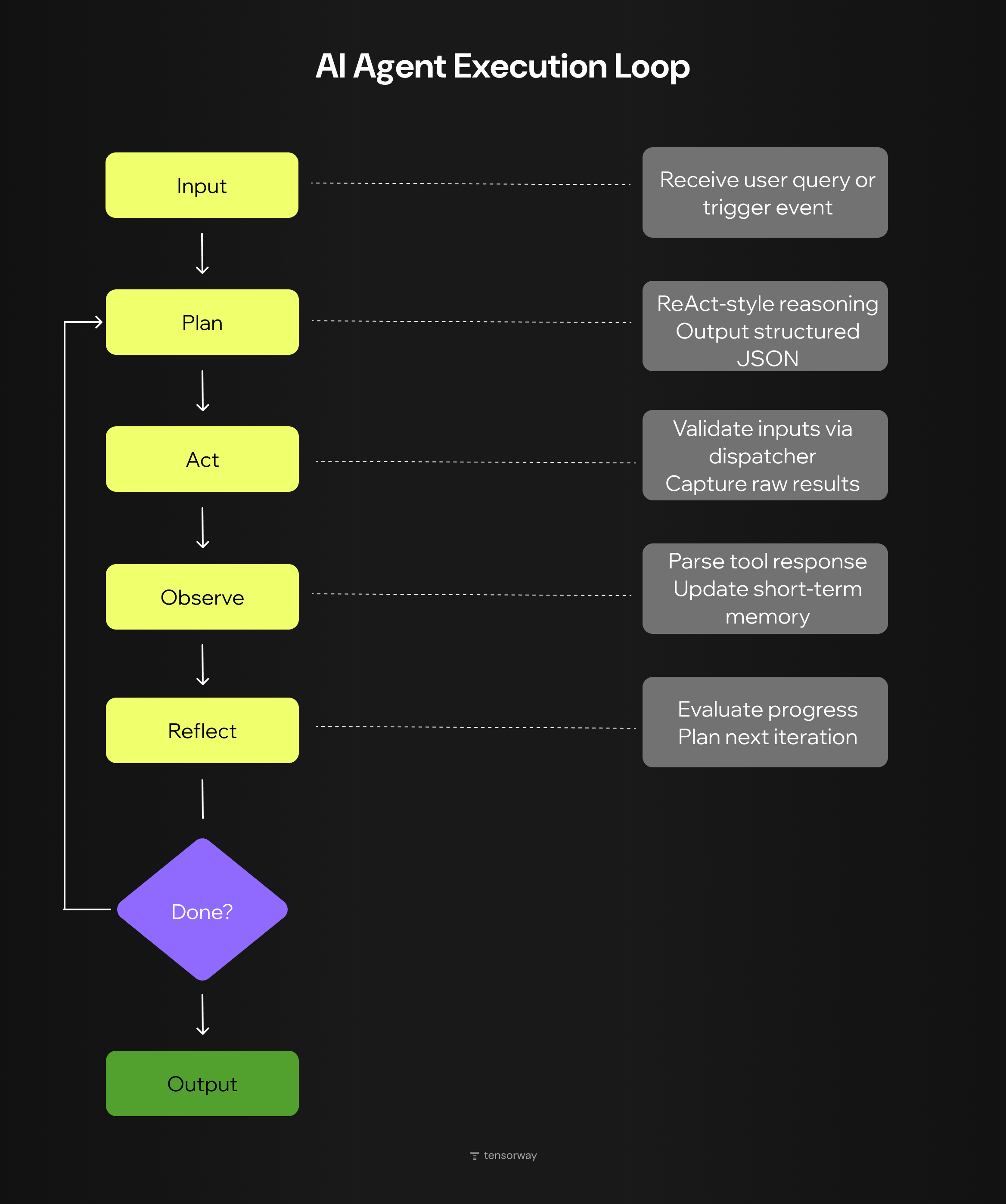
This loop defines how the agent processes inputs, makes decisions, executes actions, and incorporates feedback. Ensure each step of the loop is logged and inspectable. This helps teams diagnose errors and refine behavior over time.
Think about the state and memory design. Memory should be intentionally scoped:
- short-term memory supports active reasoning;
- episodic memory captures recent interactions;
- long-term memory stores durable knowledge.
.png)
Apart from this, introduce control mechanisms. Agents should operate through an explicit tool registry with well-defined schemas. Step limits, timeouts, and budget caps prevent runaway execution and cost overruns.
Step 3. Implement the Minimal Agent Loop
Before introducing individual components, it is important to establish a clear mental model of how a minimal AI agent operates in practice. An effective agent is defined by well-designed contracts between reasoning, tools, and control flow. Each stage of the loop should be explicit and constrained.
The following sections represent core building blocks required to implement a minimal agent loop.
- System prompt and contracts. Start with a system prompt that clearly defines the agent’s role and decision boundaries. Explicitly specify tool usage constraints, indicating when the agent may act and when it must stop.
- Tools, registry, and routing. Each tool should expose a clear interface that should consist of a name, description, JSON input schema, and safety checks. Register tools centrally and route calls through a dispatcher that validates inputs and enforces execution constraints. This separation ensures that the agent never calls tools directly or outside approved boundaries.
- Plan and take steps. In the Plan step, use a ReAct-style reasoning scratchpad that outputs structured JSON describing intent, selected tool, and parameters. The Act step executes the chosen tool with validated inputs and captures results in a standardized JSON format.
- Observe, reflect, and control flow. After execution, the AI agent should summarize outcomes and decide whether to continue or terminate. Reflection should inform the next plan without expanding the scope. For example, if the agent gathers product prices and finds a data source missing, it shouldn’t start a new unrelated data collection process. Instead, it should note the gap, adjust the next query to alternative sources, and proceed.
- Reliability mechanisms. We recommend using JSON mode and schema validation to catch malformed outputs. Implement parse-and-retry logic with bounded retries (e.g., max 3 attempts) and hard guardrails.
Step 4. Train the AI Agent
Most modern AI agents are not trained from scratch. They rely on pre-trained LLMs (GPT-4, Claude, Llama, BERT, Mistral, etc.) combined with prompt engineering and RAG (Retrieval-Augmented Generation). As a result, agents have access to external knowledge bases (documents or the web) and provide up-to-date and accurate outputs.
Fine-tuning and training agents on your own data are time- and resource-consuming processes. But if your project requires this, you need to collect and organize the datasets that the agent will learn from. This may include:
- structured data (tables, numeric datasets, etc.);
- unstructured data (text, images, audio);
- synthetic data (artificially generated data for tasks where real-world data is limited).
The data should reflect real-world conditions and include edge cases. Label and format the data according to the agent’s input requirements.
How to train an AI agent? There are several training methods:
- Supervised learning. The agent learns from labeled examples.
- Reinforcement learning. The agent learns via trial-and-error with rewards or penalties.
- Hybrid approaches. They combine multiple learning paradigms to achieve complex behaviors.
It is recommended to train the agent in cycles and test its performance at each stage.
Step 5. Test, Evaluate, Debug, and Optimize Your AI Agent
Quite often, businesses are too focused on how to build an AI agent from scratch and forget that evaluation and debugging are critical processes that allow moving a solution from prototype to production. Apart from just detecting bugs, you will also need to understand how the agent behaves under real workloads.
Prioritize Logging and Observability
Instrument every step of the agent loop. Structured logs make it possible to trace failures and identify bottlenecks.
You can rely on dedicated observability platforms such as LangSmith or Helicone. They will help visualize agent runs, compare prompt versions, and surface patterns like repeated retries or unsafe tool usage.
These insights are essential to understand how decisions are made and where constraints appear.
Apply Clear Benchmarks and Performance Metrics
Measure task success rate against a fixed evaluation set to ensure that the agent consistently produces correct outcomes. Track latency at each stage of the loop to understand where delays occur. Pay special attention to the planning and tool execution steps. Implement hallucination control. Probe edge cases where the agent is likely to invent facts or misuse tools.
Build User Feedback Loops
Collect feedback directly from users on output quality, clarity, and usefulness. Simple signals such as thumbs-up or thumbs-down can be paired with qualitative comments to guide improvements. Over time, these feedback loops help align agent behavior with real-world expectations and operational requirements.
This feedback should be categorized into structured groups, such as accuracy, completeness, tone, and actionability. High-frequency negative signals should trigger targeted reviews. At the same time, positive feedback can be used to reinforce successful patterns.
How to Create an AI Agent from Scratch: Best Practices
At Tensorway, we focus on building advanced AI solutions, including custom AI agents for businesses working across various domains. We deeply understand the specifics of their development and deployment in real-life environments.
We have compiled a set of best practices to guide teams in creating reliable, efficient, and safe AI agents from scratch.
- Define clear objectives and constraints. Specify the agent’s role and responsibilities. Explicit constraints will help you reduce safety risks and prevent scope creep.
- Choose a modular architecture. This design approach makes debugging and iteration faster.
- Isolate tool execution in sandboxed environments. Maintain a tool registry and a dispatcher to enforce proper usage. Never let agents call external functions directly without validation.
- Introduce the agent loop. Enforce budgets, timeouts, and maximum steps to prevent runaway behavior.
- Evaluate, debug, and iterate. Measure performance with benchmarks (task success rate, latency, hallucination control, etc.) and incorporate user feedback loops. Always implement regression tests and version control.
- Ensure reliability and governance. Start small and gradually expand autonomy as confidence grows. Document failure modes and known limitations. This will help you design efficient safety rules.
Conclusion: How to Build an AI Agent that Will Give You a Competitive Edge
AI agent development services is a multi-stage process that requires preparation and a clear understanding of each step. The main objective is to create an agent with well-defined tasks and behaviors. The simpler its design and processes are in the early stages, the better. This approach allows you to clearly monitor its performance and identify areas for improvement.
Are you looking for a professional team that can support you at any stage of the AI agent development process, or can take the whole responsibility for such a project? At Tensorway, we are always ready to help you. We know how to build an AI agent that will optimize your workflows and align with your organizational goals. Schedule a consultation with our experts to discuss what we can offer you.