
TL;DR
- Agentic AI systems autonomously pursue goals by planning, calling tools, and looping until finished, whereas standard chatbots only provide single answers.
- Every system combines a core reasoning layer with actionable tools and contextual memory to run the classic loop of reasoning and observation formalized by the ReAct framework.
- Successful deployment requires defining clear task boundaries upfront, choosing between single or multi agent architectures, testing tools in isolation, and logging every step before shipping.
- Most production failures stem from structural design rather than the model itself, meaning teams must actively guard against unbounded loops, tool hallucinations, and excessive permissions.
An agentic AI system is software that pursues a goal on its own — planning steps, calling tools, checking results, and adjusting until the job is done. It is not a chatbot, which answers one message and stops, and it is not an RPA bot, which follows a fixed script and breaks the moment reality deviates. An agent decides what to do next based on what just happened.
The reason this matters now is that a single prompt cannot finish real work. Reviewing a contract, sourcing an investment, or resolving a support ticket takes planning, several tool calls, and multi-step reasoning that no one-shot response can deliver. As of 2026, agentic AI systems have moved from research demos into production, and Deloitte named agentic AI one of its defining technology trends for the year .
This guide explains what these systems are, how autonomous decision-making agents work under the hood, how to build AI agents that hold up in production, and where they already deliver value.
What Is an Agentic AI System — And How Is It Different From a Chatbot?
An agentic AI system breaks a goal into steps, calls tools, evaluates the results, and loops until the task is complete — where a chatbot responds once and waits. The difference is action versus answer: a chatbot talks, an agent acts, repeatedly, until it reaches the goal or hits a stopping condition.
Underneath, an agent runs a loop: perception, reasoning, action, observation, then back to reasoning. It takes in the current state, thinks about what to do, performs an action such as a tool call, observes the result, and uses that to decide the next move. This is the pattern the ReAct framework formalized, combining a reasoning trace with actions in a single cycle.
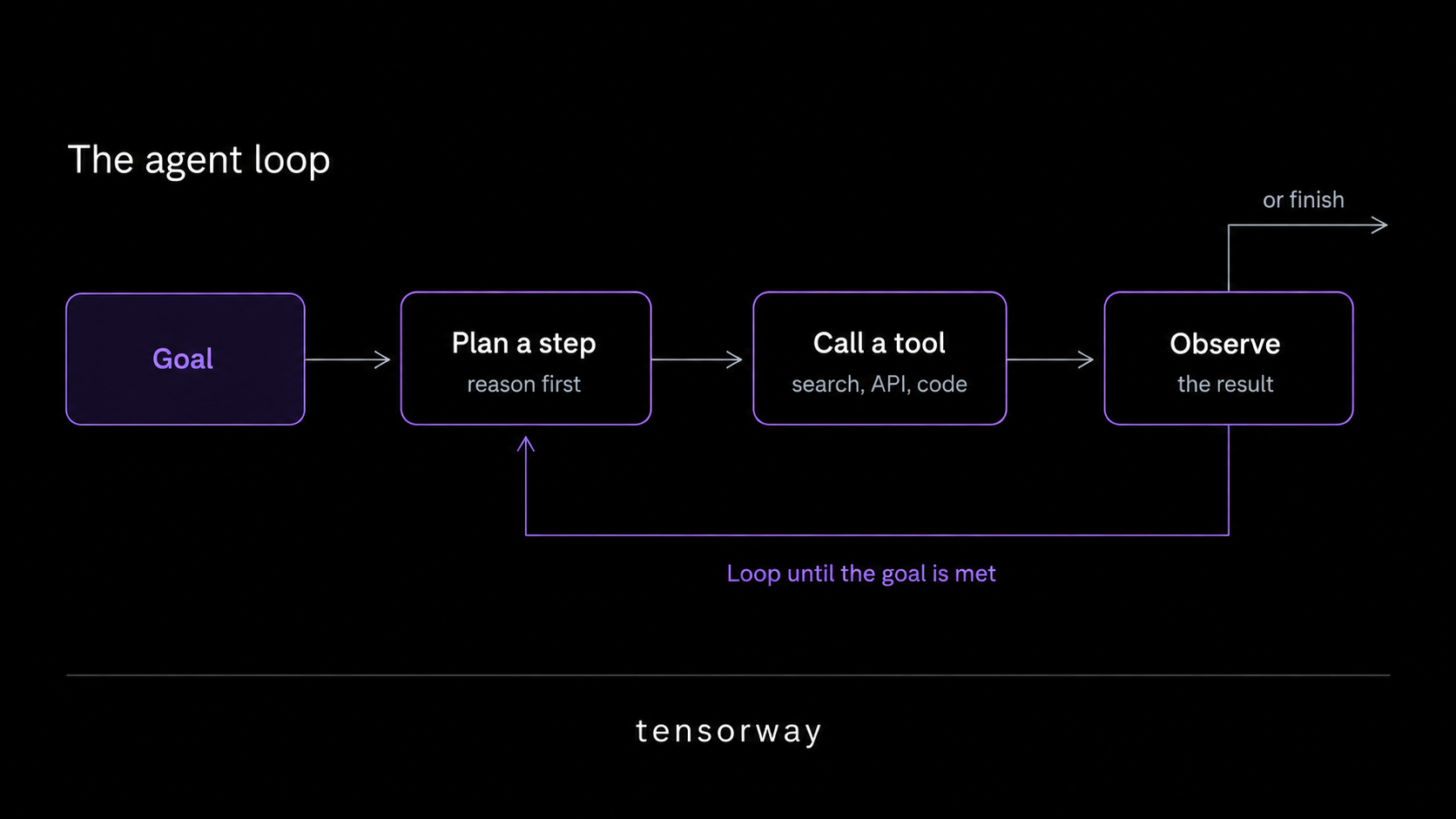
The clearest way to place an agent is against the two things it gets confused with — a chatbot and an RPA bot.
Agentic AI system vs chatbot vs RPA bot
Four properties separate LLM agents from a plain model call. They are goal-directed, working toward an outcome rather than a single reply. They use tools to act on the world. They keep memory across steps. And they reason over multiple steps instead of answering in one. A standard LLM call is one prompt in, one response out. An autonomous AI agent is a loop that keeps going until the work is finished. For a deeper look at what current agents can and cannot do, Tensorway covers agent capabilities in detail.
How Do Autonomous Decision-Making Agents Work Under the Hood?
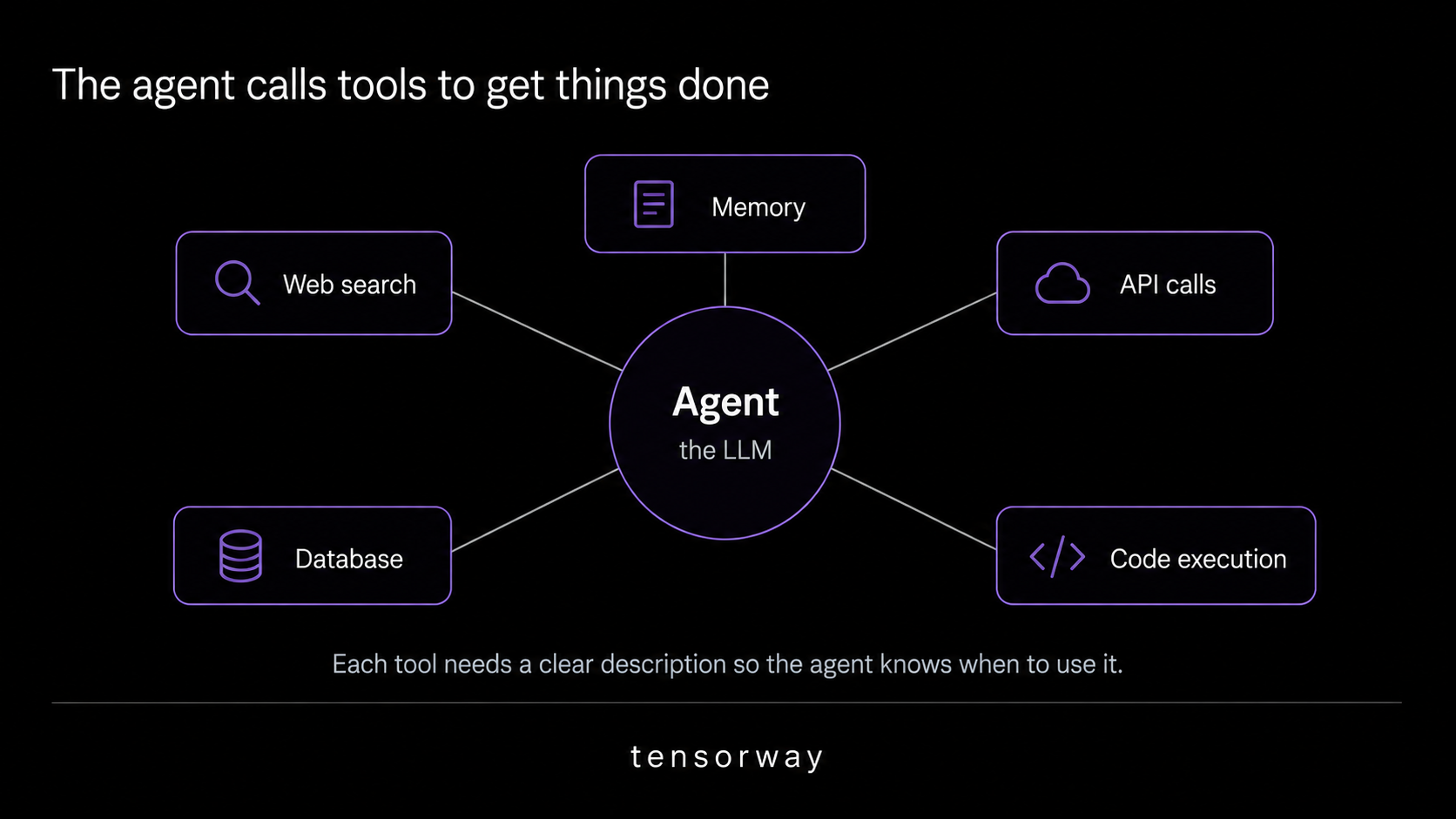
Every agentic system shares three components: a reasoning-and-planning layer, tools to act with, and memory to carry context. Understanding how they fit together is the difference between an agent that works in production and one that stalls on the second step.
Planning, Reasoning, and Tool Use
The agent reasons before it acts, deciding which tool to call and with what parameters before executing anything. This is the ReAct pattern in practice: a thought precedes each action, so the agent can weigh the last result and choose the next step rather than firing blindly. Chain-of-thought reasoning is what lets it plan across a task instead of reacting one move at a time.
Tools are the agent's hands. Web search, code execution, database reads, and API calls are what let it affect the world beyond generating text, and the quality of each tool's description largely determines whether the model calls it correctly. Anthropic found that when building its own agents, it spent more time refining tool definitions than the overall prompt, and treating the agent-computer interface with the same care as a human interface is what makes tool use reliable.
There is a choice between single-agent and multi-agent designs. A single agent handles the whole task in one loop, which is simpler and easier to debug. A multi-agent setup has a planner delegating to specialists, which suits parallel workstreams but adds coordination overhead. The common AI agent frameworks for building both are LangGraph and AutoGen for Python and CrewAI for role-based teams, and the right AI agent architecture depends on whether your task is one stream of work or several. Tensorway has written more on choosing between LLM frameworks across industries.
Single-agent vs multi-agent architecture
Memory
Memory is how an agent carries context, and it comes in two forms. In-context memory is the conversation window itself — everything the model can see in the current prompt. External memory stores information outside that window, usually in a vector store the agent queries when it needs something, which is the retrieval-augmented generation (RAG) pattern. RAG is the standard approach for large knowledge bases that will never fit in a context window. Start with in-context memory and reach for a vector store only when you actually outgrow it.
How Do You Build an Agentic AI System?
Start by defining the task boundary — the exact goal, the inputs, and the required outputs — before you pick a single tool or framework. Most failed agent projects skip this and build a clever loop around a problem nobody scoped. Naming the boundary first tells you whether you even need an agent, since many predictable tasks are better served by a fixed agentic workflow than by full autonomy.
Then choose an architecture that matches the task. A single-agent ReAct loop fits a self-contained job; a multi-agent setup fits parallel workstreams. For the stack, LangChain and LangGraph are the common choice in Python, and the Vercel AI SDK in TypeScript. The point is to match the tool to the shape of the work, not to reach for the most complex option available.
Build and test each tool in isolation before wiring it to the agent. This is the most failure-prone part of the whole system, because a tool that returns malformed data or misreads a parameter will derail the agent's reasoning downstream. Get each tool returning clean, predictable output on its own first.
Add memory only when you need it. Start in-context, and add a vector store only when context overflow becomes a real problem rather than a hypothetical one. Practitioners writing about agent engineering consistently name over-building memory and retrieval too early as one of the most common mistakes, advising teams to prove the core task works before layering on complexity.
Add observability before you ship. Log every tool call and every reasoning step, because when an agent misbehaves you need to see what it decided and why. LangSmith and Arize Phoenix are the standard options as of 2026, and skipping this step turns every production bug into guesswork. This is also where AI orchestration and monitoring meet — you cannot orchestrate what you cannot observe.
What Are the Real-World Agentic AI Use Cases That Already Work?
The strongest agentic AI use cases in production today are legal review, financial deal sourcing, IT ticket triage, and customer support — tasks that combine reasoning with repeated action. These are among the clearest agentic ai examples of agents earning their cost rather than demoing well.
In legal and contract review, an agent ingests a contract, flags non-standard clauses against a policy database, and returns a risk summary with citations to the exact clauses. It turns a slow manual read into a first-pass review a lawyer can verify, and it is one of the use cases Tensorway builds through its AI agents service.
In financial deal sourcing, an agent scrapes filings and news, filters against investment criteria, and produces a scored shortlist in minutes rather than the analyst-days the same work takes by hand. The agent does not make the decision; it compresses the search so a human spends time only on the candidates worth reviewing.
In IT ticket triage, an agent classifies incoming tickets, retrieves resolution steps, auto-resolves what it safely can, and escalates the rest. Practitioners on Reddit's r/sysadmin have documented real deployments alongside honest failure points, which is worth reading before you assume every ticket can be automated. In customer support, a first-tier agent handles common queries while a routing agent escalates edge cases to a human with a pre-populated context summary, so nobody starts a hard case from scratch.
What Are the Biggest Risks When Deploying Autonomous Agents?
The most common failures with autonomous AI agents are architecture failures, not model failures — the model is usually working fine while the system around it lets it go wrong. Getting the guardrails right matters more than picking the smartest model.
Tool hallucination is the first: an agent calls a tool with wrong or invented parameters. Strict input schemas and output validation catch most of it before the bad call executes. Unbounded loops are the second — an agent stuck on an unresolvable step will retry forever, so a maximum-step ceiling is non-negotiable, a control Anthropic recommends as a standard stopping condition.
Permissions scope is the third and most dangerous. An agent with write access to a database or an email account can cause real damage from a single bad decision, so grant minimum permissions only. Prompt injection is the fourth and fastest-growing: malicious content hidden in a tool's output can redirect the agent, a risk that climbs as agents read from more external sources. Tensorway covers these in more depth in its guide to AI agent security and governance.
Conclusion
Agentic AI systems deliver value only on tasks requiring planning, tool use, and multi step reasoning instead of simple prompts or fixed workflows. Succeeding in production means defining clear task boundaries, testing tools in isolation, and building guardrails as core features rather than late additions. In 2026 the engineering teams getting real ROI from agents keep the design simple and the scope realistic because the toughest hurdles are purely architectural.