%20(1).jpg)
TL;DR
- AI pilots fail after the demo because the sandbox skips what production needs: clean data, ownership, integration, governance. The model is rarely the problem.
- According to recent research from the RAND Corporation, the vast majority of AI initiatives never succeed, while a separate study from MIT reveals that nearly all generative AI pilots fail to deliver any measurable impact.
- These failures usually stem from a few critical problems, such as poor data quality, a lack of clear ownership, and focusing on technical accuracy rather than financial returns. The situation often worsens when companies get trapped by vendor lock-in or neglect the human side of change management altogether.
- Teams that ship start from one real business problem, fund data first, and give one person ownership of the launch date.
AI projects fail after the pilot stage because the pilot was engineered to skip everything that makes production hard, and then production asks for all of it at once. A pilot runs on a hand-cleaned dataset, a small team that cares, security exceptions, and a definition of success that stops at a good demo. Production runs on messy data spread across a dozen systems, a compliance review that won't be waived, real user load, and a finance lead who wants the saving in dollars rather than F1 score. The model usually survives that transition. The scaffolding around it does not.
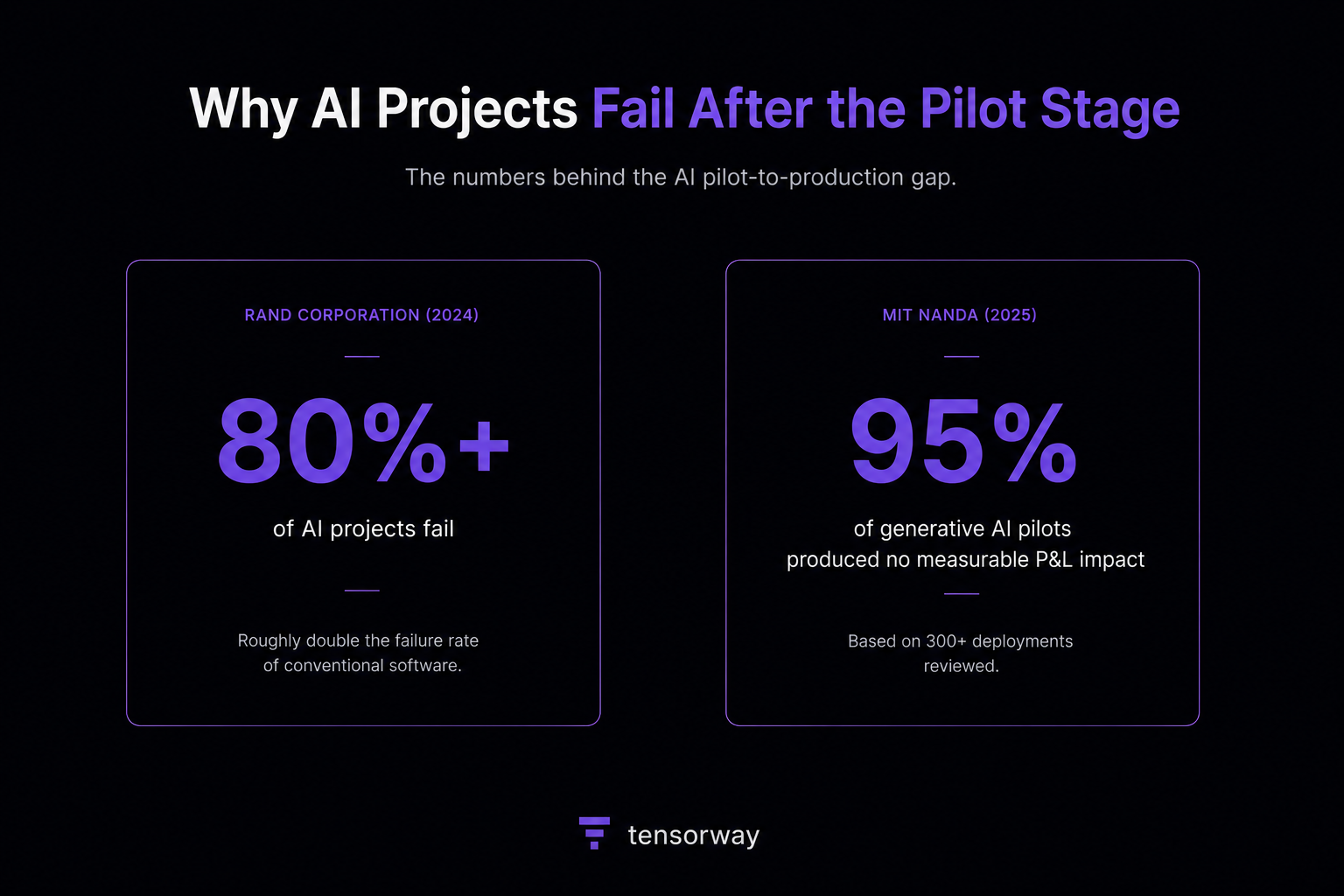
The figures behind this are not subtle. Recent data from the RAND Corporation shows that over 80 percent of AI projects collapse, which is roughly double the failure rate seen in traditional software development. This insight comes from a study where researchers interviewed 65 experienced data scientists and engineers to understand exactly why their initiatives lost momentum. MIT's State of AI in Business 2025 study, run through the Media Lab's Project NANDA, reviewed more than 300 deployments and found that 95% of generative AI pilots produced no measurable P&L impact.
This piece walks through why these pilots stall, what the surviving few do differently, and where to intervene before you've spent a year and a seven-figure budget on something that ends up as a forgotten Notion page. We deal with this exact transition on client projects, and the pattern below is drawn from that work as much as from the research.
A quick map of where pilots die
It helps to look at the most common AI adoption barriers alongside the actual data behind them, which can serve as a practical way to evaluate why your own initiative might have slowed down.
Each row is unpacked below. If you only fix one, the data points to ownership and data readiness first, but most stalled projects are tripping over two or three at once.
What is the pilot-to-production gap in AI?
The pilot-to-production gap is the distance between an AI system that works in a controlled demo and one that holds up inside a live enterprise, and it's the single most common place AI initiatives die.
The trap is built into the pilot's design. A sandbox exists precisely so the team can ignore authentication, schema mismatches, audit logging, rate limits, and cost ceilings. The pilot looks like a triumph because it was allowed to. Then a leader asks for a launch date, and every deferred problem arrives at once. The team discovers that the integration work outweighs the modeling work it spent months on.
This is not a new lesson. The same gap quietly killed most enterprise machine learning a decade ago. Teams often build highly accurate models and celebrate a successful initial demonstration, only to find that integrating that model into live production systems takes far longer than the actual development phase, assuming the project ever ships at all. We mapped that full progression in our guide to the ML development lifecycle, and the takeaway holds today. Deployment is the project. Treating it as an afterthought is how the gap forms.
Why do AI pilots fail to scale? The five reasons that keep recurring
AI pilots fail to scale because organizations run them as technology experiments when they're really operating-model tests. The model is close to incidental. These are the patterns, the actual ai implementation challenges, that come up again and again across deployments.
1. The data plumbing was never laid
Data readiness, not model accuracy, is one of the strongest predictors of whether a pilot scales. RAND's interviews found data problems to be the second most common root cause of failure, with 30 of 50 engineers flagging persistent data quality issues, and one summing it up bluntly as "80% of AI is the dirty work of data engineering".
The mechanism is mundane and brutal. The pilot runs on a curated extract that exists nowhere in the live business. Moving to production exposes serious data issues because schemas begin to diverge between systems, mandatory fields suddenly appear empty, and data quality fluctuates across different business units in ways that clean training samples never predicted. Consequently, a model that performed exceptionally well during testing can easily fail when facing real-world complexity. Teams that ship tend to invert the usual budget, spending the majority of the timeline on extraction, normalization, governance, and quality monitoring before anyone fine-tunes a model. Most of what gets blamed on "the AI" is data debt in a disguise.
2. Nobody actually owns the launch date
A pilot with five executive sponsors has zero owners. RAND identified leadership and communication failures as the single most common reason AI projects fail, ahead of any technical cause. A steering committee is not ownership. True ownership requires a single person who is responsible for the actual launch date rather than just the initial demonstration, possessing the authority to make critical trade-offs independently. When an AI project remains confined within the data science team, it inevitably stalls when it finally encounters the necessary legal, security, and operational approval processes.
3. Success was measured in the wrong currency
Many pilots are scored on accuracy, precision, or hallucination rate. That is useful for building a model and useless in a budget meeting. Executives release production money against revenue, cost reduction, or risk. Present "94% accuracy" with no dollar translation and the funding stalls precisely where operational spend becomes necessary. The fix is a discipline shift. Define pilot success as reaching production and creating measurable value, set before the pilot starts. That one change reshapes how the whole thing gets designed and what data you bother collecting.
4. Architecture lock-in
Teams reach for a single-vendor, proprietary stack because it's the fastest route to a working demo. Every subsequent system they connect makes that rigidity more expensive, and these ai integration challenges compound quietly. MIT's NANDA report found that the systems which scaled shared a different trait, deep customization and integration into existing workflows rather than a bolt-on tool. Companies that successfully scale their operations usually rely on a model-agnostic infrastructure layer that routes tasks across different systems, ensuring that switching to a new model does not require rebuilding the entire integration from scratch.
5. Build-it-and-they-will-come
Even a highly accurate model will ultimately be abandoned if the people using it do not trust its outputs. MIT found that generic tools stall in enterprise use because they don't learn from or adapt to the workflow, so users who happily rely on them at home quietly reject them at work. Without serious AI change management and front-line champions, even a technically excellent system dies in silence. This is the AI adoption challenges problem engineers most often underestimate, because it has nothing to do with engineering.
What do engineers and operators actually say about AI pilot failure?
They say the demos work and the production systems don't, and the gap between those two states is wider than any slide deck admits.
The view from the people doing the work is worth more than the boardroom summary, because it keeps the specifics that polished reporting tends to stand off.
On Reddit, frustration has curdled into dark humor. In a widely shared thread on r/artificial reacting to the MIT report, one commenter compared trusting an LLM without proper grounding to asking a toddler to fetch a drink from the fridge. Sometimes a soda, sometimes water, sometimes a jar of mayonnaise. It reads as a joke until you picture it inside a finance workflow where a CFO needs the same answer to the same question twice in a row.
There's a counter-current worth respecting too. Plenty of practitioners with years in enterprise IT push back on the doom framing, arguing that of course most pilots fail, that's literally what pilots are for, and enterprise tech has always worked by killing most experiments cheaply. Both things are true. A high pilot-kill rate is healthy if it's deliberate and cheap, and a disaster if you're discovering the failures only after a year of carrying cost. The distinction is whether you designed the kill switch up front.
How do you move an AI project from pilot to production?
You move from pilot to production by designing for production before the pilot starts, not after it succeeds. The route isn't a multi-year transformation programme. It's a handful of decisions made early enough to matter. Here is where the surviving projects put their effort.
Start from the business pain, not the model. The strongest predictor of success is opening with a process bottleneck that already costs real money, then quantifying it. MIT's data backs this up. The companies that won with generative AI picked a single pain point, executed against it, and partnered with people who knew how to ship, rather than launching ten shallow experiments at once (Fortune, 2025).
Run a conversion audit. Ask a single uncomfortable question. Of the AI pilots you've run in the last 24 months, what share reached production? For the ones that stalled, write down exactly where and why. The answer almost always traces to one of three things, fragmented data, vendor lock-in, or success metrics divorced from business outcomes.
Set your infrastructure non-negotiables up front. Before the next pilot begins, decide whether it can run on a model-agnostic layer, real-time data integration across systems, governance with audit logs, and a feedback loop where human corrections flow back into the system. Governance bolted on after launch is how regulated industries end up stuck in compliance limbo for months.
Don't go it alone if the odds say otherwise. MIT's NANDA study found that pilots blending internal specialists with outside expertise reached production far more reliably than IT-only builds (MIT NANDA, 2025). That isn't a pitch for outsourcing everything. It's evidence that scaling AI is a different skill set from building a demo, and teams that have already made the production mistakes carry that knowledge in. We've written about what this looks like inside a tightly regulated domain in our breakdown of AI automation in financial services, where the compliance and data constraints are exactly the things that ambush unprepared pilots.
Finally, treat the deployment as a living product. Assign a product manager. Write explicit service-level objectives, such as summary accuracy above 85% and latency under five seconds, 95% of the time. Budget for version 1.1 before 1.0 ships, because the project nobody volunteers to maintain is the project that quietly dies.
The takeaways
Three habits separate the projects that ship. They begin from a quantified business problem and can state, in money, the cost of leaving it unsolved. They spend disproportionately on trustworthy, integrated data and build governance in from day one rather than retrofitting it. And they hand one person genuine ownership of the production date, with success measured in dollars saved or earned rather than benchmark scores.
If your initiative is stranded somewhere between an impressive demo and a system nobody will sign off on, the bottleneck is usually one of those three. Find which one, data, ownership, or metrics, is your hidden constraint, and you'll generally find the stall sitting right next to it.

.jpg)