
TL;DR
- MCP is an open standard from Anthropic (November 2024) that connects an AI model to external tools and data through one interface, turning an M×N integration problem into M+N.
- Architecture has three parts: host, client, and server. The server exposes tools, resources, and prompts, and runs locally or remotely.
- Most useful MCP servers: filesystem, GitHub/Git, a database (Postgres), browser automation (Puppeteer), and Slack. Connect only the ones your agent needs.
- Most major frameworks support MCP: Claude Agent SDK (native), LangGraph, OpenAI Agents SDK, CrewAI, PydanticAI. MCP is not a framework and does not compete with one.
- Add security and governance from the first connection. Many teams run in-house MCP servers to limit exposure.
The best MCP tools for ai agents in 2026 are not a single product but a stack: the Model Context Protocol itself, a handful of widely used MCP servers (filesystem, GitHub, databases, browser automation), and the agent frameworks that speak the protocol natively. If you are building an agent today, the practical question is not which MCP tool to buy, but which servers to connect and which framework to wire them into.
This guide covers all three layers, grounded in primary sources rather than vendor marketing. It is aimed at developers comparing agentic ai tools who want to know which parts of the MCP stack are worth adopting first. A quick note on scope: MCP is barely more than a year old, so anything you read about it ages fast. Where a claim is time-sensitive, it is dated so you can judge how fresh it still is.
What is the Model Context Protocol, and why does it matter for AI agents?
The model context protocol ai standard is an open specification that lets an AI model connect to external tools and data through one consistent interface. Anthropic introduced it on November 25, 2024, and open-sourced the spec along with Python and TypeScript SDKs.
The problem it solves is integration sprawl. Before MCP, connecting M different AI applications to N different data sources meant writing close to M times N custom connectors. MCP turns that into an M plus N problem: implement the protocol once on each side, and any compliant agent can talk to any compliant tool. The common shorthand for this is a USB-C port for AI, since one standard interface replaces a drawer full of bespoke adapters.
Two things signal how serious this has become. As of 2026, Microsoft documents MCP as a first-class way to build agents on Azure, describing servers that expose tools, resources, and prompts to an agent. And in December 2025, Anthropic donated MCP to the newly formed Agentic AI Foundation, moving it from a single company's project toward a vendor-neutral standard.
For a step-by-step build walkthrough, Tensorway's guide on how to create an AI agent is a useful companion to the conceptual picture here.
How does MCP fit into the architecture of an AI agent?
MCP works through three parts: a host, a client, and a server. The host is the application the user interacts with, such as a desktop chat app or an IDE. Inside the host sits the agent component, which holds the AI intelligence, and the MCP client, which manages the connection to servers.
The server is where the useful work lives. An MCP server exposes a set of tools (actions the agent can call), resources (data it can read), and prompts, and it can run locally on your machine or remotely in the cloud. The agent does not need to know how a server works internally. It discovers what the server offers and calls it through the same protocol every time.
This matters for MCP AI agents specifically because it decouples reasoning from integration. You can swap the underlying model, or add a new data source, without rewriting how the agent talks to its tools.
What are the best MCP servers to use when building AI agents?
The most useful MCP servers for most agents are the ones Anthropic shipped first and the community has leaned on ever since: filesystem, GitHub, Git, Slack, Postgres, and browser automation. Anthropic released pre-built servers for popular enterprise systems including Google Drive, Slack, GitHub, Git, Postgres, and Puppeteer at launch.
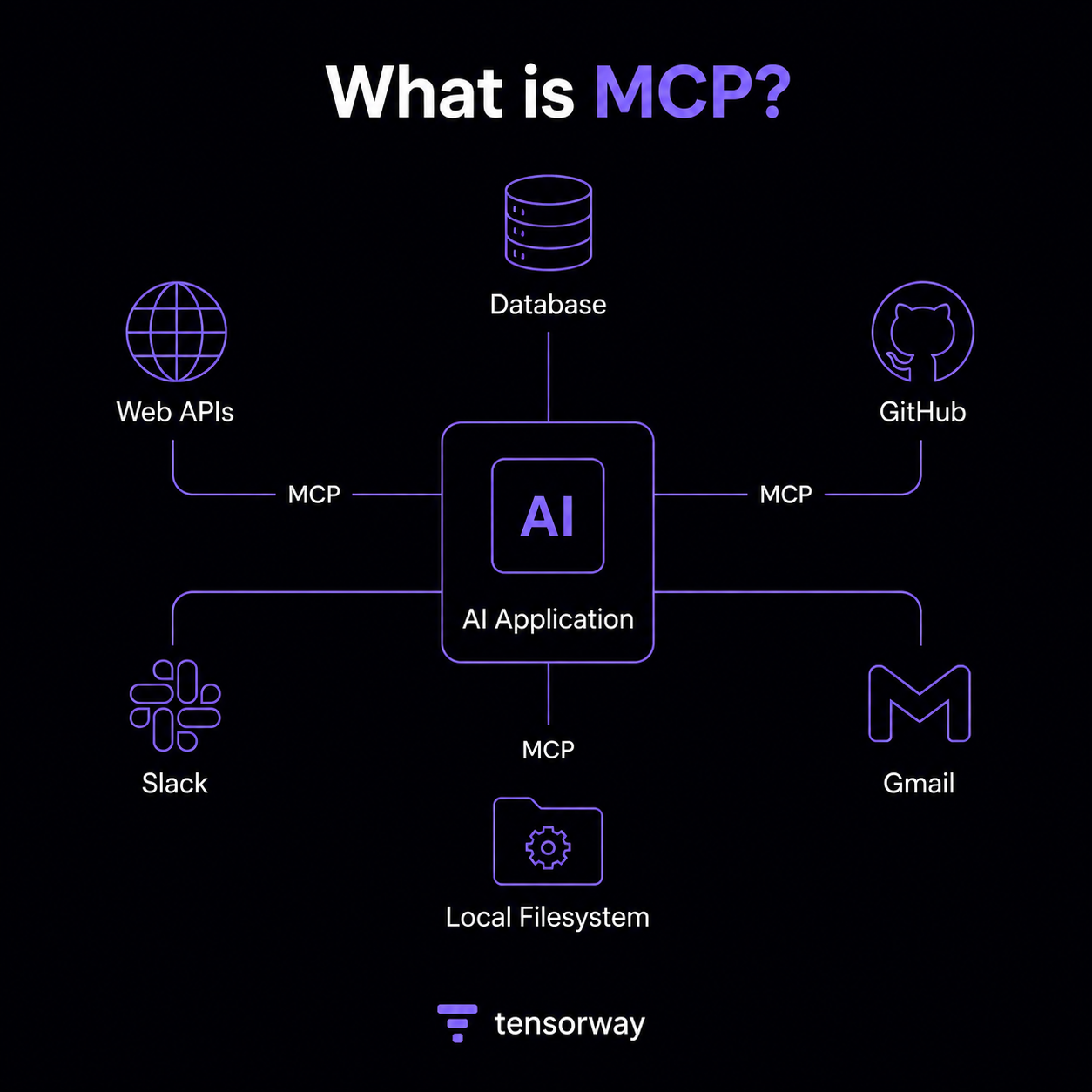
Which ones you actually need depends on what the agent does. A few patterns hold up across projects:
- Filesystem and Git or GitHub. The baseline for any coding or research agent. The filesystem server lets the agent read and write local files; the GitHub server lets it work with repositories, issues, and pull requests.
- A database server such as Postgres. Needed whenever the agent must query structured business data rather than guess from training memory.
- Browser automation (Puppeteer or similar). For agents that test web apps, scrape live pages, or fill forms.
- Slack or a messaging server. For agents that report results or take instructions inside a team's existing tools.
Developer communities back this up. A 2025 round-up that analyzed more than 1,000 developer experiences across Reddit communities including r/mcp, r/ClaudeAI, and r/cursor found that the filesystem server is treated as close to mandatory, with one r/mcp user summarizing their daily kit as filesystem, desktop-commander, a search server, and a memory server. The same write-up flagged a recurring pain point: developers reported losing hours each week to AI suggestions built on stale context, which is exactly the gap a live filesystem or docs server closes.
Which AI agent frameworks support MCP?
Most of the best AI agent frameworks now support MCP, either natively or through a community integration, so the protocol does not lock you into one toolkit. The point worth internalizing first: MCP is not a framework and does not compete with one. It handles how an agent reaches tools, while the framework handles how the agent reasons, plans, and coordinates. You use them together.
Here is where the main AI agent frameworks and AI agent development tools stand as of mid-2026, based on published comparisons and release notes.
A note on the wider trend: OpenAI announced it would adopt MCP across its products in spring 2025, and Microsoft built support into VS Code and Visual Studio. That breadth of adoption is the main reason MCP is treated as the default tool-connection layer rather than one option among many. For a broader look at how teams pick frameworks across industries, Tensorway's piece on LLM frameworks in cross-industry use is worth reading alongside this.
What is the best MCP-native framework for building AI agents?
For an MCP-first build, the Claude Agent SDK and the open-source mcp-agent library are the two most direct options. The Claude Agent SDK is built around MCP, skills, and subagents, and is the same architecture that powers Claude Code, which makes it a strong fit for teams committed to Anthropic models.
The lighter-weight choice is mcp-agent, an open-source framework that manages the lifecycle of MCP server connections so you do not have to, and implements the composable patterns from Anthropic's "Building Effective Agents" guidance. It sits closer to a pattern library than a heavy framework, which suits developers who want control without a lot of abstraction.
How do I choose the right MCP tools for my AI agent?
Match the tools to the job, and resist connecting servers you will not use. Every extra MCP server is another thing to secure, monitor, and keep current. A short decision path:
Two cautions worth keeping in mind. First, security. A common concern raised by builders is that connecting agents to live company systems widens the attack surface, though many teams address this by running their own in-house MCP servers rather than exposing third-party ones. Second, hype versus reality. MCP solved real integration friction, but it did not, on its own, make autonomous web agents production-ready overnight. Progress has been steady rather than instant, and the protocol is best understood as plumbing that makes good agents easier to build, not a shortcut that builds them for you.
The short version
The best MCP AI framework decision in 2026 comes down to layering, not picking a winner. MCP is the connection standard, the servers (filesystem, GitHub, Postgres, browser, Slack) are the capabilities, and the framework (Claude Agent SDK, LangGraph, OpenAI Agents SDK, CrewAI, PydanticAI) is the reasoning layer that ties them together. Start with the two or three servers your agent genuinely needs, choose a framework that already supports MCP, and add governance and security from the first connection rather than after the server list has grown.
If you take one thing from this, take the order of operations: define what the agent must do, pick the model context protocol tools that map to those actions, then choose the framework, not the other way around.


.jpg)