
According to the Salesforce 2025 CFO Survey, business executives state that they allocate around 25% of their total AI budgets to AI agents. The growing adoption of such solutions is driven by the benefits that they bring to the finance sector. AI-powered workflows can reduce transaction processing times by up to 80% while significantly cutting operational costs.
In this article, we will explore the taxonomy of financial automation and examine real-world use cases where AI agents are shaping the future of banking services.
What Are AI Agents in Finance
If your finance team still spends 20 hours a week reconciling ledger entries across disparate systems, your current infrastructure is a financial drain.
The reality is that traditional automation that follows rigid "if-then" logic is not sufficient for modern banking anymore. When a vendor changes an invoice format or a transaction hits a non-standard API response, legacy systems break.
Traditional tools are CRUD-based (Create, Read, Update, Delete). They move data from point A to point B, but can’t evaluate the data they carry.
AI agents function as decision-making intermediaries. They process unstructured data (like PDF contracts or hand-written invoices), decide on a course of action based on pre-set compliance guardrails, and execute the transaction.
Traditional automation fails when it encounters an unknown variable. Meanwhile, AI agents in financial services rely on LLM-based reasoning to resolve data discrepancies without human intervention.
An agent’s workflow is inherently cyclical. The system goes beyond simple task execution. It decomposes the task, remembers past actions, and actively course-corrects. It can update the plan if needed to deliver the desired output.
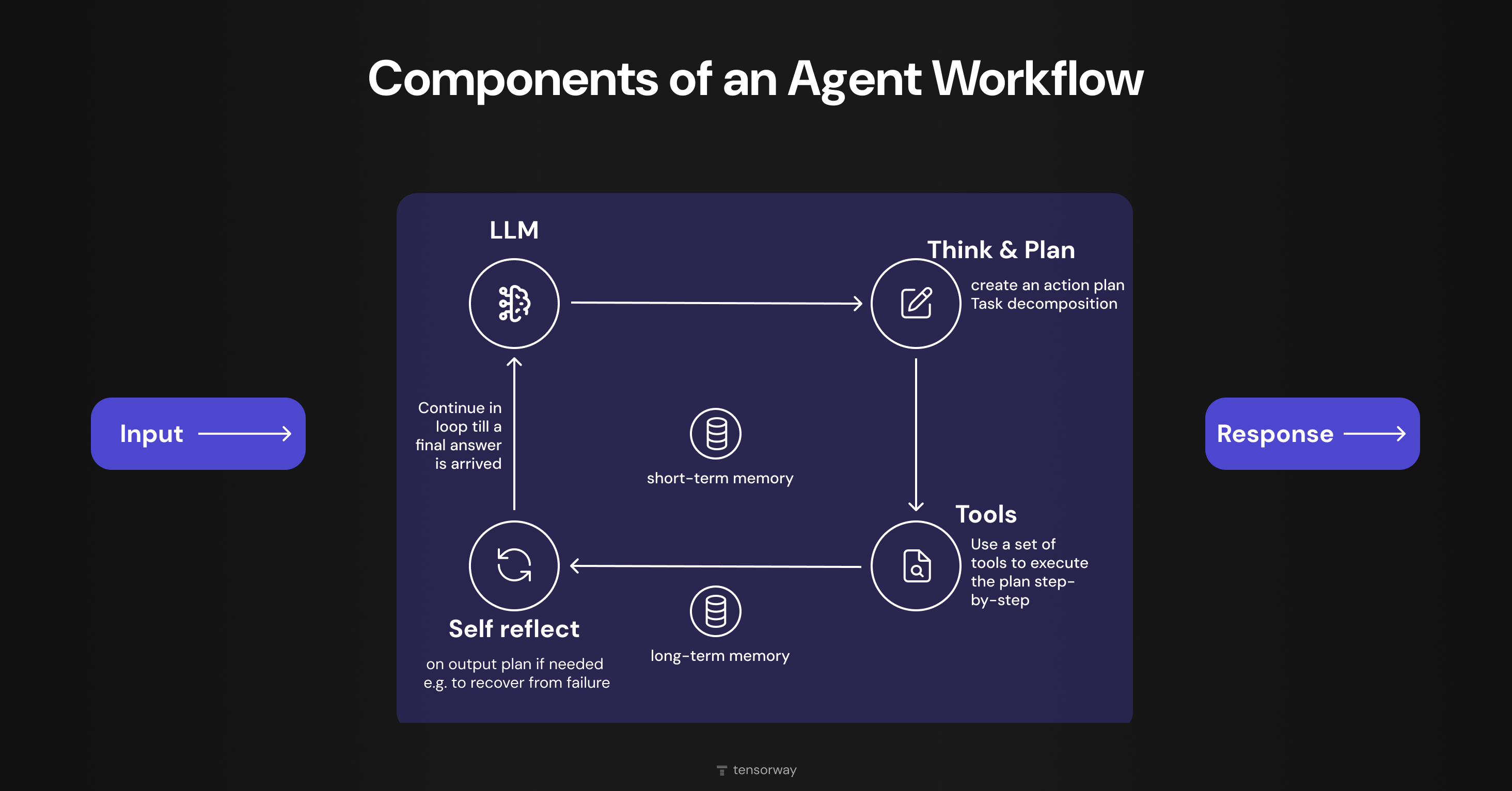
Autonomous AI agents operate via API orchestration across your ERP, CRM, and banking portals. Instead of waiting for a batch process to run at midnight, agents act on triggers in real time.
For example, when an agent detects a high-velocity transaction pattern that deviates from a client's historical baseline, it doesn't just flag it. It can cross-reference the activity against global sanctions lists, temporarily lock the sub-account, and generate a draft compliance report for a human to review.
Taxonomy of AI Agents in Banking and Finance
Modern financial systems rely on a spectrum of intelligence. Choosing the wrong agent type for a specific workflow creates technical debt. You should distinguish between solutions that simply move data and tools that reason through it.
Rule-Based Agents: Deterministic Scripting
These operate on fixed "if-this-then-that" logic. They are deterministic and excel at high-volume, repetitive CRUD operations where the data schema is static.
However, they are fragile. If a vendor changes an invoice format, the script breaks. They can’t adapt to variance.
Machine Learning Agents: Probabilistic Detection
Our machine learning development services focus on building ML agents that are statistical. They don't work with hard rules. Instead, they follow patterns in historical telemetry.
In finance, these are non-negotiable for risk management. They reduce the false positive rate in fraud detection by identifying anomalies that don't fit a standard rule set.
Generative Agents: Context Layer Processing
Generative AI in finance bridges the gap between human language and machine code. You can use these when data is trapped in non-digital formats, such as PDF contracts or legal correspondence.
They replace manual data entry with contextual extraction, turning unstructured text into structured API requests.
Autonomous Agents: Goal-Oriented Orchestration
This is the most advanced tier. You don't need to provide them with steps. It is enough to give them an objective.
They use LLM reasoning to plan sub-tasks, call specific APIs, and verify results. An autonomous agent can execute an end-to-end reconciliation: identifying missing invoices, pinging vendors, and updating the ERP without a human opening a ticket.
The table below contains the most important facts you should know about different types of financial automation tools.
AI Agents Use Cases: How They Solve Operational Friction
As an AI agents development company, we help you remove manual middleware by implementing AI agents. In a high-concurrency financial environment, human-in-the-loop processes are your primary bottleneck. Agents act as the connective tissue that allows your stack to self-orchestrate.
AI for Fraud Detection and Real-Time Telemetry
Static thresholds are useless against modern financial crime. AI agents for fraud detection replace reactive flagging with predictive prevention. They monitor transaction telemetry across payment gateways and internal risk databases simultaneously.
If an agent detects a velocity spike that deviates from a client's historical baseline, it triggers a step-up authentication challenge before the funds leave the account.
Mastercard uses AI to monitor billions of transactions annually. The system acts on decision intelligence to evaluate transaction risk in under 50 milliseconds. AI cross-references real-time purchase data against historical behavior and merchant risk profiles to authorize or block payments instantly.
Compliance and AML Orchestration
Manual KYC (Know Your Customer) is an onboarding bottleneck. AI in financial services can handle the entire verification pipeline. They can:
- Extract data from government IDs via OCR;
- cross-reference global sanctions lists and PEP databases;
- flag discrepancies for human review only when confidence scores drop below a set threshold.
This reduces onboarding latency from days to minutes.
For example, HSBC integrated AI into its AML infrastructure to solve the false positive issue. By using Google Cloud’s AML AI, the financial institution moved away from rule-based alerts to a risk-based telemetry model. AI analyzes transaction patterns to identify genuine criminal activity while ignoring non-threatening anomalies. As a result, the company noted a 60% reduction in false alerts.
Predictive Forecasting and Analytics
Traditional analytics look backward. AI agents pull real-time data from ERP modules and market feeds to generate rolling cash-flow forecasts. They identify liquidity gaps before they hit the balance sheet, allowing your treasury team to move capital proactively.
Microsoft’s treasury department manages over $130 billion in assets. The company replaced manual, spreadsheet-heavy forecasting with an AI-driven predictive engine. Its AI applications scan real-time data from global operations, bank accounts, currency exposures, and even breaking global news to predict cash-flow fluctuations.
This implementation has dramatically optimized Microsoft’s treasury operations, saving the company over 300,000 hours in intelligent collection and credit review processes.
System Connective Tissue
Agents eliminate the manual CSV export loop. An autonomous Reconciliation Agent operates across your banking portal and internal ledger:
- It reads a daily bank statement.
- It searches the CRM for the matching client record.
- It verifies the line item against the open invoice in your ERP.
- It marks the transaction as settled and pings the account manager via Slack.
Nominal, a financial AI platform, showcases exactly how agentic connective tissue eliminates the manual CSV-to-ERP loop. AI agents plug directly into enterprise banking portals and ERP systems to execute real-time ledger reconciliation.
The agent continuously reads daily bank statements, applies contextual understanding to match variable line items, and auto-posts the adjustments to the ERP. The system handles timing differences and vendor variations autonomously. As a result, it ensures over 90% automation without human data entry.
Trading and Investment Support
In high-frequency sectors, agents manage the execution pipeline. They can analyze liquidity across multiple exchanges to minimize slippage and execute trades based on pre-defined risk parameters.
JPMorgan Chase deployed a reinforcement learning AI system named LOXM specifically for executing complex equity orders. LOXM analyzes historical and real-time market telemetry to optimize trading speed and routing.
Benefits of Using AI Agents in Finance
In a high-concurrency financial industry, manual interventions are often the biggest barrier to operational efficiency. The introduction of an agentic model eliminates this traditional bottleneck and provides businesses with some other critical advantages.

Operational Velocity and Accuracy
AI in fintech eliminates the manual middleware. While a human analyst takes hours to reconcile complex cross-border settlements, an autonomous agent performs the task in milliseconds with zero fatigue-driven error.
By automating the reconciliation and reporting pipelines, you shift from reactive batch processing to real-time financial telemetry.
Scalability without Headcount
Traditional scaling in finance is linear. To process more transactions, you need to hire more auditors. AI agents break this rule.
Once the logic guardrails are established, an agent can scale from 100 to 1,000,000 transactions instantly. This allows fintech companies to handle enterprise-level volumes without a proportional increase in overhead.
Strategic Data Leverage
Most financial data today is trapped in unstructured PDFs, emails, or legacy logs. AI agents act as the context layer that unlocks this information. What is even more important is that they transform this data into actionable forecasting.
By pulling real-time market feeds and internal ERP data, agents provide rolling cash-flow predictions that allow treasury teams to move capital proactively rather than defensively.
Challenges of Implementing Autonomous AI Agents
The transition to autonomous finance is a high-stakes migration. If your architecture isn't resilient, automation can scale a single logic error into a catastrophic compliance failure. Based on our experience in AI agent development and implementation, we defined the key challenges you should be prepared for.
Integration and Legacy Debt
Most financial institutions operate on "spaghetti" legacy systems with API-poor mainframes.
To avoid this, deploy agents as a headless orchestration layer. Instead of a full rewrite, use agents to bridge legacy databases with modern cloud environments via custom adapters and webhooks.
Governance and Regulatory Compliance
In the finance industry, compliance with regulatory frameworks like GDPR and AML is obligatory.
Traditional neural networks often can’t provide the required transparency. If a transaction is flagged or a loan is denied, the AI cannot provide a specific audit trail or a human-readable rationale. This lack of accountability makes the system vulnerable to regulatory fines.
The "black box" problems can be solved with the implementation of the Explainable AI (XAI) protocols. Every decision made by an automated agent is logged with a clear rationale, and there are specific data points that triggered the outcome. This ensures that your compliance team can justify any decision during an external audit.
Data Integrity Guardrails
An agent is only as reliable as its data source. Data silos and the "garbage in, garbage out" principle can become serious issues.
Establish automated data governance. Before an agent executes a transaction, a validation layer checks for data completeness and anomalies. If the input is corrupt, the system rejects the process before the logic executes.
AI Agents in Banking and Finance: Future Trends
With the advancements in AI development, the finance industry is moving from the automation-as-a-tool stage toward financial autonomy. Here are the major trends that drive this transformation.
- Hyper-personalization. Future agents will go beyond back-office tasks to handle front-office strategy. Such agents will manage individual portfolio rebalancing and tax-loss harvesting for millions of retail customers simultaneously.
- Agent-to-Agent (A2A) commerce. In the near future, your company’s procurement agent will negotiate directly with a vendor’s sales agent, execute the smart contract on a blockchain, and trigger the payment through an autonomous treasury agent. All this will happen without any human clicks.
- Strategic long-term impact. The long-term impact is a total decoupling of business growth from operational complexity. Finance teams will evolve from data processors into system architects. Human role will shift from managing spreadsheets to managing the agentic guardrails that govern a self-sustaining financial machine.
Wrapping Up
The most critical asset in a volatile market is the ability to scale operations up or down instantly without the friction of recruitment or layoffs. AI agents give businesses the power to scale their operations instantly without having to hire large teams or deal with outdated technology.
Moving from manual data entry to AI-driven automation becomes a necessity for financial institutions to stay competitive. As the industry shifts toward a future where AI handles complex transactions directly, the companies that adopt these intelligent systems now will be the ones leading the market tomorrow.
At Tensorway, we specialize in building and integrating AI agents tailored to the stringent demands of the financial sector. Today, our portfolio includes 5+ custom AI agents for different domains. Have an idea for an autonomous solution for your business? Contact us to discuss how our experts can help you!


.jpg)
.jpg)