TL;DR
- An AI voice agent listens, understands intent mid-sentence, and replies in natural speech with sub-second latency, which sets it apart from rigid IVR phone trees and text chatbots.
- The real engineering challenge is latency, since a three-second pause that feels normal in chat is unacceptable in conversation, so voice agents need streaming architectures that transcribe, reason, and speak at once.
- The strongest returns come from three areas: inbound Tier-1 support, appointment scheduling, and outbound lead qualification, with Gartner predicting AI will handle 70% of customer service interactions by 2028.
- A reliable human escalation path is non-negotiable, because callers trapped in a loop with no way to reach a person is the fastest way to lose their trust.
- Smart rollout starts with low-stakes tasks like after-hours messaging and FAQ routing inside a contained sandbox, while complex CRM or database integrations usually call for custom development rather than off-the-shelf SaaS.
Every missed call after hours becomes a dropped database record that costs your business revenue. In high-concurrency industries, when you force your customer support teams to repeat the same scripts manually, you create an operational bottleneck. As a result, it caps your growth. You lose your leads due to the lack of possibility to answer a phone line instantly. Today, such issues can be efficiently addressed with the introduction of AI voice agents.
An AI voice agent is software that can manage speech-to-text processing and text-to-speech generation in real time. Such solutions are trained to detect intent mid-sentence and respond in natural speech. This makes them different from rigid Interactive Voice Response (IVR) phone trees and text-based chatbots that read an automated script aloud.
In this article, we are going to talk about the capabilities of modern voice AI agents and the key limitations you should stay aware of before implementing such a solution into your business processes.
What Is an AI Voice Agent and How Is It Different from a Chatbot?
An AI voice agent is a real-time voice interface that is powered by a large language model (LLM). It is designed to listen, process intent mid-sentence, and respond using natural speech synthesis. Thanks to the advancements in tech, all this can happen with sub-second latency. With the introduction of conversational voice AI, businesses can transition operations away from deterministic systems and make their interaction with clients more natural and vivid.
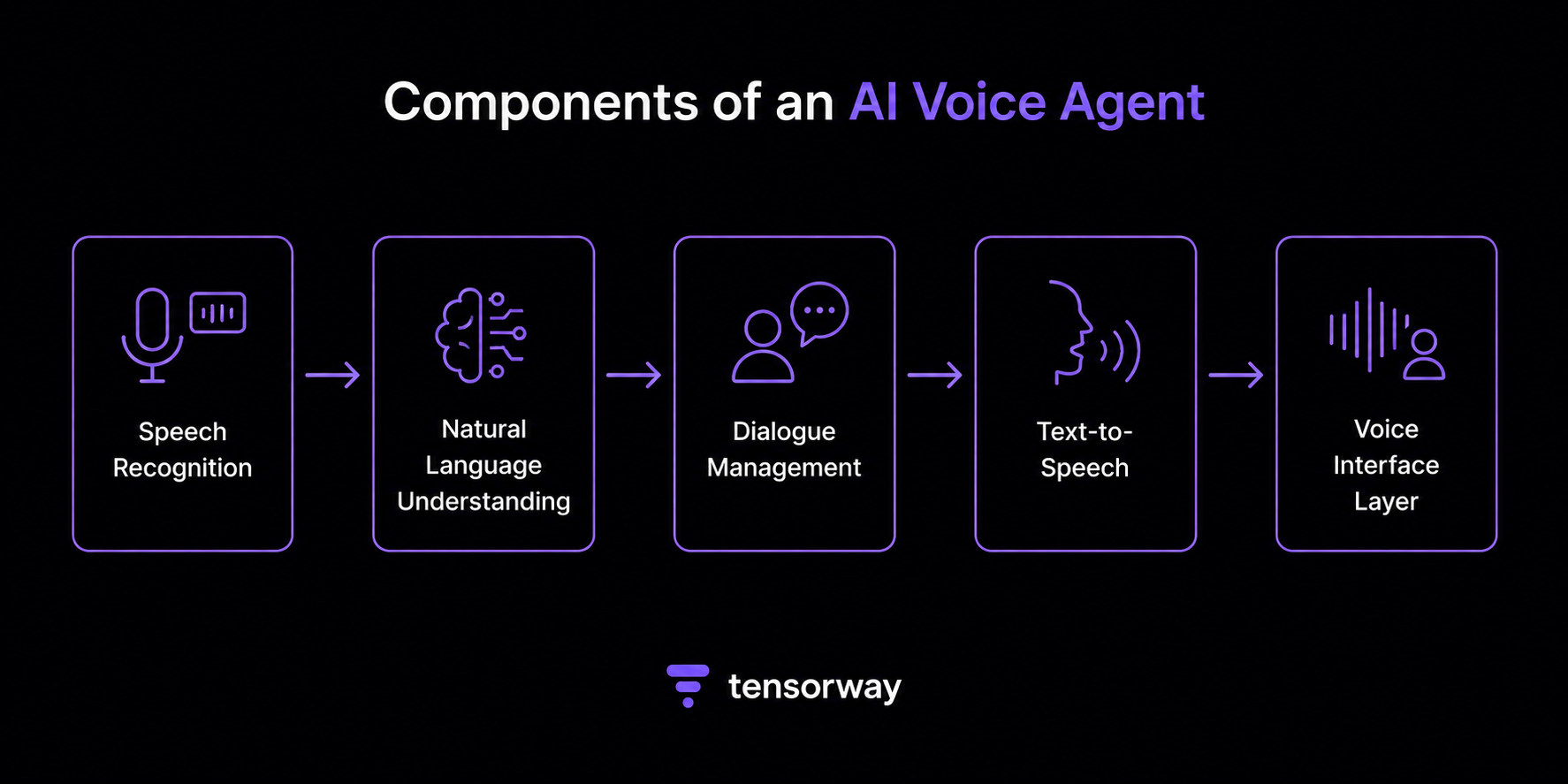
To better understand how an AI calling agent functions, we suggest analyzing what makes it different from traditional telephony and text-based communication systems.
Legacy IVR Systems vs. AI Voice Assistant for Business
Traditional Interactive Voice Response systems operate on deterministic logic. They route incoming calls based exclusively on Dual-Tone Multi-Frequency (DTMF) keypad inputs or explicit keyword matching.
The system breaks if a user departs from the predefined script. Such cases lead to routing errors or forced agent escalations.
At the same time, an AI voice bot can work with unstructured spoken language. It can participate in multi-turn dialogue and retain context across sentences. As a result, it smoothly adapts when a user changes their mind or interrupts mid-stream.
Chatbot Architecture vs. AI Receptionist
Both AI chatbots and voice agents rely on LLMs for core reasoning. However, they face entirely different engineering constraints. The primary differentiator is latency.
When users interact with a text chatbot, and there is a 3-second delay while the model generates a response, it is a standard experience.
In a voice conversation, such a pause is inappropriate. AI phone agents require specialized streaming architectures. These solutions should be able to handle simultaneous audio ingestion, transcription, reasoning, and synthesis without interrupting the conversational flow.
How to Build AI Voice Agent?
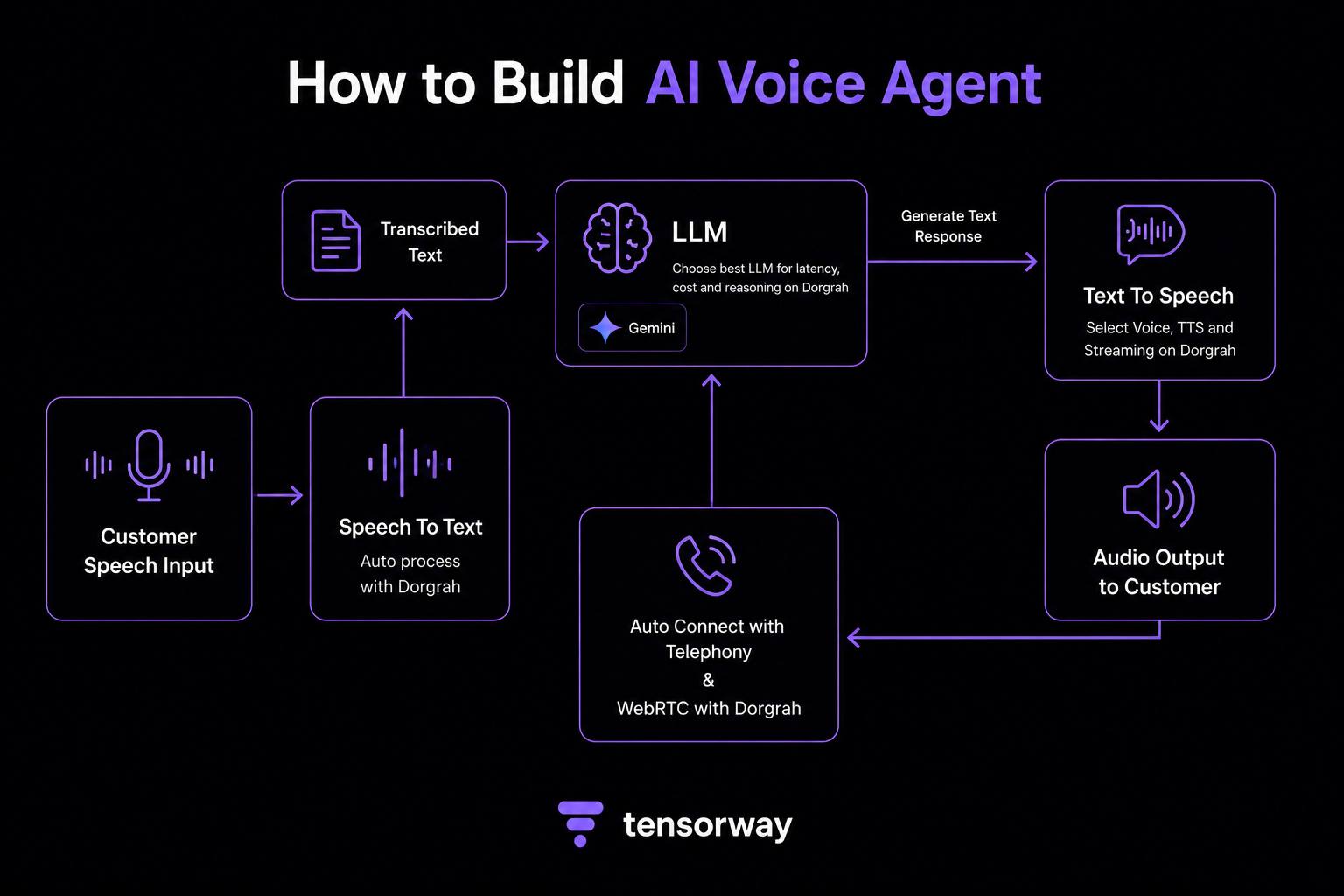
There are three separate tools that should be linked into a single loop to ensure the smooth functioning of an AI voice agent.
- A listening tool instantly translates the caller’s spoken words into text.
- An AI reasoning engine processes that text to understand the intent and draft an answer.
- A voice tool reads that answer aloud using natural human inflections. The audio is streamed straight back to the caller's phone.
Infrastructure platforms like Retell AI and Vapi package this entire loop into ready-to-use software interfaces (APIs). This allows businesses to deploy responsive voice layers directly into their existing phone systems so that they don’t need to build custom speech models from scratch.
The commercial application of this architecture is accelerating rapidly. According to CB Insights’ State of AI 2025 report, about 10% of all AI acquisitions in 2025 were related to AI agents and infrastructure. This proves a high corporate interest in the development and integration of such solutions.
Meanwhile, data from The State of Voice Agents in 2026 market analysis by AI Voice Research shows that enterprise adoption of voice agents is accelerating rapidly. Production deployments grew 340% year-over-year. The strongest growth occurred in the second half of 2025.
How do Businesses Use Voice AI Agents?
Businesses that deploy AI phone agents can observe the highest return on investment in three specific areas:
- Inbound customer support;
- continuous appointment scheduling;
- high-volume outbound lead qualification.
You shouldn’t expect such systems to replace entire departments. They are designed and implemented with a goal to decouple high-frequency, low-complexity tasks from your human workforce.
Organizations deploy voice agents to instantly resolve Tier-1 inbound calls. When a customer calls to check an order status or update billing details, the AI can handle this directly. The volume of these automated interactions is accelerating. According to Gartner, automated systems and generative AI will handle 70% of all customer service interactions by 2028.
However, the customer workflow can be broken if you deploy a voice agent without a dedicated escalation path. When a caller hits a complex issue, the system should offer smooth routing to a human operator.
On Reddit, one of the users shared their experience that coincides with this idea: “A hybrid approach works best—using AI for basic tasks while having humans available for more complicated interactions. It can lead to faster resolutions and a better overall customer experience.”
Businesses also integrate AI receptionists as autonomous booking engines. Healthcare providers and professional service firms rely on these systems to schedule, modify, and confirm appointments without human intervention. The voice layer queries the internal scheduling API, identifies concurrency conflicts, and commits the booking to the database. All these steps can be executed while the user is still on the line.
User sentiment across G2 reviews for AI receptionists confirms that such solutions bring measurable business outcomes across industries. When companies automate their front-desk voice layer, they consistently report identical operational wins:
- Dropped calls hit near-zero.
- Inquiry response times decrease to seconds.
- Early-stage lead qualification scales without human intervention.
According to reviews, modern AI receptionists can also help businesses determine “whether a caller is a genuine customer prospect or simply someone browsing.”
Sales operations apply AI voice technology to outbound data pipelines. The process of dialing through unverified inbound lead lists can be very time-consuming for human representatives. That’s why businesses rely on AI outbound calls to execute the initial contact. An AI calling agent dials the prospect, navigates the preliminary discovery framework, evaluates purchase intent, and automatically books a discovery meeting onto a senior executive’s calendar.
What Should You Know Before Deploying an AI Voice Agent?
Production-ready voice AI technology functions reliably at scale. When corporate deployments collapse, the failure rarely stems from the underlying speech-to-text pipeline or streaming audio latency. Quite often, projects stall due to structural scoping mistakes. Success requires isolating narrow business workflows, pre-engineering human escalation protocols, and systematically testing capabilities within tightly contained operational sandboxes.
Operations teams must define the voice agent's structural scope with absolute precision. A deployment optimized for high-velocity outbound lead qualification operates on an entirely different logical framework than, for example, AI voice agent healthcare use cases require.
The outbound sales agent prioritizes processing speed and strict classification logic to secure a calendar slot. At the same time, the healthcare industry demands a near-zero error tolerance framework. A medical agent must be trained to manage multi-step data verification before revealing or updating any clinical data. Moreover, it needs broader context processing windows and deep semantic search capabilities to handle variable human inputs regarding physical symptoms or medication schedules.
When you use a single voice agent to manage contradicting operational modes, this leads to severe prompt drift and logic conflicts inside the core context. That’s why operation teams must deploy completely decoupled architectures with dedicated system boundaries and separate data containment pipelines to ensure that agents can function adequately.
But before writing the first line of conversational logic or system prompts, engineering teams must also think about the exact technical handoff loop to human operators. Otherwise, callers can be just trapped inside an automated telephony sequence with no clear exit path.
As the AI voice agent use cases are actively discussed on Reddit, many users believe in the feasibility of such a system for handling repetitive queries. But at the same time, they highlight the importance of proper escalation. One of the users wrote: “For me, trust would come down to two things: how natural it sounds and how smoothly it hands off to a human when needed. If customers feel stuck in a loop or can’t reach a real person when frustrated, that’s a dealbreaker.”
At Tensorway, we have solid expertise in AI agent development. And based on our practice, we always recommend businesses to initiate their AI deployment strategy with a localized, low-risk use case. This helps safeguard system reliability and protect customer relationships.
Avoid launching an untested voice agent on live sales lines or cancellation queues. If the system encounters an API failure or a sudden user interruption, the call will crash. Any tests performed in production may break your highest-value pipelines before your team will be able to patch the underlying bugs.
Instead, start with low-stakes tasks like:
- After-hours messaging;
- simple FAQ routing,
- appointment confirmations.
These workflows have highly predictable conversational paths. Such an approach minimizes system errors and lets your team safely check system logs and fix call lag without risking customer relationships.
When you see that the system runs smoothly in this sandbox, you can scale it to your main operations.
Wrapping Up
Implementation of AI voice agents requires strict attention to your underlying data architecture. And the efficiency of such an initiative greatly depends on your choice of the correct system based on your goals. Off-the-shelf AI in SaaS can cope well with simple FAQ retrieval. But they fail when they need to perform more complicated tasks, like executing database writes or synchronizing with proprietary CRM systems.
If your voice agent must verify inventory across multiple warehouses or trigger asynchronous billing updates, standard software will cause multiple integration issues. You require custom development. Introduction of a tailored conversational logic layer ensures that your communication infrastructure aligns precisely with your security protocols and operational requirements.
With more than 7 years of experience in building advanced AI solutions, Tensorway can become your reliable partner in introducing AI technology in your business processes. Contact us to discuss how we can help you.

.jpg)