
TL;DR
- Most companies (about 87%) now use AI in hiring to save time, yet candidates largely distrust it, with only roughly a quarter believing it can fairly assess their skills.
- Modern recruitment AI reads context through semantic search and embeddings, unlike old keyword systems that reject strong candidates for missing exact terms.
- Scheduling automation brings the clearest payoff, cutting scheduling costs by 40 to 65% and time-to-hire by 30 to 50%.
- The main dangers are biased models, legal exposure (EU AI Act, EEOC, NYC Local Law 144), and opaque "black-box" rejections nobody can explain.
- The smart play is a hybrid setup where AI filters high-volume applications and humans handle senior roles and final decisions.
The adoption of AI in recruitment is gaining momentum. According to SightsIn Plus HR industry analysis, 87% businesses rely on artificial intelligence in their hiring processes. Time savings are named among the key grounds for AI implementation.
However, according to Gatner, only 26% of candidates believe that AI-powered tools can truly evaluate their skills. Despite significant speed gains, recruitment automation comes with immediate vulnerabilities. Integration of standard applicant tracking systems (ATS) can introduce algorithmic bias and drop specialized talent that doesn’t hit arbitrary keyword densities. To solve this bottleneck, businesses should move toward custom AI agent development services that align with their specific technical evaluation logic.
In this article, we are going to talk about the key benefits of AI recruitment tools and explain how to avoid the common risks related to the automated hiring process.
What Is AI in Recruitment and How Does It Work?
Recruitment AI replaces rules-based software with predictive machine learning and natural language processing. The system ingests unstructured data (PDF resumes, portfolio code, and interview transcripts) and maps it to structured vector databases.
The enterprise recruitment stack separates these capabilities into two distinct operational layers:
- Assistive layers (basic execution automation). These systems hook into calendar APIs to coordinate multi-stage panel interviews, parse contact details into standard fields, or trigger transactional follow-up sequences.
- Autonomous layers (independent decision engines). These workflows evaluate historical hiring trends to score applicant profiles, write hyper-targeted outbound pipelines, and dynamically adjust screening weights based on final hiring outcomes.
What Is the Difference between Rule-Based Queries and Semantic Search?
A lot of modern applicant tracking systems auto-reject candidates because their profiles lack exact keywords. That is a standard SQL query or regex string match.
True recruitment AI relies on semantic search and vector embeddings.
Instead of just detecting rigid keywords, a semantic model recognizes a wider context. For example, it can identify that a candidate detailing distributed systems infrastructure matches a cloud scalability role. And in this case, specific keywords like “Kubernetes” don’t even need to explicitly appear in the profiles.
Continuous data feedback loops power machine learning. AI recruitment software can track which applicants survive the engineering manager loop. And based on this, it automatically optimizes early-stage sourcing filters to find similar talent profiles.
How Is AI Applied across the Recruitment Funnel?
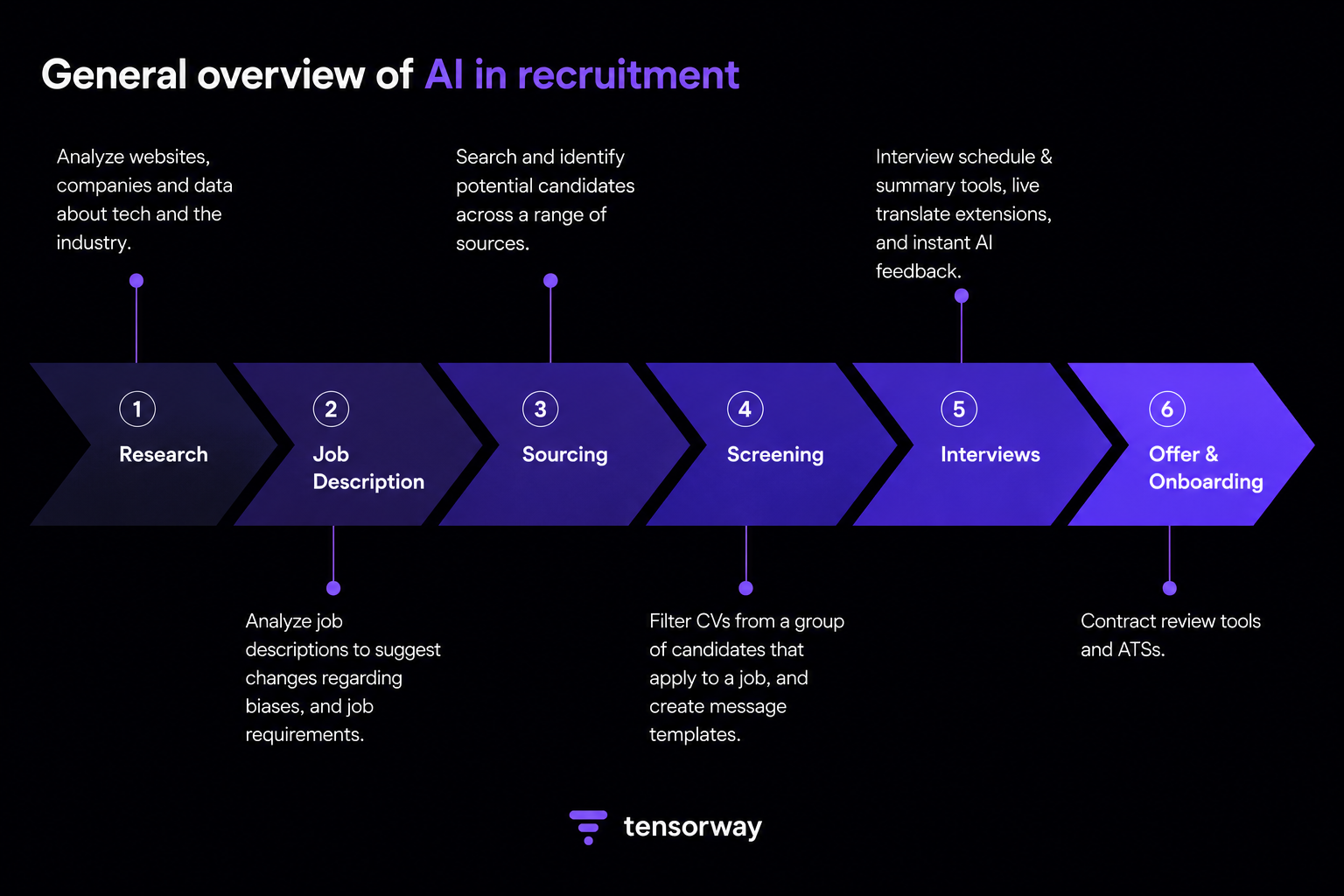
Modern AI agent development is transforming every node of the traditional hiring lifecycle. Autonomous pipelines replace high-volume candidate screening with data-driven precision and targeted final selection. The table below shows the key AI use cases at different stages of the recruitment process.
How Is AI in Recruitment Changing the Hiring Process?
Enterprise talent intelligence suites (such as Workday AI or Greenhouse) can now process and score incoming software applications at machine speed, which is impossible for a human recruiter. The immediate trade-off of AI candidate screening is a spike in false negatives. The underlying models often drop highly capable specialists whose non-linear careers don’t match set training weights.
Communities like r/jobs are increasingly filled with candidates who receive automated rejections within minutes of submission. One of them described their experience: “I applied, and I got an insta-rejection email, and then I got the thank you for applying email a few minutes later.” As a rule, it happens because their resume formatting or phrasing deviates from corporate baseline patterns.
At the next stage of the recruitment process, AI interview tools like Paradox’s Olivia and ModernHire manage initial candidate verification. AI chatbots put applicants through structured question sets and score their responses before greenlighting them for live engineering rounds.
The real friction occurs when video assessment platforms like HireVue deploy biometric layers to analyze vocal cadence and micro-expressions. This automated evaluation has severely damaged the candidates’ trust. Some job seekers are even ready to withdraw their applications as they strongly believe that a HireVue interview is “quite invasive to both personal privacy and biometric data.”
The most stable and least controversial application of machine learning is scheduling. Calendar automation tools like Calendly AI can handle multi-stage panel coordination, time-zone conflicts, and transactional status updates without human intervention. According to candidate.fyi, AI helps businesses reduce scheduling-related costs by 40-65% and time-to-hire by 30-50%.
What Are the Real Risks of AI in Hiring?
AI in recruitment is one of the technology use cases that demonstrates the importance of human oversight. Thanks to automation, the responsibilities and tasks of recruiters can change. But any attempts to fully replace such specialists result in growing risks for your organization.
Amplification of AI Bias in Hiring
When you train a machine learning model on historical data, you can’t expect that human bias will be eliminated. Quite often, it may happen vice versa. In 2018, Amazon scrapped its AI recruitment project. And this case remains the industry’s warning label. The algorithm reviewed a decade of engineering resumes, noticed the vast majority came from men, and explicitly trained itself to penalize profiles containing the word "women’s".
Modern models still run into this structural failure:
- Homogenous training sets. When historical hiring trends skew heavily toward one demographic, the engine treats correlated keywords as success metrics.
- Pedigree bias. Models often over-index on specific zip codes, high-income hobbies, or elite universities.
- Pattern overfitting. The software tends to clone your existing team profile instead of identifying objective engineering capability.
Legal Risk and Regulatory Enforcement
Regulators are actively penalizing unmonitored automated screening. Under the EU AI Act, employment and recruitment software is classified as a high-risk application. This designation requires companies to implement strict logging, data governance, and algorithmic transparency.
In the United States, the legal landscape demands strict human guardrails. For example, the US Equal Employment Opportunity Commission has made clear that employers remain responsible for hiring decisions influenced by AI and other automated screening tools.
At the same time, regulations like New York City's Local Law 144 mandate annual, independent bias audits for automated employment decision tools (AEDTs) before deployment.
Black-Box Problem
The most difficult engineering bottleneck of AI recruiting is the black-box problem. Deep neural networks score applicants based on complex vector weightings across millions of parameters. As a result, the software can’t generate a clear trail explaining why a candidate failed a screen.
On Reddit, there are a lot of stories from candidates who got rejected by AI tools. Some of these stories had a happy ending if the candidates were insistent enough. After receiving an immediate automated rejection for a role they perfectly matched, a candidate messaged an HR manager directly on LinkedIn. The manager agreed the rejection seemed like a mistake and stepped in to investigate the algorithmic error. A little bit later, the candidate got an invitation for a first call.
Where Can We Use AI Recruiting and When Is It Better to Avoid It?
AI delivers the best results when it handles entry-level jobs or positions that attract thousands of applicants. It can scan massive piles of resumes in seconds and automatically coordinate calendar invites. This allows companies to eliminate hours of boring paperwork without any negative impact on the quality of the hire.
At the same time, it wouldn’t be the best idea to use AI to find senior executives or creative leaders. AI resume screening software can’t judge human personality, unique talent, or complex salary negotiations. Moreover, if you let artificial intelligence independently make final hiring choices, you expose your business to massive legal risks and potential lawsuits.
The most successful companies use a hybrid strategy that relies on a human-machine collaboration. In this case, the AI layer is responsible for the opening steps and sorting through massive piles of applications to create a short list of qualified people in minutes. Then, human recruiters and hiring managers take over to conduct live interviews and analyze problem-solving skills.
Standard AI talent acquisition software is built for the average business. Its functionality is designed following the assumption that every company evaluates talent the exact same way. For those organizations that have their unique vetting processes or operate in heavily regulated industries with strict data privacy rules, off-the-shelf software doesn’t work. Standard tools often drop top-tier talent simply because their career paths look a bit unusual.
In this case, it makes sense to skip generic software and invest in custom generative AI development. Your tailored system will evaluate applicants based on your company's actual performance standards and protect your hiring quality.
Wrapping Up
Recruitment automation can help you significantly reduce administrative overhead for your HR department. However, the use of off-the-shelf candidate scoring models may lead to dropping elite talent with non-traditional professional paths.
High-velocity hiring requires a tailored infrastructure that prioritizes context and semantic capability over literal keyword matching. Custom software development allows you to introduce explainable data processing that matches your hiring standards and protects your business from compliance failure.
Ready to replace routine manual processes with advanced automation? At Tensorway, we have successfully deployed 15+ major AI projects and 5+ custom AI agents across domains. We know how to address the specific pain points within different business processes and are ready to help you overcome your operational bottlenecks. Contact us to discuss your project!