For years, quantum AI lived in the same mental category as teleportation and time travel. Most business leaders dismissed it as a physics experiment with no real deadline on the calendar.
That changed when IBM publicly stated that 2026 will mark the first year a quantum computing AI outperforms a classical system on a problem no classical-only method can solve as well. The company is already testing quantum-enhanced workflows in drug discovery, materials science, financial optimization, and logistics. In late 2025, Google's 105-qubit Willow chip completed a complex physics simulation in two hours. The same task would take the fastest supercomputer over three years. It was the first time a quantum processor delivered verified results at this scale.
So is quantum AI real? Yes (but with important context). We are still in the early stages, and hype can outpace hardware. Below, we break down what quantum artificial intelligence actually is, how it differs from classical AI, where it delivers value today, and what it means for businesses preparing for the next wave of intelligent systems.
What Is Quantum AI: Definition and Core Principles
Quantum AI (quantum artificial intelligence) is a field of computing that applies the principles of quantum mechanics (superposition, entanglement, and quantum interference) to the design, training, and execution of artificial intelligence models, an area increasingly explored by AI development services like ours. Unlike classical AI systems, which process data using binary bits fixed in a state of 0 or 1, quantum AI operates on quantum bits (qubits) capable of representing multiple states simultaneously. This property allows quantum AI systems to explore vast solution spaces in parallel, making them particularly suited for optimization, molecular simulation, and complex pattern recognition tasks that exceed the practical limits of classical computing architectures.
As of 2026, most real-world implementations of quantum computing AI fall into the hybrid category, where quantum processors handle computationally intensive sub-tasks while classical systems manage data preparation, error correction, and result interpretation.
How Quantum AI Works: Quantum AI Explained Step by Step
To understand how quantum AI works in practice, it helps to trace the path data takes through the system, from input to actionable output.
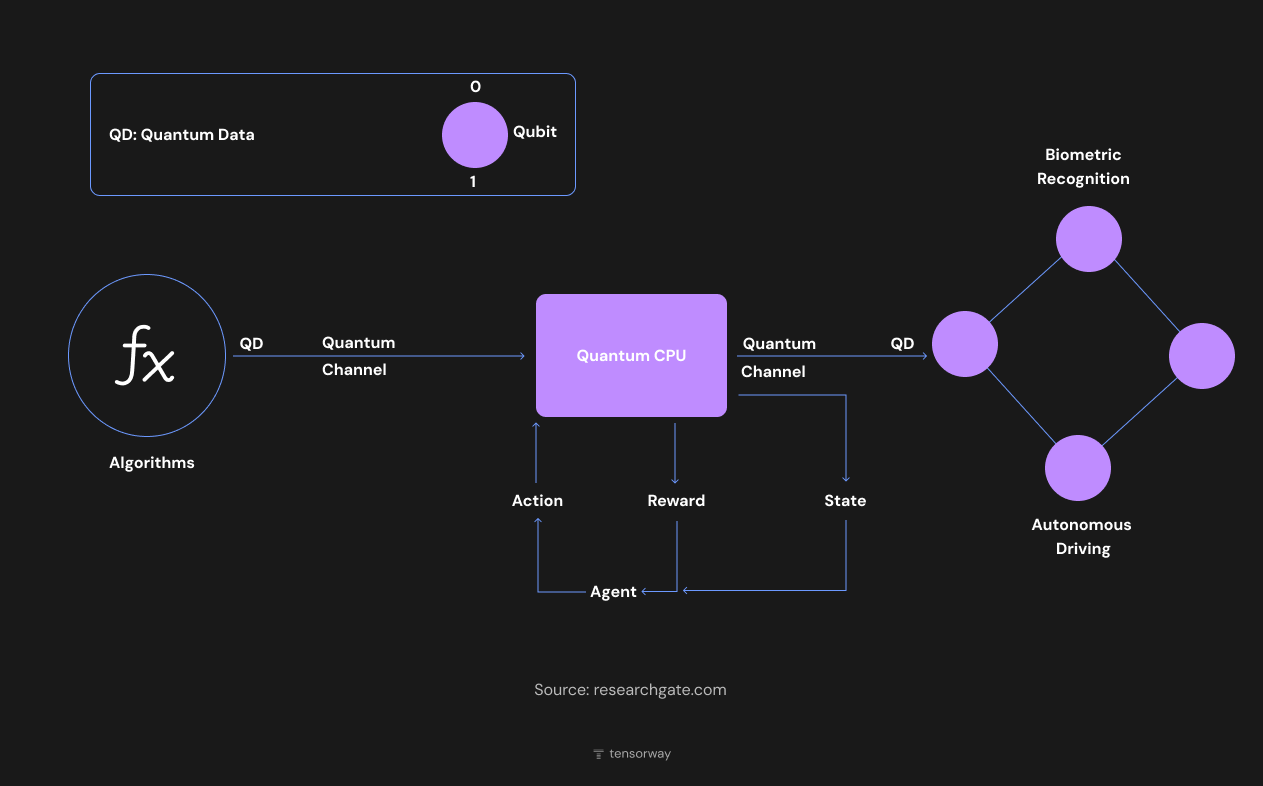
Step 1: Encoding Data into Quantum Form
Сlassical data (numbers, images, sensor readings) first passes through quantum algorithms that translate it into quantum data (QD). These algorithms encode information onto qubits using quantum gates, transforming binary values into quantum states that can hold far more information per unit than classical bits.
Step 2: Processing through the Quantum Channel
The encoded quantum data travels through a quantum channel into a quantum processor (quantum CPU). Here, the core advantage kicks in. Thanks to superposition, each qubit processes multiple values at once. Thanks to entanglement, qubits coordinate with each other across the system, enabling the processor to evaluate millions of variable combinations simultaneously rather than sequentially.
Step 3: Output and Application
The quantum CPU produces processed quantum data, which flows through a quantum channel to downstream applications (biometric recognition systems, autonomous driving models, financial risk engines, or any domain that benefits from high-dimensional pattern analysis).
Step 4: The Learning Loop
In quantum machine learning workflows, the system operates through a reinforcement cycle: an agent takes an action based on the quantum processor's output, receives a reward signal indicating how well that action performed, observes the new state of the environment, and feeds this information back into the system.
This four-stage architecture is what allows quantum AI to optimize thousands of variables at once, learn from sparse datasets, and refine decisions in real time.
Quantum AI vs Classical AI: Key Differences That Matter
Classical AI and quantum AI are built on fundamentally different computing models. Understanding where they diverge, and where they overlap, helps clarify why quantum AI is emerging as a complement to classical systems rather than a replacement.
The differences go deeper than bits versus qubits, which we covered above. What actually changes is how models learn, how they handle errors, and how they scale under pressure.
- Training approach. Classical AI models learn through gradient descent: adjusting millions of parameters step by step across thousands of iterations. It works, but it gets expensive fast at scale. Quantum AI takes a different route. Variational quantum algorithms run a hybrid loop where a quantum circuit proposes solutions and a classical optimizer tunes the parameters. This loop can converge faster on certain problem types because the quantum circuit explores a higher-dimensional parameter space in each iteration.
- Error model. Classical systems are deterministic. When hardware works correctly, the output is exact. Quantum systems are a different story. We are still in the NISQ era (Noisy Intermediate-Scale Quantum), where qubits are inherently unstable. Decoherence, gate errors, and environmental noise introduce uncertainty into every computation. That means quantum AI needs purpose-built error mitigation strategies layered on top of the algorithm itself. Classical AI simply does not have this constraint.
- State space scaling. Adding one classical bit doubles storage capacity linearly: 10 bits represent 10 values. Adding one qubit doubles the state space exponentially: 10 qubits can represent 1,024 states simultaneously. At 50 qubits, the state space exceeds what any classical supercomputer can fully simulate. This exponential scaling is what gives quantum AI its theoretical edge on high-dimensional problems. But it also makes quantum overkill for simple tasks where classical linear scaling is more efficient.
The table below captures the core differences at a glance:
For most everyday AI tasks like chatbots, image recognition, or predictive analytics, classical systems remain faster, cheaper, and more reliable. Quantum AI steps in where classical methods hit structural walls.
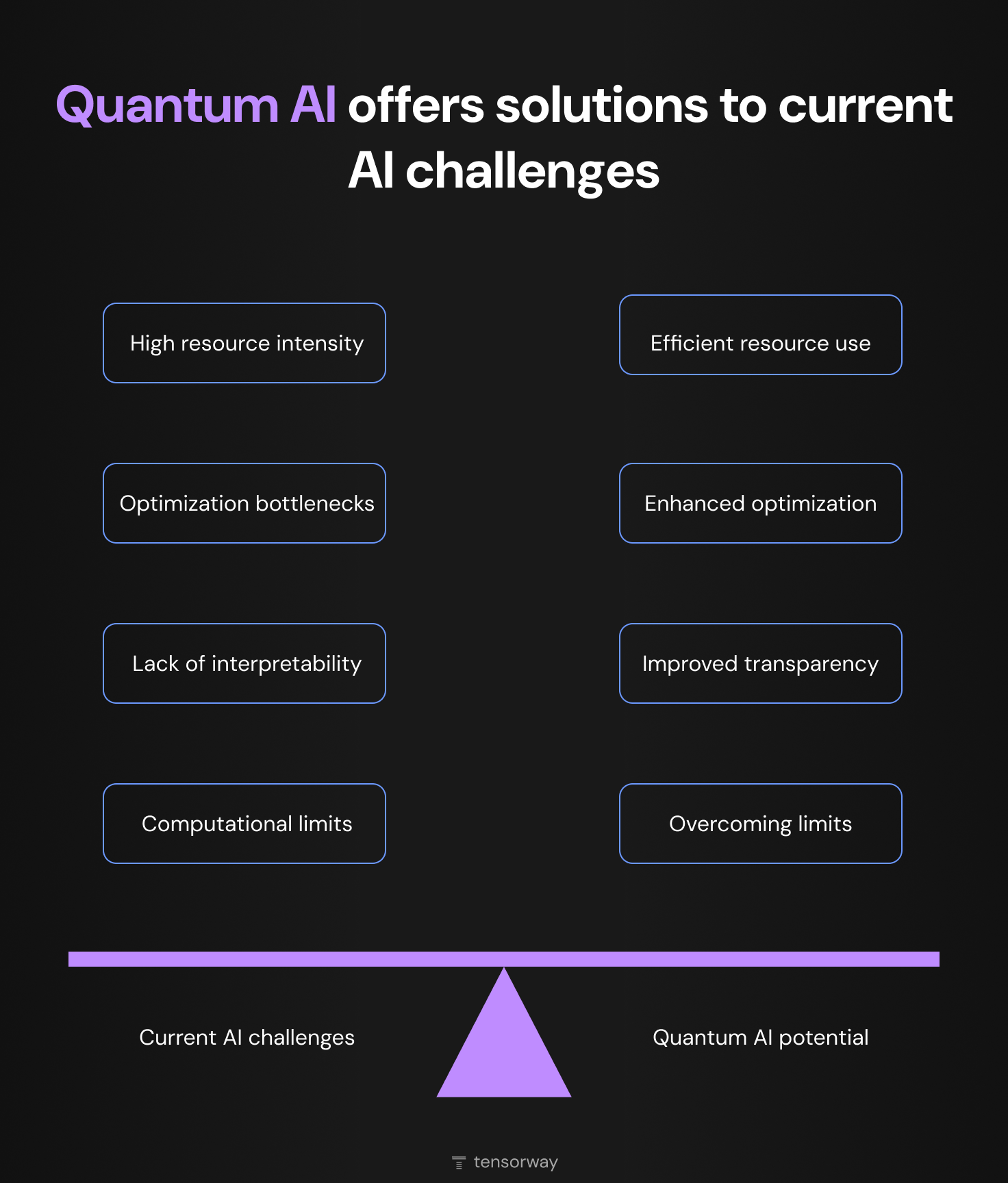
And those walls are real. Classical AI struggles with massive resource demands when training large models, optimization bottlenecks on problems with thousands of interdependent variables, limited interpretability inside deep learning black boxes, and hard computational limits when simulating molecular or quantum-level phenomena. Quantum AI is built for exactly these gaps: more efficient resource use through parallel qubit processing, stronger optimization through superposition, improved transparency through measurable quantum circuit states, and the ability to push beyond classical computational boundaries.
Top Quantum AI Applications Across Industries
The best way to judge any emerging technology is to look at who is spending real money on it, and why — and right now, businesses are investing heavily in machine learning development services to turn that potential into measurable results.
Finance and Risk Management
Financial services lead quantum AI adoption and the reasons are structural. Portfolio optimization, fraud detection, and risk modeling all involve massive numbers of interdependent variables, exactly the problem class where quantum processors excel.
JPMorgan Chase was one of the first financial institutions to build an internal quantum research team. In May 2025, the bank partnered with Quantinuum, Argonne National Laboratory, and the University of Texas at Austin to demonstrate quantum speedup using the Quantum Approximate Optimization Algorithm (QAOA) for applications in financial modeling, logistics, and telecommunications. Separately, JPMorgan and IBM co-authored research on pricing European call options using Quantum Amplitude Estimation (a method that achieves a quadratic reduction in the number of samples needed compared to classical Monte Carlo simulations).
Italian bank Intesa Sanpaolo tested quantum machine learning for fraud detection – using variational quantum circuit classifiers on IBM's quantum tools to analyze hundreds of thousands of transactions. According to a World Economic Forum report, the quantum model outperformed traditional methods in accuracy while using fewer data features.
For context on how classical ML-based fraud detection systems are built and deployed today, the architecture quantum methods will eventually augment is worth understanding in its own right.
In Turkey, Yapı Kredi used D-Wave's quantum hardware to model potential failure points across its SME network – identifying systemic financial risk in ways that classical computation could not practically replicate.
The UK government committed $162 million in April 2025 to quantum technology for combating financial crime. Dutch banks ING, ABN Amro, and Rabobank jointly explored quantum-enhanced stress testing, while JPMorgan built a quantum-secured crypto-agile network connecting its data centers (one of the first deployments of quantum security infrastructure in production).
Drug Discovery and Healthcare
A single drug takes over a decade to develop, costs $1-3 billion, and has roughly a 10% success rate. The bottleneck is computational: simulating how molecules interact at the quantum level overwhelms classical hardware. Quantum AI attacks this problem directly.
IBM and the Cleveland Clinic are running quantum-classical hybrid systems for protein folding studies, bringing simulation times down from weeks to hours. The partnership between Algorithmiq, Cleveland Clinic, and IBM Quantum went further developing computational tools for photon-activated cancer drug research on IBM's quantum hardware. This collaboration was selected as a finalist in the Wellcome Leap Quantum for Bio Challenge, a global initiative awarding up to $40 million for quantum applications in healthcare.
Accenture and 1QBit built a quantum-enabled molecular comparison application for Biogen, the biotech company focused on neurological conditions. Their quantum method matched or exceeded classical approaches for analyzing molecular similarity and the team went from initial conversation to enterprise-ready application in just over two months.
Supply Chain and Logistics
Routing, scheduling, and inventory problems involve thousands of interdependent variables that scale exponentially making logistics a natural fit for quantum optimization.
Volkswagen partnered with D-Wave to test quantum-optimized bus routing during the Lisbon Web Summit. The system processed live traffic and passenger data to calculate optimal routes in near-real time, one of the first real-world demonstrations of quantum computing in public transit. D-Wave reported significant efficiency gains for both route optimization and Volkswagen's car painting assembly line.
DENSO (a Toyota subsidiary) used hybrid quantum algorithms to optimize taxi dispatch in Kyoto. The quantum solution served the same daily demand with 43 vehicles instead of 62 (a 30% reduction in fleet size). In Bangkok, their quantum route optimizer cut total driving distance by nearly 10% for an 18-vehicle fleet.
BMW has explored quantum computing for supplier network optimization, using quantum algorithms to match components with suppliers across price, quality, and timeline variables. Airbus and BMW jointly tested quantum-optimized assembly line scheduling, reducing sequencing conflicts and improving on-time delivery rates.
ExxonMobil and IBM Research collaborated on quantum models for maritime inventory routing of liquefied natural gas shipments tackling a fleet optimization problem with uncertainties like weather and demand fluctuations that push classical systems past their limits.
Quantum Machine Learning: Where Quantum Meets ML Workflows
Quantum machine learning (QML) is an interdisciplinary field that applies quantum algorithms and quantum information processing to the training, optimization, and inference stages of machine learning models. QML leverages superposition, entanglement, and interference to represent data in high-dimensional quantum state spaces, enabling certain computational tasks to be performed with exponentially fewer resources than classical methods require. The field covers both quantum-enhanced classical algorithms, where quantum subroutines accelerate specific steps within traditional ML pipelines, and fully quantum models designed to run natively on quantum hardware. As of 2026, the hybrid approach dominates practical implementations.
The QML ecosystem comprises several interconnected components, each targeting a specific stage of the machine learning workflow:
.png)
- Quantum deep learning embeds quantum circuits as layers within neural networks, representing complex feature relationships with fewer parameters and less training data.
- Quantum clustering leverages superposition to evaluate multiple grouping configurations simultaneously, accelerating segmentation tasks that classical algorithms like k-means struggle with as dimensionality grows.
- Feature topology development encodes classical data into quantum state spaces through quantum feature maps, surfacing structural patterns invisible to classical feature engineering. This is the mechanism behind QML models achieving higher accuracy on fewer data features.
- Quantum data and quantum processing form the infrastructure layer: classical datasets are encoded into quantum states and processed through quantum circuits that evaluate multiple computations in a single pass.
- Quantum search algorithms (notably Grover's algorithm) provide quadratic speedup for finding optimal solutions in unstructured datasets. In ML pipelines, this translates to faster hyperparameter tuning and model selection.
- Mathematical algorithms such as variational quantum eigensolvers (VQE), quantum approximate optimization (QAOA), and quantum kernel methods provide the computational foundation that makes quantum-enhanced training, classification, and optimization possible.
For engineering teams already running ML in production, QML does not require a full infrastructure rebuild. The entry point is hybrid: quantum modules plug into existing TensorFlow or PyTorch pipelines for specific sub-tasks, accessible through cloud platforms like IBM Qiskit, AWS Braket, and Google Cirq without owning quantum hardware.
Does Your Business Need Quantum AI Right Now?
For most companies in 2026, the honest answer is no. Classical AI and high-performance computing still handle the vast majority of business workloads effectively. That said, the window between irrelevance and urgency can close faster than expected. Here are the signals that your organization is approaching the threshold where quantum AI becomes relevant:
- Your optimization models cut corners to finish on time. You cap variables, simplify constraints, or accept "good enough" solutions because full problem spaces are too large for classical solvers.
- Training costs scale faster than results. Doubling GPU spend no longer produces meaningful accuracy gains. The bottleneck may be architectural, not budgetary.
- You work with molecular or materials data. Simulating quantum-level interactions (drug binding, polymer behavior, battery chemistry) pushes classical hardware to its theoretical limits.
- Monte Carlo simulations run overnight. Risk models, pricing engines, or forecasting pipelines that require millions of classical samples could benefit from quantum amplitude estimation's quadratic speedup.
- Your data is high-dimensional and sparse. Quantum feature maps can extract patterns from complex, low-volume datasets where classical models underperform or overfit.
- You need real-time decisions on complex variable sets. Fleet routing with live traffic, dynamic portfolio rebalancing, or manufacturing scheduling across thousands of constraints.
The companies that benefit most from quantum will be those that recognized the signals early and treated preparation as a low-cost investment rather than a late-stage scramble.
What Comes Next
The path to quantum readiness starts with a strong machine learning foundation. At Tensorway, we help companies build ML infrastructure that delivers results today and adapts to emerging technologies like quantum AI. If you want to explore where quantum-enhanced approaches fit into your roadmap, reach out to our team and we will help you find the starting point.

.jpg)
.jpg)