
TL;DR
- Automated due diligence uses AI to handle the document-heavy parts of deal screening, reading data rooms, extracting financials, flagging risks, so analysts interpret instead of gather.
- The scale is the point. One PE fund's agent analyzes 5,000+ company profiles in hours, cuts initial screening time by 80%, and builds investment decks 8x faster.
- Across financials, market, operations, risk, and governance, the split is consistent: AI gathers and organizes, the analyst interprets and decides.
Automated due diligence is the use of AI to do the document-heavy, repetitive parts of deal screening, reading data rooms, extracting financials, flagging risks, so analysts spend their hours on judgment instead of data entry. The work that used to fill an analyst's week now runs in the background, and the analyst reviews the output rather than assembling it from scratch.
This is no longer a fringe experiment. As of 2026, 95% of private equity funds report their AI initiatives are meeting or exceeding the original business case, according to FTI Consulting's latest Private Equity AI Radar. The question for most firms has shifted from whether to use AI to where it earns its place in the deal funnel, and where it quietly creates risk. This article walks through both.
What is AI due diligence in private equity?
AI due diligence is the application of machine learning and language models to the investigation a firm runs before committing capital. It covers reading filings, financial statements, contracts, and market data, then surfacing the metrics and red flags a human would otherwise dig out by hand. The point is not to remove the analyst. It is to move the analyst up the value chain, from gathering to interpreting.
Adoption tells the story. Over 80% of PE and VC firms had used AI by late 2024, up from 47% a year earlier, a jump that few technologies in finance have matched. Pictet's 2024 survey found nearly two-thirds of general partners were running GenAI pilots, with more than 40% already using it in business processes. The direction is clear, but the gap between piloting and scaling is where most of the real work sits.
For the engineering view of how these systems handle messy source files, Tensorway's work on document understanding gives a concrete sense of what extraction at this scale involves.
How do PE firms automate deal screening with AI?
PE firms automate deal screening by pointing AI at the two slowest stages: finding targets and reading their documents. A multi-agent setup typically splits the job. One agent scans news, filings, and web signals to surface candidates. Another extracts financials from annual reports and presentations. A third scores each target against the firm's own criteria, and a fourth drafts the investment memo or committee deck.
The scale this unlocks is the headline. One private equity fund Tensorway worked with built an agent that analyzes over 5,000 company profiles in a few hours, cutting initial screening time by 80% and producing investment decks 8 times faster than the manual process. Before the system, a single analyst spent roughly 60 hours a week on market research and networking. That time now goes to the deals worth a closer look.
This matters because of a structural problem in the industry. The 2024 Deal Origination Benchmark Report found that PE firms typically see only about 16.5% of relevant deals in their target markets, which means more than 80% of opportunities never reach the table. Deal sourcing automation widens that field by scanning sources no human team could cover at once.
What does machine learning due diligence do that manual review cannot?
Machine learning due diligence reads thousands of pages and cross-references them in the time a person spends on a single contract. The difference is not just speed, it is coverage. A model can compare every document in a data room against every other, catching a contradiction between, say, a financial projection and a customer contract that a tired reviewer at 11pm would miss. This is the part of due diligence automation that genuinely changes the work rather than just speeding it up.
One useful data point comes from a 2024 peer-reviewed study of 384 respondents, which found that higher AI automation significantly improved both error reduction and compliance, with the strongest results in larger firms that had used AI longer. The same study made a point worth holding onto: human oversight independently improved accuracy, and the combination of oversight plus automation beat either alone. AI reads, humans judge, and the pairing is what works.
What are the best AI due diligence tools and software for PE?
The best AI due diligence tools fall into two camps: data-room analyzers that answer questions about uploaded documents, and AI-native platforms built around private equity workflows. As of 2026, the market has filled with both, from generative platforms that ingest a virtual data room and answer hundreds of questions in minutes, to agents that conduct expert interviews and assemble auditable reports.
Choosing AI due diligence software comes down to fit rather than feature lists. A few questions separate a useful tool from an expensive one:
- Does it work with your existing data room and CRM, or does it demand a new workflow your team will resist?
- Can it show its sources, so a finding can be traced back to the document it came from?
- Does it handle your sectors, or was it trained on deals that look nothing like yours?
Real practitioners are blunt about the value when the fit is right. Founders of one AI diligence startup, drawn from Blackstone and BCG, describe their tool as replacing the $500,000-plus commercial due diligence work traditionally bought from McKinsey, BCG, and Bain. Another team, with backgrounds at Vista Equity Partners and Goldman Sachs, frames the goal as letting investors reach an 80% understanding of a deal in moments, so they can say no earlier and spend time on the deals that deserve it.
For firms weighing whether to buy a platform or build one tuned to their process, Tensorway's AI agents development work covers the custom route.
How does AI handle commercial and investment due diligence?
AI handles commercial due diligence by reading the market, not just the target. Commercial due diligence asks whether a company's market is growing, where it sits against competitors, and whether its revenue claims hold up. AI supports this by pulling competitor activity, market-share data, and industry signals from sources scattered across the web, then organizing them into a picture an analyst can challenge.
For private equity due diligence specifically, the investment due diligence process usually runs across financials, market position, operations, risk and compliance, and governance. AI now touches each: extracting performance history and debt structure from filings, mapping competitive position, flagging litigation or regulatory exposure, and checking board and ownership structures. One Swedish platform reported its AI surfaced a serious regulatory exposure in a US target that a two-week manual review had missed, which is the kind of catch that pays for the tool on a single deal.
Here is how the work splits across the main diligence areas.
The pattern holds across every row: AI gathers and organizes, the analyst interprets and decides. A tool that blurs that line, making the call instead of surfacing the evidence, is where most firms get burned.
This is also where AI risk assessment earns its keep. By cross-referencing data across documents, AI flags inconsistencies and red flags that a rushed human review overlooks. The value is highest exactly when deadlines are tightest, the moment human attention is least reliable.
Is AI due diligence safe to trust? The honest limits
No, not without human oversight, and the firms doing this well are clear-eyed about why. Three limits keep AI from running unattended.
First, hallucination. A model can state a wrong figure with the same confidence as a right one. Deloitte's 2025 report found 35% of organizations were hesitating on GenAI specifically because it can produce errors, a hesitation that makes sense in a setting where one bad number can sink a deal.
Second, the talent gap. FTI's 2026 research names talent as the primary constraint on scaling AI, cited by 35% of respondents. The tools are ahead of the people who know how to run them, and buying software does not close that gap on its own.
Third, the black-box problem. Generic models and half-built pilots produce findings nobody can trace or defend, which is useless in a process where every conclusion may need to stand up to an investment committee or a regulator. The fix is consistent across credible deployments: keep a human in the loop, demand traceable sources, and validate the model on your own deals before trusting it on a live one.
The short version
AI due diligence in 2026 is mainstream, measurable, and still dependent on human judgment. The firms getting real value treat it as a way to read more, faster, not as a replacement for the analyst who decides what the reading means. Screening that took weeks now takes hours. Teams that once saw a sliver of their market can scan thousands of targets. And the catch a tired reviewer misses at midnight gets flagged by a system that does not get tired.
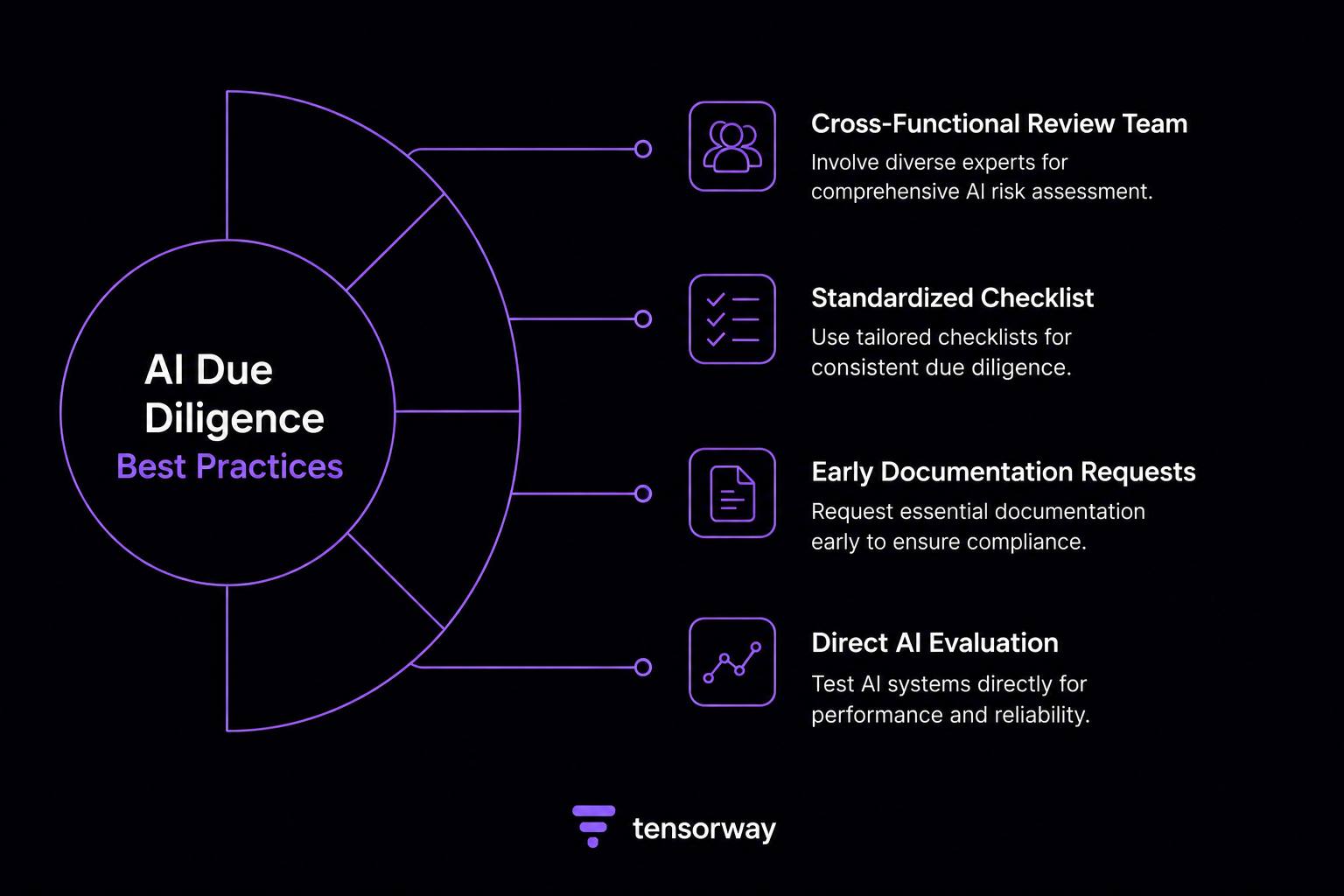
The order of operations is what separates a useful rollout from an expensive one. Start with the slowest, most repetitive stage of your funnel, usually document review or initial screening. Demand tools that show their sources. Keep a person accountable for every conclusion that reaches the committee. Done that way, automation widens the funnel and sharpens the judgment at the end of it, rather than replacing it with false confidence.