
TL;DR
- Traditional RAG retrieves information once along a fixed path and works only for simple questions.
- Agentic RAG puts an AI agent in charge, so it plans the query, picks the right data source, grades what it finds, and searches again if needed.
- Self-correcting frameworks like Self-RAG and Corrective RAG let the system catch its own mistakes and avoid confident hallucinations.
- Build a solid traditional retrieval baseline first, because a weak retriever just makes an agent amplify bad data and waste tokens.
- Watch out for higher latency, rising costs, and stale knowledge bases, since your underlying data quality sets the hard limit on performance.
Most enterprise AI initiatives launch with a traditional RAG pipeline. A basic retrieval augmented generation system is linear and predictable. It converts a user query into an embedding, retrieves matching document chunks, and generates a response. However, business demands and expectations from AI change, and such a rigid method is not sufficient today.
Agentic RAG changes this approach. In an agentic framework, data retrieval becomes an active process managed by an AI agent. The agent actively evaluates the quality of the retrieved information, refines its search strategy, and iterates until it has the exact data required to solve the problem.
In this article, we will take a closer look at the peculiarities of the agentic RAG architecture and explain how the agentic retrieval loop functions. Moreover, we will share our practical tips on how to implement agentic RAG into your workflows to ensure the highest efficiency.
What Is Agentic RAG, and What Makes It Different from Traditional RAG?
Agentic RAG is retrieval augmented generation where an AI agent decides when, what, and how many times to retrieve information. This makes it different from the traditional RAG approach, where information is retrieved just once per query along a fixed path.
In 2020, Patrick Lewis, in cooperation with other authors, introduced retrieval augmented generation in their seminal paper Retrieval-Augmented Generation for Knowledge-Intensive NLP Tasks. This original architecture (traditional RAG) performs a single retrieval step. It queries an external knowledge index, retrieves the most relevant passages, and conditions the language model on those documents to generate the final response.
Agentic RAG extends this foundation. It places agent reasoning on top of the retrieval mechanism. The system treats data retrieval as a tool that the agent chooses to use based on the complexity of the user’s prompt.
Traditional RAG retrieves once and generates once. At the same time, agentic RAG retrieves, grades, retrieves again, and generates.
Agentic RAG stands out for:
- Query planning. It analyzes the user's intent and breaks complex questions down into smaller, logical sub-queries.
- Multi-step retrieval. The agent can run sequential searches over time. The results gathered from its first search inform the parameters and targets of its next search.
- Self-grading of documents. A dedicated evaluation loop analyzes the retrieved data chunks before they ever reach the final generation phase. The system judges whether the information is relevant, accurate, and free of contradictions.
- Source fallbacks. If the primary vector database returns poor results, the agent can fall back to alternative tools, such as querying a relational SQL database or launching an external web search.
The table below contains a brief comparison of traditional and agentic RAG.
How Does Agentic RAG Work?
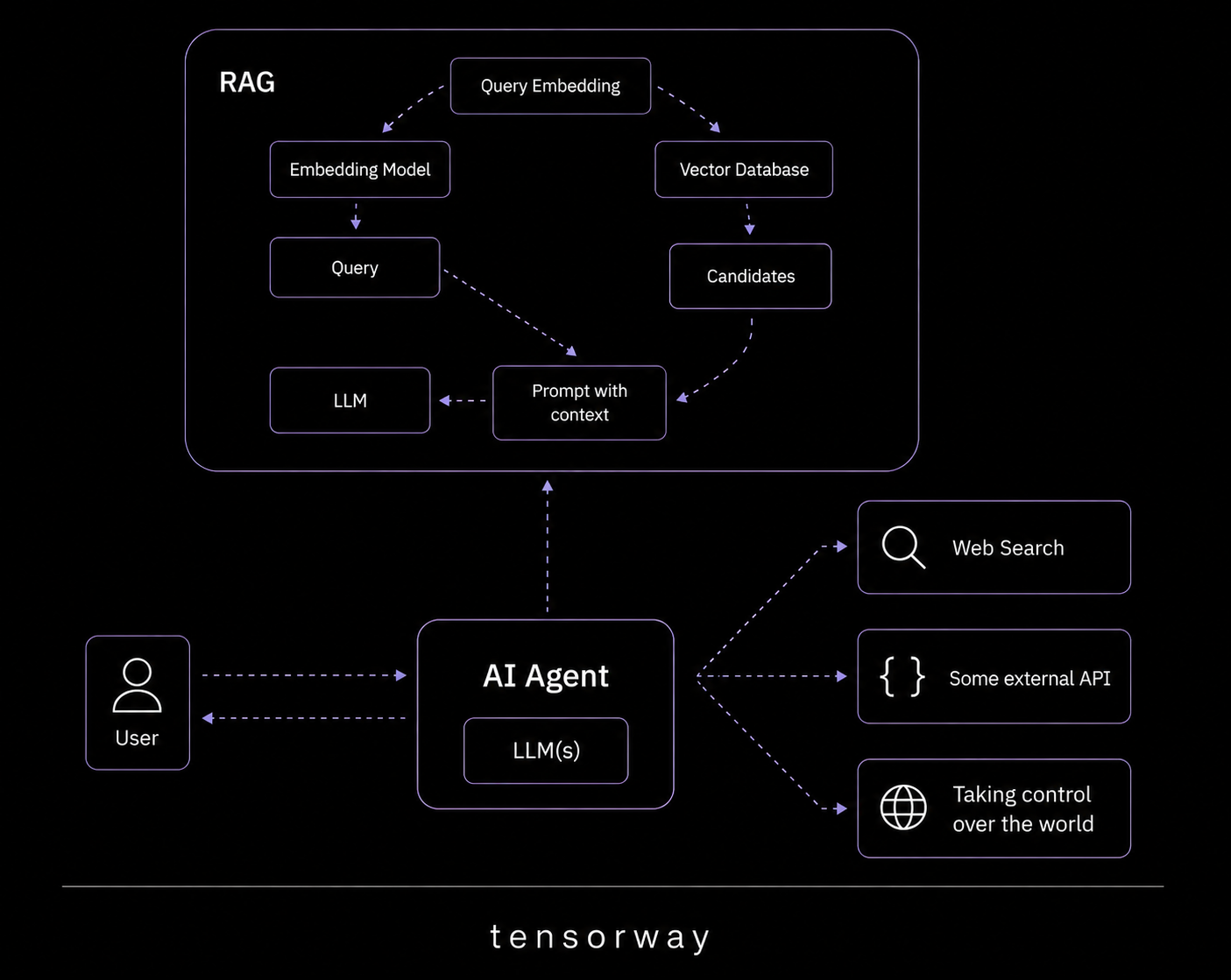
Agentic RAG finds information using a continuous loop. The central AI model oversees the entire search process, when a user asks a question. The system gathers data and immediately evaluates it through a built-in feedback step. It checks whether the collected facts truly answer the request. If the information is incomplete or irrelevant, the agent filters it out, changes its search direction, and looks for new data. This cycle of evaluating and adjusting continues until the system gathers the precise information needed to deliver a reliable final response.
Query Planning and Multi-Step Retrieval
When a complex prompt enters the system, the agent first uses a technique called query decomposition. It doesn’t treat a multi-part question as a single search string. The question is broken down into a logical sequence of smaller sub-queries. This step is essential when the system needs to work with different documents or time periods. The agent schedules these searches. Sometimes, it runs them in parallel, or it can wait for the results of the first search to inform what it looks for next.
Once the sub-queries are defined, a semantic router determines the best tool for each specific task. The system acknowledges that a single vector index is not the answer to every question. The router dynamically sends the request to the most appropriate data destination, depending on the intent of the sub-query.
After retrieving the initial data, the system uses a reranking model to clean up the results. Standard databases are good at finding related information. But they often pull in irrelevant details. The reranking layer scores these findings based on how well they answer the question. It also filters out the noise so that only the highest-quality information goes to the AI model.
Self-Correction: Self RAG and Corrective RAG
The most important characteristic of agentic architectures is their ability to catch and correct their own mistakes.
The first major shift toward this came with Self-RAG. This framework trains the underlying model to generate special critique tokens on demand. Before retrieving data for every single prompt, the model decides whether it needs external knowledge to answer the question. Once it retrieves information, it evaluates how well the passages support the answer and checks for any unhelpful or irrelevant sentences.
Corrective RAG (CRAG) was built on this concept. It integrates a dedicated evaluator to grade the retrieved documents immediately after lookup. The evaluator classifies the retrieved context into three categories: correct, incorrect, or ambiguous. This immediate grading step changes how the system works with uncertainty. If the documents are identified as incorrect or completely missing the target, the agent avoids a confident hallucination. It triggers a web search fallback or queries a completely different index.
The table below summarizes the key differences between the three RAG concepts.
How to Build an Agentic RAG System?
- The first rule of building an agentic RAG system is to establish a solid traditional retrieval baseline before adding any agent logic. You need to make sure that your chunking strategies, embedding models, and vector database (Pinecone, Weaviate, pgvector, etc.) work smoothly on their own
- If your underlying retriever is weak and fetching poor-quality chunks, an agent will only amplify those mistakes and burn through your token budget while trying to fix fundamentally bad data.
- Once your baseline database is reliable, you can begin layer-by-line integration of autonomous behaviors. First, introduce dynamic routing. Let the agent choose the best tool for every request. The agent analyzes the incoming query and decides whether to send it to a vector search for internal PDFs, a SQL database for numbers, or an external API for live data.
- Next, implement a grading step right before the generation phase. To reduce hallucinations, you should introduce a simple LLM call or classifier to check the relevance of data. If the information isn’t a close match, the grader simply rejects it.
- Finally, it is vital to log every single routing, retrieval, and grading decision your system makes. This will ensure system visibility and allow you to optimize its performance in the future. You can integrate production observability tools like LangSmith or Arize Phoenix. When an agent acts unpredictably, these platforms let you trace the exact line of reasoning and understand why an agent chose a particular source or why a grader rejected a valid document chunk.
As you scale your architecture, you need to decide whether to keep expanding your retrieval infrastructure or fine tune the underlying model. The choice between RAG vs fine tuning depends on what you are trying to optimize.
What Are the Real-World Agentic RAG Use Cases That Already Work?
Today, agentic retrieval frameworks are used to solve high-friction operational challenges across industries.
Enterprise knowledge assistants rely on agentic RAG to address fragmented internal data silos. For instance, an engineering team lead might ask for the deployment history of a legacy software module. The autonomous agent can concurrently query corporate wikis, Jira tickets, and technical PDFs, grade the overlapping data for absolute accuracy, and compile a single response with precise inline citations. This type of multi-source orchestration is one of the tasks that we focus on at Tensorway. We design custom AI agents that transform scattered corporate documentation into automated knowledge engines.
In automated customer service, agentic architectures act as an intelligent frontline filter that protects support queues from volume spikes. For instance, a customer asks a highly specific troubleshooting question about an account integration. The RAG agent scans product documentation and user manuals, but if its self-grading layer flags the retrieved data as ambiguous, it immediately escalates the ticket to a human agent. As one of the Reddit community members noted, “The hardest part of building an AI agent is getting it to hand off to a human” and added: “Everyone talks about making their AI agent smarter. Nobody talks about making it know when to stop.” Agentic RAG can help you overcome this issue.
Traditional RAG pipelines consistently fail when confronted with multi-hop questions that require deep comparative analysis. An agentic framework solves this by breaking a prompt like "Compare our Q1 infrastructure costs against our cloud expenditures in Q2" into separate retrieval steps for each individual entity. The agent executes a targeted lookup for the Q1 financial reports, locks in those metrics, runs a second search for the Q2 ledger, and only then synthesizes the data into an accurate comparative table.
What Are the Biggest Challenges When Deploying Agentic RAG?
In production environments, the most common failures in agentic systems stem from unbounded retrieval loops and poor grading decisions. When you add an autonomous layer, it can solve many traditional accuracy issues. But it also introduces unique operational risks that engineering teams need to mitigate.
- Latency and cost creep. Every extra retrieval and evaluation requires an additional LLM call. When deployed within asynchronous multi agent systems, a single complex query can trigger a cascade of internal API requests. This frustrates users with high latency and increases your monthly infrastructure bills. It is recommended to enforce strict retry caps and closely monitor latency.
- Compounding grading errors. If your grading model misjudges a highly relevant piece of text as irrelevant, it will erroneously reject the data and force the agent down an entirely wrong retrieval path.
- Stale or fragmented knowledge bases. Advanced agentic reasoning can’t fix a vector database that contains missing data or outdated documents. The baseline quality and freshness of your underlying data storage remains the absolute hard limit for the entire application's performance.
Wrapping Up
The transition from traditional RAG to an agentic architecture represents a huge change in how enterprise apps interact with data. Agentic RAG replaces a rigid retrieval step with a dynamic loop controlled by the agent. The system can plan the query, execute the lookup, grade the relevance of the results, and retrieve again if the initial evidence falls short. In such a way, you eliminate the single point of failure that plagues traditional RAG pipelines.
To manage such self-correcting systems, you need to take care of latency caps and data hygiene. But as a result, you get a resilient AI engine that can safely navigate complex business workflows without hallucinating. If your team is ready to build high-performing retrieval loops, at Tensorway, we can help. Share your requirements with us to get more information about our services.